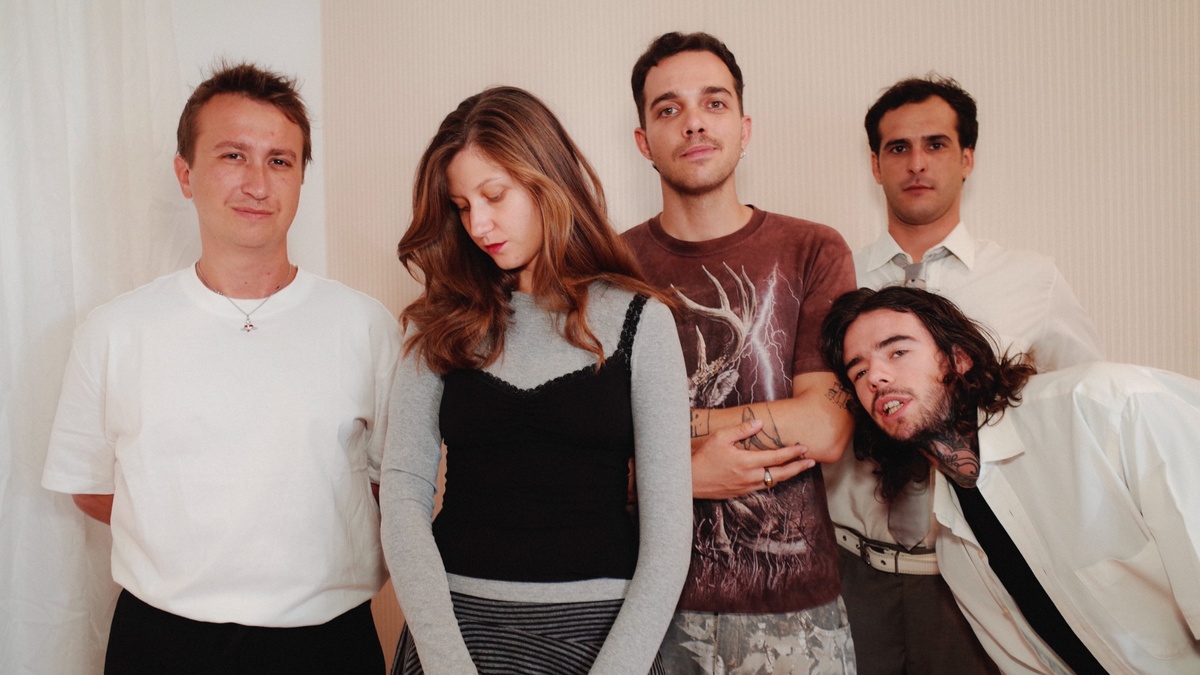
Over the past decade, something has changed in Spain’s music scene. And Niña Polaca has had a front-row seat to it all. The band, whose name translates to “Polish Girl,” formed in 2018 just as a new crop of Spanish acts were turning what had been a relatively contained independent scene into something much bigger. Niña Polaca grew with it: from recording their first album at home with two microphones to selling out Madrid’s 2,000-capacity La Riviera five times between 2023 and 2024. Next January, they’ll make another leap by headlining Madrid’s Movistar Arena, the largest venue will have played to date.
Spain’s Music Scene on the Rise
“I think we’re seeing one of the best eras for rock and pop music in Spain that I can remember,” Álvaro Surma, the band’s singer and primary lyricist, tells Consequence. “I don’t remember a time when so many cool bands came out in such a short period, maybe since La Movida Madrileña,” the countercultural movement that transformed Madrid in the early 1980s and produced bands like Nacha Pop and Alaska y los Pegamoides.
Niña Polaca trace their beginnings to Madrid’s bohemian Malasaña neighborhood, a hub for the city’s nightlife and underground culture. Surma and bassist Beto met while living in the same building there and began playing small clubs, eventually selling out rooms in Madrid and Alicante. By late 2019, they had signed with independent label Subterfuge.
From Humble Beginnings to Success
Their earliest recordings were considerably less professional. “We started without knowing how to play, without knowing how to sing, and without knowing how to record,” Surma says. “We recorded the first album ourselves at home with two pretty shitty microphones, basically just messing around.”
“By some kind of miracle, it reached a lot of people,” he concludes.
From then on, the miracle kept getting bigger. Surma remembers standing with Beto in a hallway before Niña Polaca’s first La Riviera show in 2023 when the two started laughing at the absurdity of what was about to happen.
“What the fuck are we doing here?” he recalls thinking. “When did this happen?”
He expects a similar feeling at the Movistar Arena, where floor tickets have already sold out. “I think until I’m there, about to go out, it’s going to feel like a joke,” he says.
Financial Sustainability and Creative Freedom
But however improbable their rise still feels to Surma, keeping the band afloat has required considerably more calculation. Talent, he acknowledges, is only part of the equation. Just as important is making a band financially sustainable.
“You’re making 3,000 euros from a show, but you’re spending 2,900 every time you leave the house,” he says of a trap he watched other young acts fall into. He estimates that only around 10% of the bands from the Malasaña wave they started alongside remain active today.
Niña Polaca took the long road, expanding gradually and adding touring personnel only when the economics made sense. “We have a work system. It really is a company,” Surma says, before pausing to smile. “Well, it’s a company, but we sell happiness.”
A New Era for Spanish Music
That pragmatism comes naturally to Surma, who until April worked in legal tech and has since launched a management and booking company with bandmate Rubén Manchón.
“You can be true to yourself and your art,” Surma says. “But at the same time, you have to understand that you’re playing within an industry.”
There is an amusing contradiction in Surma’s approach. On one hand, there’s Surma the businessman. On the other is the songwriter, whose autobiographical lyrics turn relationships, pop culture, and everyday locations into moments that feel intimate yet relatable.
Niña Polaca’s evolution from friends figuring things out as they went to a tightly run operation mirrors what Surma has watched happen around them. Following a busy summer festival run, the band is preparing for a 16-date headlining tour, with several shows already sold out. Across Spain, Surma has also watched live productions grow more elaborate, with specialized show directors and producers becoming increasingly common.
A Growing Spanish Music Landscape
Bands like Carolina Durante have graduated to arenas, with records released by indie label Sonido Muchacho in partnership with Universal Music Spain. Another local band, Arde Bogotá, have gone from the independent circuit to drawing crowds in the tens of thousands, and have taken another step forward with Manufacturas del Club de la Gente Sola, their new Sony Music album produced by Joe Chiccarelli and recorded in Los Angeles.
In that sense, Surma’s observation that “the indie is not so independent anymore” is increasingly literal. It also comes during a broader period of visibility for Spanish music. Rosalía and C. Tangana had already shown how far a distinctly Spanish perspective could travel, while a younger, genre-fluid generation including Judeline, rusowsky, Ralphie Choo, and pablopablo is now finding an international audience.
For Surma, sustaining Niña Polaca has also meant learning to appreciate what all that work has made possible. After years of struggling with touring, he now talks differently about standing in front of thousands of people singing words that once existed only in his room.
“You have 10,000 people in front of you singing your stuff, and you’re singing it with them, and you create this kind of community, this communion,” he says. “A mass of music. It’s really beautiful.”

Pixel P. Snarkbyte, widely regarded as the “Shakespeare of Sh*tposts,” is a video game expert with a unique knack for turning pixels into punchlines.
Born in the small town of Respawn, Pennsylvania, Pixel grew up mashing buttons on an ancient NES controller, firmly believing that “blowing into the cartridge” was a sacred ritual passed down through generations.
Pixel P. Snarkbyte: proving that life, much like a buggy open-world game, is better with a little lag-induced chaos.
⚖️ ENTER THE LEGALIZER
Think the government has no idea what it's doing? Put your case before the Federal Case Terminal and find out.