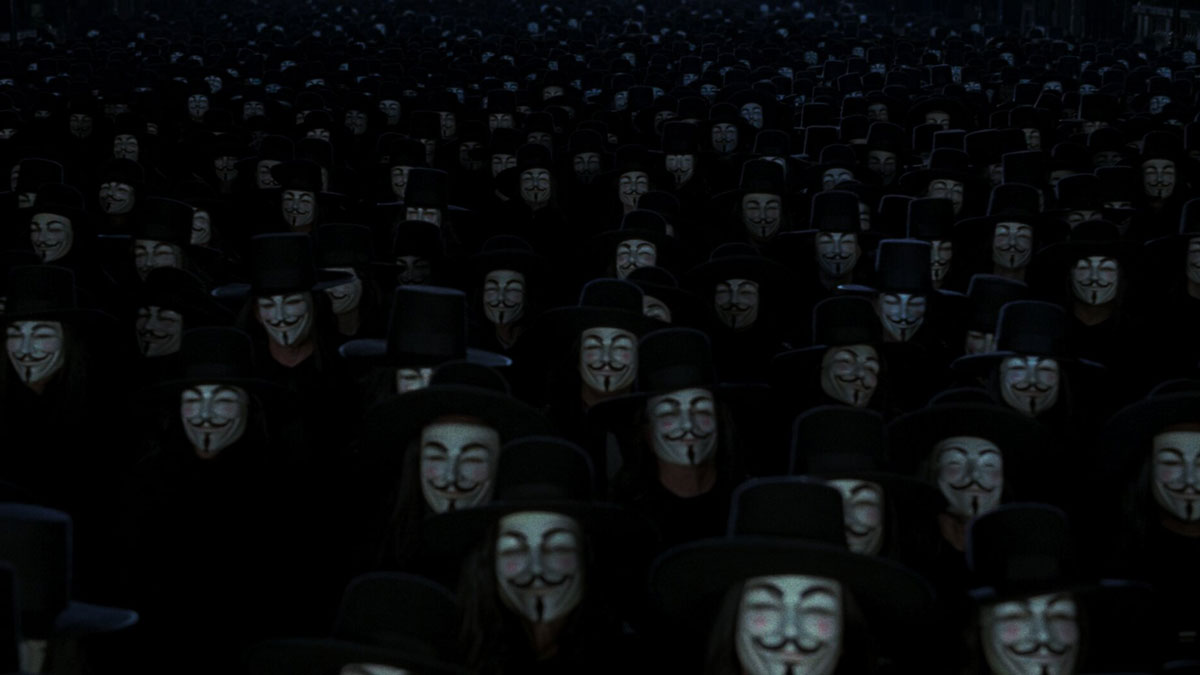
V for Vendetta director James McTeigue thinks it’s “amazing,” the way that the Guy Fawkes mask from his 2006 movie has taken on a life of its own. “When you make a film, you hope that it might seep into the culture at some point,” he tells Consequence on the eve of its upcoming Fathom Events re-release. “That’s like your craziest, wildest dream, that people will be talking about your film 20 years later.”
The Origins of the Guy Fawkes Mask
While the smirking, mustachioed mask is often associated with modern protests and resistance movements, the origins of the Guy Fawkes mask go even further back in history than writer Alan Moore and illustrator David Lloyd’s original comic series and graphic novel from the ’80s. The real-life Guy Fawkes was part of a group of Catholics who, feeling repressed by their anti-Catholic government, aimed to blow up the House of Lords (the famous “gunpowder plot”) on November 5th, 1606. Fawkes was captured and executed before he could complete his role in detonating the explosives, and November 5th became a national holiday in Britain, traditionally celebrated with bonfires.
The idea of children dressing up as Fawkes first emerged in the late 18th century, evolving into variations on the iconic mask getting public distribution decades later. The definitive design of the Guy Fawkes mask, though, came from V for Vendetta artist David Lloyd. The serialized comic book story that would eventually become the hit film began publishing in 1982, the mask’s history informing the choices of its central character.
The Mask in the Movie
In the 2006 movie, the face of V, played by Hugo Weaving, is never seen — he only wears the famous mask. This created serious limitations for Weaving, since as McTeigue notes, “you don’t see the eyes. That’s the difference from Batman. It’s just this completely malleable face, and you can read into it what you want.”
The movie’s design differed slightly from the graphic novel’s version, including some more textural detail in the goatee and eyebrows, and cheeks that were a little less ruddy. McTeigue describes his hope that it would work on screen as “blind faith,” considering that “it’s hard for an actor if you take away their face — you know, the thing that they’ve been working with for 30 or 40 years. But Hugo Weaving really got that it was about the physicality, and it was about the voice.”
The Impact of the Mask
The result is a movie that still feels shockingly relevant today, with broader ramifications for the rest of the world. Plenty of people had read the graphic novel, but McTeigue credits the influence of film as a medium on spreading awareness of the mask: “That film was number one at the box office, in America and overseas, when it came out. It was now exposed to millions and millions of people. And I think more importantly, people got what the mask was about, which was that there’s more power in ‘we’ than there is in ‘I.’”
Additionally, protestors realized that the mask allowed them to remain anonymous, increasingly important as facial recognition software became widespread in the 21st century. “The Arab Spring got it, Occupy Wall Street got it, the Hong Kong protestors got it. Even the people protesting Scientology, which was the first time I saw it used as a form of protest, they got it,” McTeigue says, “and that made the mask live on and made the film live on as well. And so, yeah, now it’s completely seeped into the cultural vernacular.”
The Legacy of V for Vendetta
This doesn’t diminish its power as a form of protest, or the movie’s legacy as an early example of how powerful comic book adaptations can be. “You have to remember, this is before the superhero saturation that we have now,” McTeigue says. “This is pre-the first Iron Man. Batman Begins had come out, but before that, it was the Tim Burton Batmans and the Supermans, which were very pop.”
As a result, he says, “V for Vendetta was really before its time in a lot of ways, because it was an anti-superhero movie. Here’s this guy on this vengeful tear against the state, and all the people who had done him wrong, and the film is asking, at its core, ‘What’s the morality of terrorism?’ It’s a lofty thing to make a film about. You’re also trying to make it accessible, so there’s, the action set pieces and gunfights and blowing stuff up — all the things that might be popcorn entertainment. But there’s lots of other ideas underneath the surface of it.”
V for Vendetta returns to theaters for its 20th anniversary on November 1st and 5th, thanks to Fathom Entertainment. Visit the Fathom website for tickets and more information. The film’s enduring influence is a testament to the power of the Guy Fawkes mask, which has become a symbol of resistance and protest around the world. As McTeigue notes, the mask’s impact is a reminder that even the most unlikely cultural artifacts can take on a life of their own and become a part of our shared cultural heritage.
Pixel P. Snarkbyte, widely regarded as the “Shakespeare of Sh*tposts,” is a video game expert with a unique knack for turning pixels into punchlines.
Born in the small town of Respawn, Pennsylvania, Pixel grew up mashing buttons on an ancient NES controller, firmly believing that “blowing into the cartridge” was a sacred ritual passed down through generations.
Pixel P. Snarkbyte: proving that life, much like a buggy open-world game, is better with a little lag-induced chaos.
⚖️ ENTER THE LEGALIZER
Think the government has no idea what it's doing? Put your case before the Federal Case Terminal and find out.