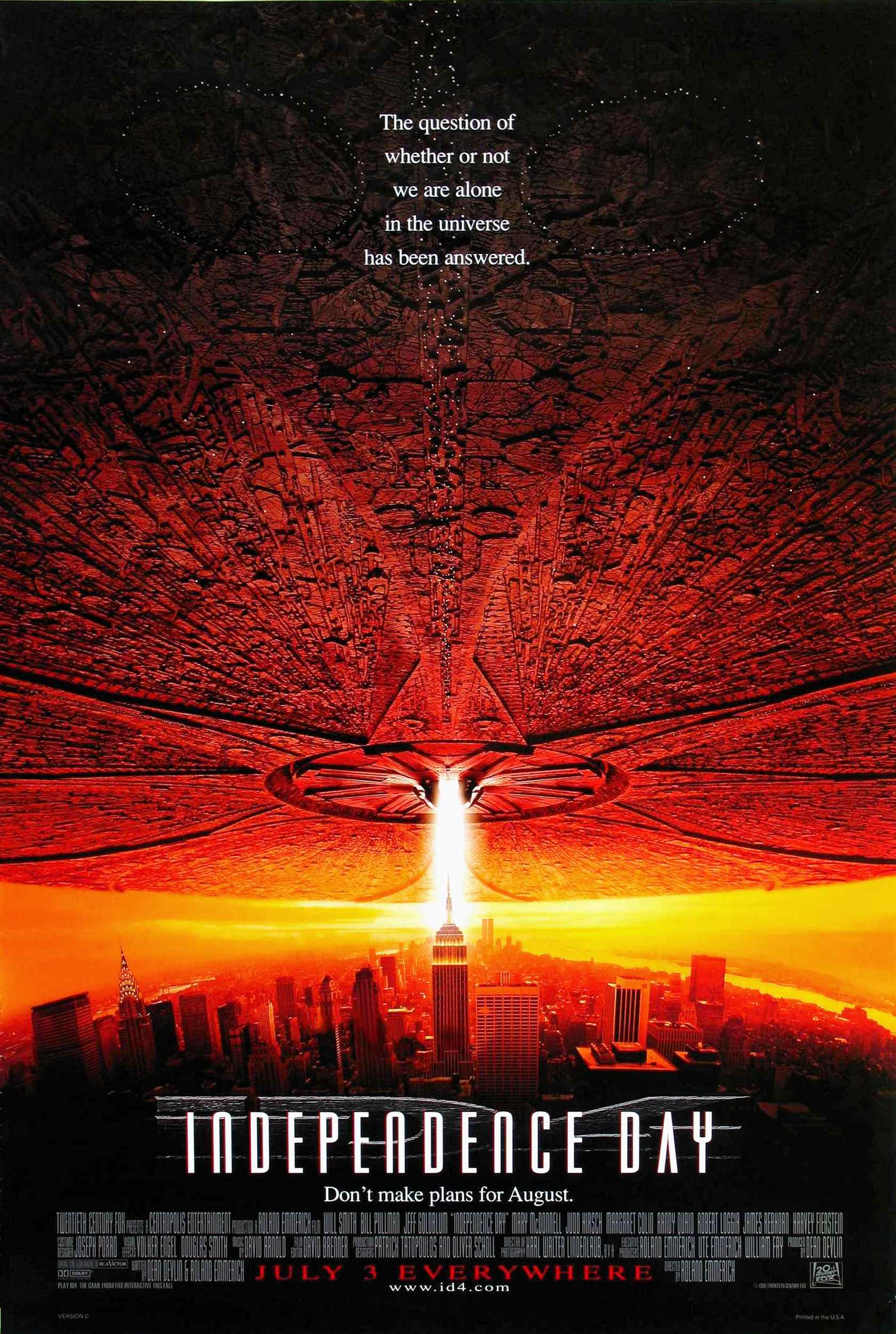
It’s been 30 years since Independence Day became a cultural phenomenon. The film achieved a rare kind of ubiquity that select blockbuster films used to enjoy, when going to see a movie on its opening weekend in a theater was an obligatory summer event. The reviews were scattershot, as you’d expect for a loud, 2.5-hour movie about the destruction of much of the modern world at the hands of menacing, tentacular, heavily-shielded aliens. But it hardly mattered. Independence Day was an honest-to-God event.
Having been directed by Roland Emmerich, it sure felt like one. Independence Day follows a series of disparate stories over a few days as aliens position their large spacecraft over every major world city before letting loose with destructive columns of blue light. Meanwhile, Captain Steven Hiller (Will Smith, in the role that truly pushed him over the top into the realm of mega-stardom) has to try to get a deposed alien to the government and himself back to his worried family, David Levinson (Jeff Goldblum) has to get the President (Bill Pullman) to believe that aliens are using military signals against the world, and a host of colorful characters try to rally together to bring down a much larger threat.
The Film’s Impact
Putting the film into that context is key to understand exactly why it broke out the way it did. After all, the film was the highest grossing of its year and the only release of that year to cross the $300 million domestic mark. Independence Day arrived when film technology was good enough to make something on its scale, but expensive enough that it was still something of a rarity. Its $75 million budget was huge, its heavily promoted destruction set pieces were bigger still, and it came during a year when some of the other heavy-hitting box office smashes included Eddie Murphy’s The Nutty Professor, the Mel Gibson vehicle Ransom, a live-action 101 Dalmatians, and The Birdcage.
Independence Day also came out during a strange time. In 2016, American Crime Story and ESPN’s O.J.: Made in America recast that infamous trial as an integral turning point in modern American history, and in any case by 1996, popular culture was getting around to addressing the larger national dialogues born out of that lengthy ordeal. For the most part, it was by throwing the nation’s collective arms around diversions, anything that could adequately help Americans forget for a few hours that the whole of the country was sitting on a hotbed of racism, police abuse, legal injustice, and the general sense that things were on the decline.
A Time of Political Unrest
The ’90s were a more politically unstable time than many recall, when so many pop culture touchstones are as innocently homogenous as possible in hindsight. There was a roiling cultural tension still carrying over into the latter part of the decade, and for film and TV’s semi-meaningful attempts to engage with it in some way, one of the dominant methods was to just try and forget about it. By refusing to acknowledge that difference existed, we could overcome it, or at least force “difference” back to a place where polite society wouldn’t have to stress about it.
For a blockbuster summer movie to then argue that only a united world can truly stand together was an uncommonly bold message. Now, before moving forward, it’s probably valuable to acknowledge here that Independence Day isn’t exactly a misunderstood paragon of political cinema. It’s a distinctly American affair, the rest of the world being laid to waste much like the US, but existing largely off-camera aside from various globe-trotting montages about exchanges of information.
A Legacy Endures
Consider Bill Pullman’s iconic speech, probably the best-remembered moment of the entire film outside of Will Smith welcoming an alien to Earth with a punch to the face. The sincere, earnest belief in redemption so key to the wide appeal of Independence Day almost feels quaint three decades later. Much has been written on how so much action filmmaking of the post-9/11 era has reflected a more nightmarish aesthetic, whether it’s the cultural paranoia of the Bourne series or the wall-of-ash aesthetics of so many big-budget films.
Independence Day is a fine spectacle of its kind, but its commentaries of any kind are either incidental or painfully of the era — and yet, that speech endures, as does the film. It’s a reminder of a world that was still doing poorly by so many of its own, but could aspire to more. In at least that singular respect, they really don’t make them like that anymore.
Independence Day is available to stream on Disney+ and Hulu, and on VOD via Prime Video and Apple TV.
Pixel P. Snarkbyte, widely regarded as the “Shakespeare of Sh*tposts,” is a video game expert with a unique knack for turning pixels into punchlines.
Born in the small town of Respawn, Pennsylvania, Pixel grew up mashing buttons on an ancient NES controller, firmly believing that “blowing into the cartridge” was a sacred ritual passed down through generations.
Pixel P. Snarkbyte: proving that life, much like a buggy open-world game, is better with a little lag-induced chaos.