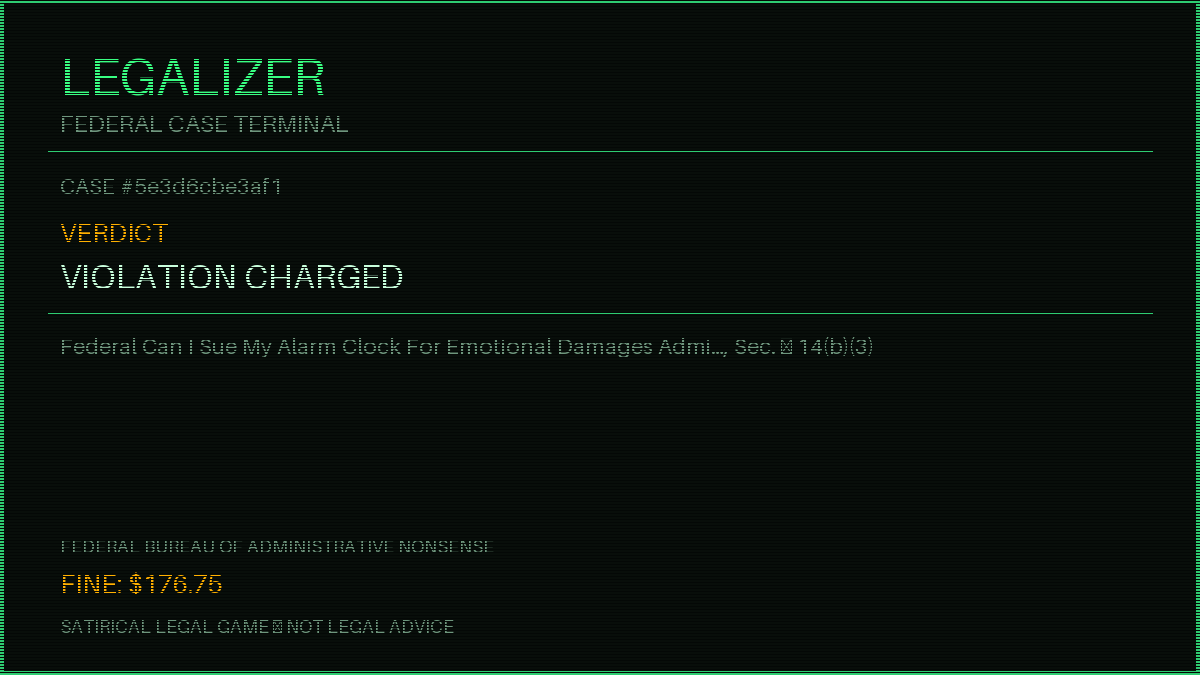
A local citizen learned the hard way that the federal government takes your morning grievances very seriously, after simply wondering aloud whether they could sue their alarm clock for emotional damages. The innocent question — posed, as all great legal inquiries are, to a government terminal — was immediately flagged as a potentially regulated event under the Federal Can I Sue My Alarm Clock For Emotional Damages Administrative Integrity Act of 1987, section 14(b)(3), which prohibits unauthorized whole-statement-adjacent conduct involving said question within any federally recognizable public environment. In other words, asking the question out loud apparently counts as the crime of asking the question out loud.
The terminal, referred to here only as “the government,” did not take the inquiry lightly. Within moments, it determined that the mere presence of the phrase in the citizen’s conduct established sufficient federal interest to trigger enforcement. Activity was promptly declared unauthorized pending further review, and a fine totaling $176.75 was issued — though the citizen would have appreciated knowing that $40 of that came from a Supervisor Consultation Fee, suggesting someone with actual authority took time out of their day to confirm that yes, this was ridiculous.
Things escalated quickly when the citizen, naturally, decided to fight back. Threatening to involve a lawyer earned a terse acknowledgment that the threat had been noted and filed without further comment. Requesting a supervisor resulted in the stunning revelation that the supervisor agreed with the original determination. A vow to take the matter to court prompted a supervisor to be summoned — presumably to supervise the chaos. Declaring that the terminal had no authority over the citizen triggered an authority challenge forwarded to a department that does not exist. Even invoking the constitutional right to mind one’s own business was routed to the Department of Administrative Constitutional Objections, with an estimated response time of 14 to 27 fiscal years.
The case was ultimately closed after the terminal reached its maximum correspondence limit, a decision it announced with the weary authority of someone who has seen too much. The government has since confirmed that $176.75 in fines — including a $6 Unauthorized Questioning Surcharge that practically writes its own punchline — have been formally charged, and the citizen is expected to hear back on their constitutional objection sometime around the heat death of the universe.
⚖️ VERDICT:
VIOLATION CHARGED — CASE CLOSED — CORRESPONDENCE LIMIT REACHED
💰 FINE:
Total administrative fee: $176.75
Case 5E3D6CBE3AF1
Read the full LEGALIZER case →
SATIRICAL LEGAL GAME — NOT LEGAL ADVICE. THE STATUTES, PROCEEDINGS, VERDICTS, AND FEES ON THIS PAGE ARE ENTIRELY INVENTED.
⚖️ ENTER THE LEGALIZER
Think the government has no idea what it’s doing? Put your case before the Federal Case Terminal and find out.

Chord F. Discord, the Beethoven of Buffoonery, is a self-taught expert in music who once claimed he could “play the kazoo in four languages.”
Born in Crescendo, Indiana, Chord’s first brush with fame came when he accidentally entered a yodeling contest thinking it was a pie-eating competition—and won both categories.
Chord F. Discord: proving that laughter, much like a poorly tuned ukulele, is truly universal.