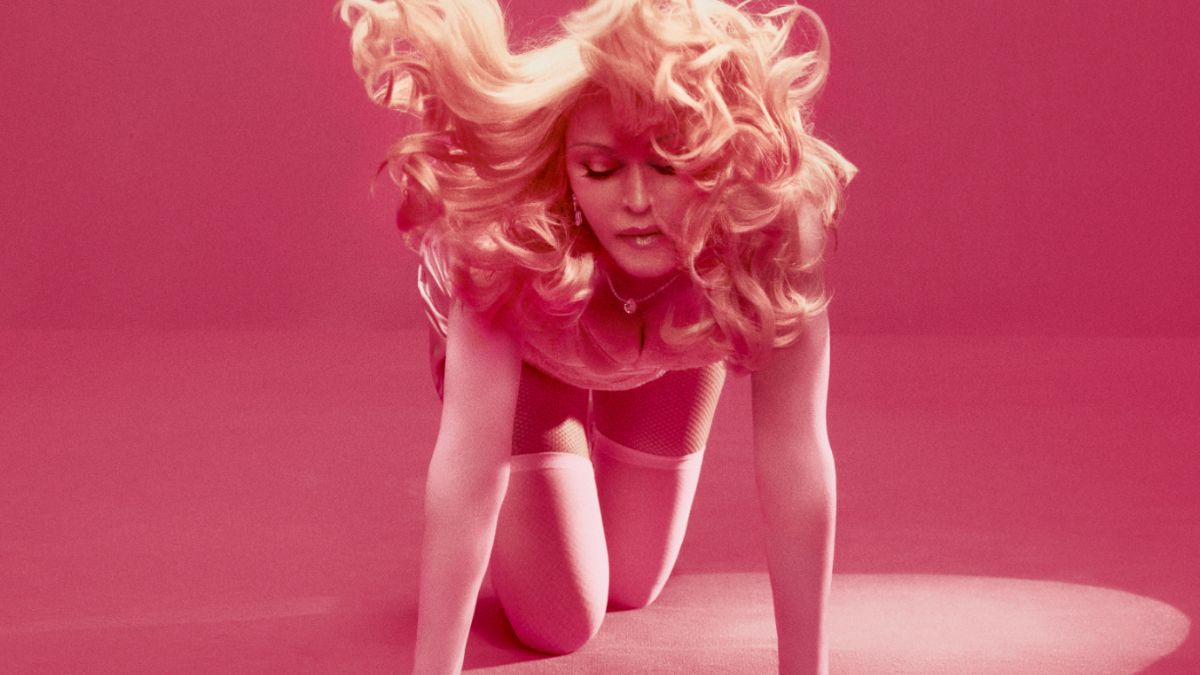
Madonna’s Confessions on a Dance Floor didn’t need a sequel. The original 2005 album, helmed with producer Stuart Price, was a landmark presentation of dance pop in its purest, most majestic form; it was created in conversation with Madonna’s own career, serving as a distillation of the dance-forward stylings she’d been sharpening and honing since her very first album in 1983. It folded in the spiritual, exploratory instincts of Ray of Light and Music — records that had already treated the dance floor as something closer to a threshold than a party — and married them to a newly disciplined, continuous-mix architecture that felt both classic and modern.
Reviving the Original’s Self-Reflexive Vibrance
Confessions II is Madonna’s attempt to revive the original’s self-reflexive vibrance and create another dance pop opus, one that centers the dance floor as a space for transcendence and spiritual awakening. With Stuart Price once again behind the boards, and with an international cohort of guests like Feid and Stromae, pop scribes Cirkut and Andrew Watt, previous collaborator Mirwais, and her daughter Lola Leon, Madonna sets out to prove that the dance floor can still redeem her. The problem comes when Confessions II talks about transcendence instead of actually delivering it.
A Return to Form
Though uneven, it’s still fair to deem Confessions II a return to form for Madonna, at least relative to her own catalogue. It’s much better than her last album, 2019’s Madame X, and the bratty sheen of 2015’s “Bitch I’m Madonna” — confirmation that Madonna was indeed lagging behind pop music’s progression — is nowhere to be found. While the production can often be busy, Confessions II is way less concerned with any kind of gargantuan beat drop or sounds that are too garish; after all, that’s Stuart Price’s whole MO.
Lyrical Content and Scope
This is particularly evident in the album’s lyrical content and scope, which fail to provide substantial ‘confessions’ and too often skim the surface. Madonna seems much more concerned with literally telling her audience that they should go out and dance because it’s “good for the soul” and will be especially helpful if you’re going through a breakup; maybe the only caveat there is that going out dancing can also help you embrace your personal identity, something touched upon in the New York-centric “Danceteria” and “L.E.S. Girl.”
Similar to the original Confessions, Madonna guides us through the DJ set with numerous spoken word passages, explaining her philosophies around dance music and offering commentary with an intimate, almost seductive hue. It’s a fun choice, though most of the time, what she says doesn’t amount to a whole lot. Sometimes, these spoken word moments are jarring and truly exciting — “Everything” has the apex of this approach, Madonna regularly chiming in with the remark “It’s not okay/ I don’t fuck with it” and spitting the words with some serious attitude.
Far too often, Madonna surrenders to the intoxicating pull of her own music and leaves us without much to ponder or explore. The opening three tracks, “I Feel So Free,” “Good For the Soul,” and “One Step Away” are so lyrically similar that it’s challenging to find a line that represents any differing points of view. Even the Feid-featuring “Read My Lips,” which has a few Spanish passages, can’t save itself from being a stereotypical ‘boy, bye’ clap-back.
In conclusion, while Confessions II is a return to form for Madonna, it falls short of delivering the transcendence it promises. With Stuart Price at the helm and a talented group of collaborators, the album has its moments, but ultimately, it relies too heavily on dance floor cliches and fails to provide substantial lyrical depth. Despite this, Madonna remains a beloved and influential figure in the music industry, and Confessions II is still a notable release in her extensive discography.

Pixel P. Snarkbyte, widely regarded as the “Shakespeare of Sh*tposts,” is a video game expert with a unique knack for turning pixels into punchlines.
Born in the small town of Respawn, Pennsylvania, Pixel grew up mashing buttons on an ancient NES controller, firmly believing that “blowing into the cartridge” was a sacred ritual passed down through generations.
Pixel P. Snarkbyte: proving that life, much like a buggy open-world game, is better with a little lag-induced chaos.