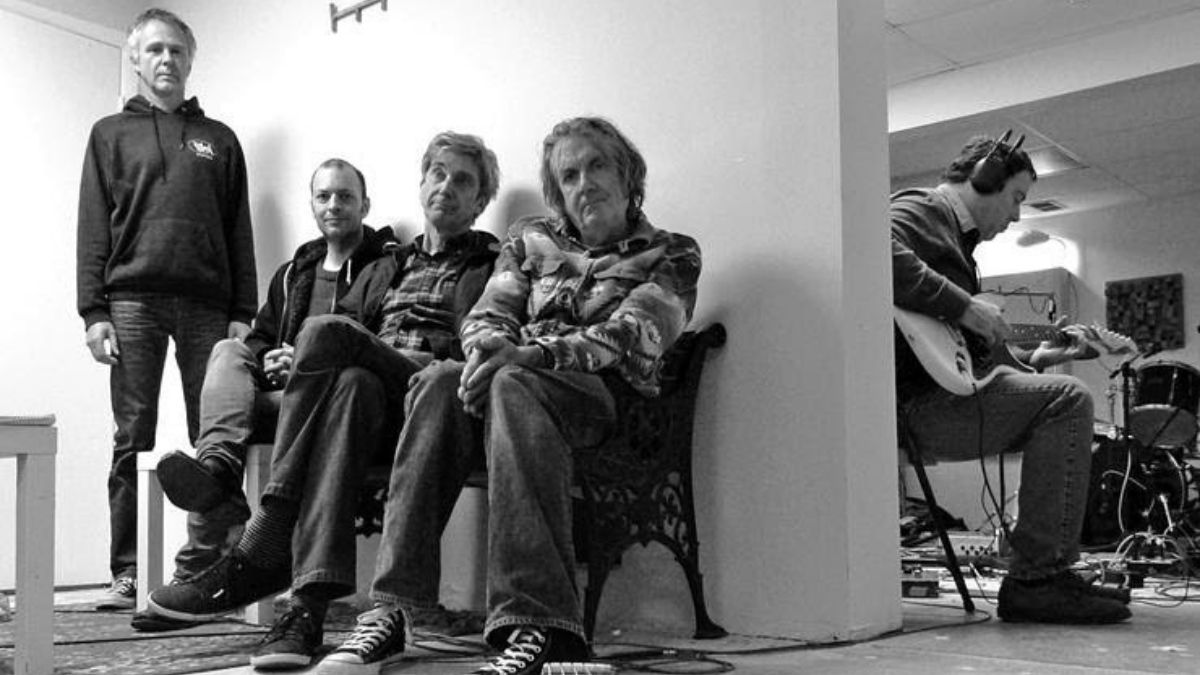
David Fair, co-founder of the influential DIY rock band Half Japanese, has died. Fair’s passing was shared Sunday by Thick Syrup Records and filmmaker Jeff Feuerzeig, a longtime friend who directed the 1993 documentary Half Japanese: The Band That Would Be King. Fair’s brother and bandmate Jad Fair also posted a childhood photo of the two on Facebook following the news.
Early Life and Career
David and Jad Fair started making music together after their family moved from Michigan to Uniontown, Maryland, in the mid-’70s, eventually turning their home recording sessions into Half Japanese. Neither brother had much interest in the conventional. They traded instruments, ignored traditional tunings and song structures, and built their earliest recordings around the belief that raw sound and flowing imagination mattered more than the “right” way to play.
Producer Don Fleming, a friend and former Half Japanese member, said Fair died peacefully on Saturday shortly after his daughter Harper toasted him with a root beer float. Fleming also said Fair had undergone treatment for cancer over the past several years, though a cause of death has not formally been announced. “The sweetest guy, with a great sense of humor,” Fleming wrote. “He was a pure artist and musician, all from the heart.”
Influence and Legacy
That philosophy was eventually distilled into David’s much-circulated essay “How to Play Guitar.” “If you ignore the chords, your options are infinite, and you can master guitar playing in one day,” he wrote. It wasn’t a joke. Half Japanese’s deliberately devil-may-care approach became an early blueprint for lo-fi and DIY rock and retroactively influenced generations of artists who heard possibility in the band’s sound.
After debuting with the 1977 EP Calling All Girls, Half Japanese made an appropriately excessive first full-length statement with 1980’s triple album 1/2 Gentlemen/Not Beasts. The band’s lineup expanded over the years, with Fair remaining a major presence through records including Loud, Our Solar System, and Sing No Evil before leaving in 1987. He continued collaborating with Jad outside the band and periodically returned to Half Japanese, including for 2014’s Overjoyed, their first album in more than a decade.
By then, Half Japanese’s influence had traveled far beyond the underground circles where they began. Kurt Cobain was a noted admirer and invited Half Japanese to open dates on Nirvana’s 1993 “In Utero” tour, while the band’s fiercely homemade approach has been cited as an influence on artists including Sonic Youth, Daniel Johnston, Beat Happening, and Neutral Milk Hotel. Though David wasn’t part of the touring lineup during the Nirvana dates the invitation spoke volumes about how far the project he and his brother started had traveled.
Later Work and Legacy
Fair also remained prolific away from Half Japanese, releasing music under his own name and with Jad, as well as projects including Coo Coo Rockin Time. He was also a visual artist, carrying the same anything-goes creative instinct into painting and other work.
For all the mythology that eventually grew around Half Japanese, Fair’s musical outlook remained uncomplicated and unchanged: pick up the instrument, make the sound you want, and don’t worry too much about what you know or don’t know. As he put it at the end of his guitar manifesto, the idea is to make one tiny movement and “rule the world.”
In conclusion, David Fair’s passing marks the end of an era for Half Japanese and the DIY rock community. His influence will continue to be felt through the generations of artists he inspired, and his legacy as a true original and innovator will live on through the music and art he created. Half Japanese may have started as a small, homemade project, but its impact on the music world has been profound, and David Fair will be deeply missed by all who knew him and his work.

Pixel P. Snarkbyte, widely regarded as the “Shakespeare of Sh*tposts,” is a video game expert with a unique knack for turning pixels into punchlines.
Born in the small town of Respawn, Pennsylvania, Pixel grew up mashing buttons on an ancient NES controller, firmly believing that “blowing into the cartridge” was a sacred ritual passed down through generations.
Pixel P. Snarkbyte: proving that life, much like a buggy open-world game, is better with a little lag-induced chaos.