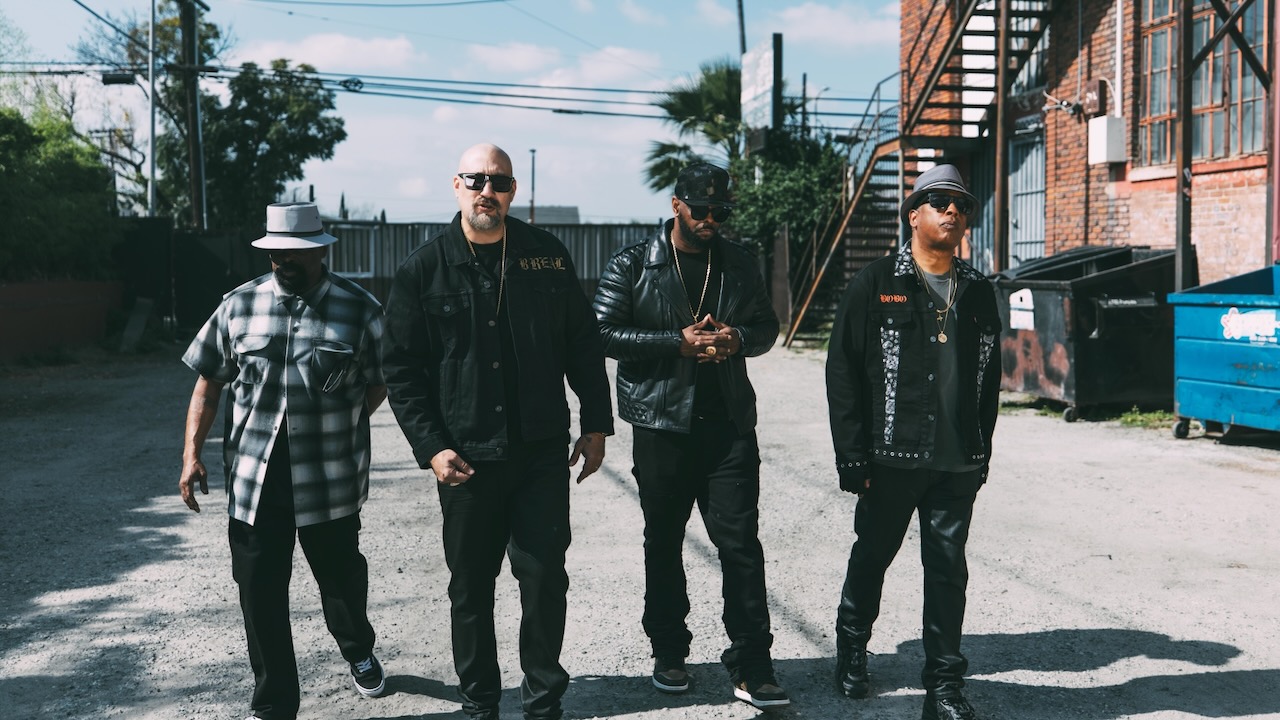
For Cypress Hill, making Dios Bendiga, the band’s first album of original songs written entirely in Spanish, meant returning to an idea that had been on the shelf for decades. After all, long before Latin American rap became the global force it is today, B-Real, Sen Dog, and Eric Bobo were proving that it could exist in the first place. Nowadays, when Latin American rap stars such as Argentina’s Trueno refer to the group as “the translators of rap,” they aren’t simply paying tribute. They’re describing what Cypress Hill meant for an entire generation of MCs who first heard hip-hop reflected in a language and identity that felt like their own.
The Road to Dios Bendiga
That reputation didn’t emerge overnight. Early songs like “Latin Lingo” and “Tres Equis” hinted at the group’s bilingual identity, but it was 1999’s Los Grandes Éxitos en Español, a collection of Spanish-language reinterpretations of the band’s by-then classic songs, that cemented their influence across the region.
You’d be hard pressed to find anyone who thinks Cypress Hill has anything left to prove to its Latin American fans in 2026. Yet Dios Bendiga finds them taking one of the boldest risks in their career, a testament to the band’s creative ambition. “The genre of Latino hip-hop has grown and the talent out there is so phenomenal,” B-Real tells Consequence. “We’re looking at it like, ‘Okay, where can we fit in there?’”
A New Challenge
For years, touring schedules, side projects, and other commitments kept such a project on hold. However, recent collaborations by the band’s members with Spanish-speaking artists such as Lupillo Rivera and Santa Fe Klan reminded Cypress Hill that there was still unfinished business.
This time, though, translating familiar songs wasn’t enough. The challenge was writing an entire album from the ground up in Spanish.
The breakthrough came during an intense stretch of writing last November. With Eric Bobo at the helm as musical director, the band carved out roughly two weeks to focus almost exclusively on the project, trusting decades of chemistry rather than overthinking the process. Producer DJ Flict helped shape that momentum into an album that sounds unmistakably like Cypress Hill.
Writing in Spanish
For B-Real, the biggest challenge wasn’t the music. It was the words.
Born and raised in Los Angeles, he grew up speaking English while learning Spanish at home from his Cuban mother and Chicano father. Although fluent in conversation, he quickly realized songwriting demanded a different level of confidence. His vocabulary wasn’t as instinctive, forcing him to weigh every phrase more carefully.
“I wanted to test my abilities,” he says.
Bringing in outside writers might have made the process easier, but it also would have defeated the purpose. Friends occasionally helped polish expressions or flag awkward wording, but B-Real insisted every verse remain his own.
Rather than slowing him down creatively, the language itself began to take him in new directions. Choruses came together more naturally than they often did in English and melodies started appearing in places where he normally wouldn’t have looked.
“I thought it was going to be a lot harder,” he admits. “But it brought something out that was different, a different vibe. We had fun doing it.”
Collaborations
Although Cypress Hill hadn’t planned to build Dios Bendiga around collaborations, certain songs naturally called for outside voices. Mexican rapper Alemán, whose versatility had already impressed B-Real through previous collaborations, became the obvious choice for the album’s opening track “Wacha Trucha,” while Trueno felt like the perfect fit for “Saca la Bolsita” after the chemistry they had developed on a “Fuck the Police” version a few years back.
The album also reunites the group with original member Mellow Man Ace on “Campeones,” providing a full circle moment that linked the band’s newest chapter to some of its earliest experiments in Spanish. “He fucking killed it, you know, like we knew he would,” B-Real says.
A Reciprocal Relationship
Those collaborations reflect a relationship with Latin American hip-hop that has gradually become reciprocal. Listening to artists from Argentina, Mexico, Colombia, Chile, Spain, and elsewhere became part of the creative process itself. Rather than looking back at the movement they helped inspire, the band found itself learning from what it had become.
That also explains why Trueno’s description of Cypress Hill as “the translators of rap” resonates with B-Real. “He’s a student of hip-hop, and we appreciate that,” he says.
“I think people like him appreciate the fact that we did that because no other rappers had done that at that point,” he adds, reflecting on their legacy. Looking back, he sees those recordings less as a novelty than as proof that rap in Spanish could reach audiences far beyond niche communities.
Performing Dios Bendiga Live
If writing Dios Bendiga meant stepping outside their comfort zone, performing it live may prove just as challenging, especially in Latin America. Decades of touring have turned the band into a regular festival fixture throughout the region. Earlier this year, the band headlined Lollapalooza Brazil before one of the festival’s biggest crowds.
“I feel fans over there are crazier,” B-Real says. “Fans go crazy here in the US, but because they get these shows more often the appreciation is different. When you go to Brazil or Argentina it’s always wild because they don’t know when you’re coming back.”
That bond with Latin American audiences has been forged mostly through the band’s English-language catalog, which has become a collection of anthems for hip hop fans. But once their upcoming “Once Upon a Time in South America Tour” hits Buenos Aires, Santiago, Lima, and Quito in November, the possibility of chanting along to a new set of songs created in Spanish could make the shows reach a fever pitch.
“People are warming up to the new album,” B-Real says. “So we’re getting ready for that. When we go down there in November, we’re going to try to do something very different. Challenge ourselves, as always.”
Stream Cypress Hill’s Dios Bendiga in Hi-Def at Qobuz

Pixel P. Snarkbyte, widely regarded as the “Shakespeare of Sh*tposts,” is a video game expert with a unique knack for turning pixels into punchlines.
Born in the small town of Respawn, Pennsylvania, Pixel grew up mashing buttons on an ancient NES controller, firmly believing that “blowing into the cartridge” was a sacred ritual passed down through generations.
Pixel P. Snarkbyte: proving that life, much like a buggy open-world game, is better with a little lag-induced chaos.
⚖️ ENTER THE LEGALIZER
Think the government has no idea what it's doing? Put your case before the Federal Case Terminal and find out.