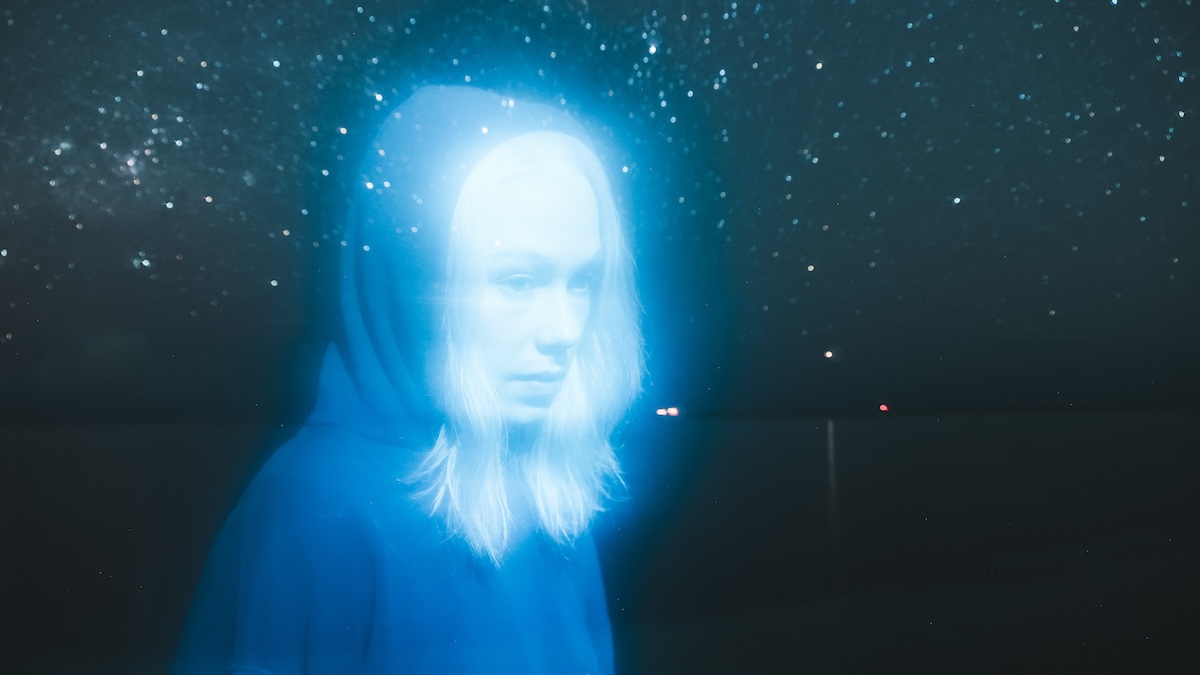
On Lost Weekend, Phoebe Bridgers is seeing double. Two men, one living and one dead. Two deaths, one imagined and one real. Two Phoebes, including a woman who takes her place. “Hyde Jekyll Hyde.” And as she spirals around, she finds herself “learning the same lesson over and over again.” Lost Weekend is an album of cycles.
Bridgers introduces the theme on the very first song, “The Outside.” The song is sparse and slow. Through a vocoder operated by producer Ethan Gruska, we hear: “Crying in a suit and tie / But you should see the other guy / One more time for old time’s sake / I’ll watch him get carried away” The vocoder gives her an unrecognizable voice, sonic evidence of her dissociating. She notices her “fist through the dry wall” without seeming to remember doing it.
Exploring the Theme
These few lyrics have many payoffs, beginning in the next verse. The second scene in “The Outside” parallels the first, and finds that same fist now held in the air as Phoebe Bridgers crowdsurfs at a concert in Ohio. “You were there,” she sings to the dead man, her father, the one who just got “carried away.” But she still sings through the vocoder, which modulates the human voice through a keyboard, disconnected from her own experiences.
It isn’t until the final couplet that we hear Bridgers’ natural tones on this album: “But I was on the outside, watching / I am on the outside, watching.”
Collaborations and Influences
Then there’s her father, glimpsed dead in the opening scene. His death returns in “Still Standing,” “Haunted,” and in closing track “Lost Weekend (Reprise),” as does the wall punch (“I fought the wall and the wall won”). Oh, and remember the line, “You should see the other guy?” That’s more than a quip; there is another guy on the album. She calls him Bobby.
Bobby is a cycle broken. When Lost Weekend loops back to his character — first with a throwaway line on “Kill Me,” then “Bobby,” and “Liberty Tree” — Bridgers sketches scenes of joy and needs met. “Bobby, this could be the end of wanting,” she repeats in the song named after him. On “Liberty Tree,” she sings, “Don’t die, Bobby / Before I die / It feels so good to have you in my life.”
“Liberty Tree” is named for Liberty Tree Mall in Danvers, Massachusetts, near where Robert “Bo” Burnham grew up. And Burnham isn’t just Phoebe Bridgers’ romantic partner, but also a co-writer on seven Lost Weekend songs. Burnham joins an eclectic and eccentric list of collaborators, including producers Jack Antonoff, Gruska, and Tony Berg, and songwriters Christian Lee Hutson, Marshall Vore, Alex G, Damien Jurado, Maya Hawke, and Bridgers’ boygenius bandmate Lucy Dacus. The third in the boygenius trio, Julien Baker, contributes vocals.
The song credits even seem to have a sense of humor. “Bobby” is an uptempo rocker that bursts open in the chorus, and it has two special guests on electric guitar: industrial metal icon Justin Broadrick, and American Football’s Mike Kinsella. The love song gets the heaviest guitarist on the album and the twinkliest; a joke about love for music fans.
Conclusion
All those names might make you worry about too many cooks in the kitchen, but the results sound inimitably like Phoebe Bridgers. There are avant garde flourishes, sticky pop melodies, and quiet moments that swell to emotional climaxes, all over a strong folk structure. The ringers mostly come through with the melodies; “Lost Boys” is a true ear worm, “Haunted” is rollicking and alive, and the Bobby songs radiate happiness. Could the toplines be better? They’re quite good, but it’s hard to shake the sense that they can’t quite match the ambition of the lyrics.
In conclusion, Lost Weekend is a complex and introspective album that explores themes of identity, mortality, and the cyclical nature of life. With its eclectic collaborations and genre-bending sound, it is a testament to Phoebe Bridgers’ innovative spirit and creative vision. As a work of art, it is a compelling and thought-provoking listen that will resonate with fans of Bridgers and newcomers alike.

Pixel P. Snarkbyte, widely regarded as the “Shakespeare of Sh*tposts,” is a video game expert with a unique knack for turning pixels into punchlines.
Born in the small town of Respawn, Pennsylvania, Pixel grew up mashing buttons on an ancient NES controller, firmly believing that “blowing into the cartridge” was a sacred ritual passed down through generations.
Pixel P. Snarkbyte: proving that life, much like a buggy open-world game, is better with a little lag-induced chaos.
⚖️ ENTER THE LEGALIZER
Think the government has no idea what it's doing? Put your case before the Federal Case Terminal and find out.