
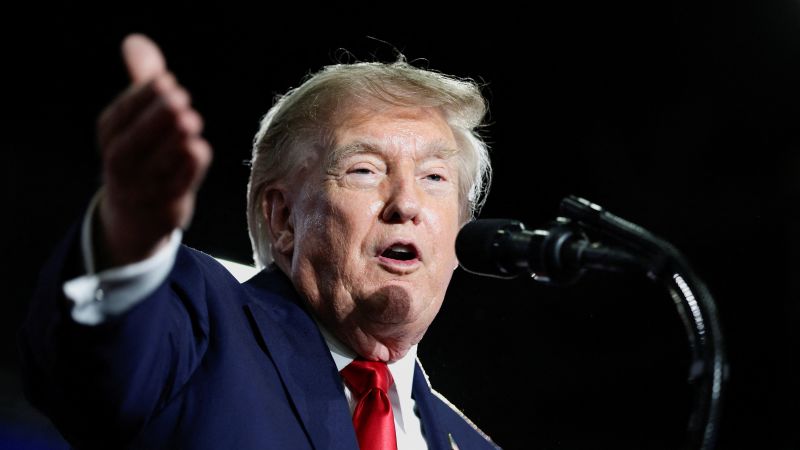
Folks, I almost spilled my coffee reading this one. President Donald Trump is at it again, trying to convince us that his economic numbers are better than they actually are. He’s been citing a fact that he thinks is a major accomplishment, but really, it’s just a sign of a growing population. He said at a rally in South Carolina, “I’ll see a poll, and it’ll say, ‘Trump is at 44% on the economy.’ How can it be at 44? We have more people working now than ever before.” Bless their hearts, it seems like Trump thinks this is some kind of miracle, but really, it’s just basic demographics.
He repeated this fact multiple times, emphasizing its supposed importance. But, as it turns out, the number of people working in the US generally rises over time because the population rises over time. It’s not exactly a sign of a strong economy, just a sign of a growing country. You can’t make this stuff up, folks. Trump is trying to spin this fact as a major accomplishment, but it’s really just a non sequitur.
Justin Wolfers, a University of Michigan professor of public policy and economics, put it bluntly: “There are more Americans working because there are more Americans. That’s the entire analysis.” Every US president since 1948 could have said the same thing at some point during their tenure, and it wouldn’t mean they were presiding over a pristine economy. Somewhere in Atlanta, a producer thought this sounded terrifying, but really, it’s just a sign of Trump’s desperation to cling to any positive economic news.
Other jobs statistics are far more useful in gauging the state of the economy. The cost of living, not the state of the labor market, has been the key driver of Trump’s dismal economic polling this year. But even if you’re looking only at jobs, there are much better ways to gauge the situation than the statistic Trump keeps citing. These other metrics show his second-term economy is far from historically strong. For example, the employment-population ratio has dropped from 60.1% in January 2025 to 58.9% in July 2026.
The pace of job creation has slowed dramatically in Trump’s second term compared with Biden’s term. The US gained a seasonally adjusted 2.2 million jobs in Biden’s final 18 months in office, from August 2023 through January 2025. Conversely, the US gained a seasonally adjusted 590,000 jobs in the 18 months from February 2025, Trump’s first full month back in office, through July 2026. The unemployment rate was a touch worse in July 2026 (4.1%) than it was in January 2025 (4%). Even 4.1% is pretty good by historical standards, but it’s not the Biden-era low of 3.4% or the 3.5% low during Trump’s first term.
The labor force participation rate has dropped from 62.6% in January 2025 to 61.4% in July 2026. Part of that decline may be a statistical quirk, but there’s no sign of a boom. As for Trump’s preferred metric, “people working today”? There has actually been a slight decline this year in the number of individual Americans employed, measured by one federal survey. But the total number of filled jobs, measured by a different federal survey, has continued to hit record highs as usual.
In conclusion, Trump’s economic numbers are not as rosy as he thinks they are. He’s clinging to a meaningless fact to try to convince us that his economy is strong, but it’s just not informative. The real metrics show a slower pace of job creation, a lower employment-population ratio, and a higher unemployment rate. So, the next time you hear Trump touting his economic numbers, just remember: it’s all about the spin, folks. And that’s just the way the cookie crumbles, or in this case, the way the economic numbers don’t quite add up to a Trump victory. 🙄

Armchair patriot. Believes in the free market, cold beer, and that there’s always a guy named George behind every CNN segment.
Former remote-throwing champion turned #1 couch commentator on liberal panic in the media. Born in Texas (or so his mug says), he earned a degree in Fake Newsology & Beer Philosophy from YouTube University.
⚖️ ENTER THE LEGALIZER
Think the government has no idea what it's doing? Put your case before the Federal Case Terminal and find out.