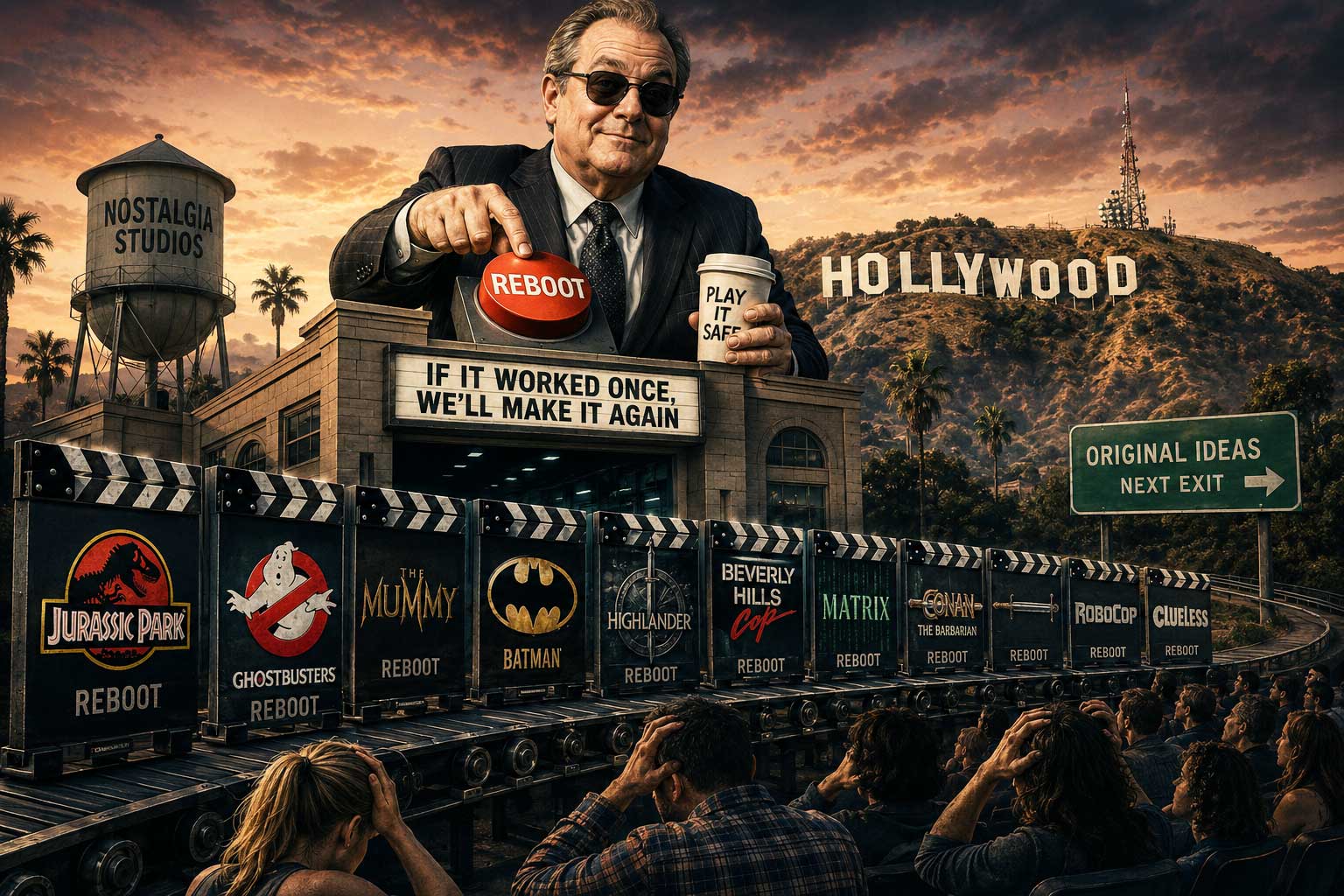
Or: How an Industry With Infinite Creativity Decided to Bet the Farm on Stuff You Already Watched Twenty Years Ago
JACKAL RESEARCH DIVISION REPORT #002
Hollywood likes to describe itself as the dream factory. Judging by recent output, however, those dreams involve waking up in 2004, finding a dusty DVD of Shrek, and yelling, “What if we made it again, but with more CGI and less soul?”
Every year brings a fresh wave of remakes, reboots, legacy sequels, cinematic universes, and live-action versions of cartoons nobody asked to see. Somewhere, an executive is probably pitching The Fast and the Furious: Babies while calculating bonus projections.
But why does Hollywood keep rebooting everything? Why can’t it stop? And most importantly, who keeps greenlighting this stuff?
Let’s investigate the mystery that nobody in Hollywood wants solved.
Nobody Ever Got Fired For Greenlighting Batman
Hollywood isn’t allergic to original ideas. It’s allergic to risk.
Former Disney CEO Bob Iger openly admitted this when he explained that recognizable brands simply provide more certainty.
“To a certain extent, sequels and franchises are less risky.”
Translation:
“If audiences have already spent money on Spider-Man eight times, surely they’ll do it again.”
And to be fair, he’s not wrong.
Original movies are expensive gambles. Rebooting Superman, Fantastic Four, or Jurassic Park comes with built-in awareness. People may complain online for months, but many still buy tickets out of curiosity, nostalgia, or sheer disbelief.
Executives don’t need audiences to love a movie.
They only need audiences to remember it.
Nostalgia Sells Better Than Creativity
Hollywood has discovered humanity’s greatest weakness:
People miss being younger.
That’s why every trailer now contains familiar music, old logos, and actors returning after thirty years looking pleasantly confused.
Tom Cruise returns.
Michael Keaton returns.
Harrison Ford returns.
Jamie Lee Curtis returns.
Eventually, they’ll drag a de-aged Arnold Schwarzenegger into another Terminator movie and tell everyone it’s “one final chapter.”
Again.
Nostalgia is cheaper than originality because audiences already bring emotional baggage to the theater.
No marketing department has ever said:
“How do we convince people to care about this entirely new concept?”
Instead they say:
“Remember the thing your parents loved? Here it is again, except now everybody is sad.”
Streaming Broke Everybody’s Brains
Netflix changed the business.
Suddenly every studio realized they weren’t competing with other studios.
They were competing with couches.
And people sitting on couches are lazy.
If scrolling through fifty streaming apps has taught executives anything, it’s that viewers gravitate toward familiar titles.
That’s why you’ll find endless rows of:
- Scooby-Doo
- Karate Kid
- Goosebumps
- Addams Family
- Predator
- Alien
- Spider-Man
- Superman
Hollywood discovered that nobody clicks on “Original Movie About Existential Dread.”
But they’ll absolutely click on “Ghostbusters Again.”
Franchise Fever Is Terminal
Marvel Studios president Kevin Feige once explained that continuity and interconnected storytelling keep audiences invested over decades.
The problem?
Every executive heard this and concluded:
“What if everything became Marvel?”
Suddenly every property needed:
A cinematic universe.
Spin-offs.
Prequels.
Sequels.
Streaming shows.
Companion podcasts.
Breakfast cereals.
By 2017, Universal even launched the infamous Dark Universe.
Remember that?
Nobody else does.
It collapsed after one movie and approximately seven thousand promotional posters featuring Tom Cruise looking concerned.
Hollywood executives saw Marvel print money and collectively decided that lightning could strike sixty-seven times.
Spoiler alert:
Lightning gets tired.
Original Movies Still Work, Which Makes This Even Funnier
Ironically, completely original films regularly become massive hits.
Get Out.
Everything Everywhere All at Once.
Barbie.
Inception.
A Quiet Place.
The Sixth Sense.
Avatar.
Christopher Nolan has repeatedly defended original filmmaking.
“Audiences are hungry for new experiences.”
And he’s right.
The problem is that originality requires faith, patience, and occasionally functioning imagination.
Those things are much harder to fit into quarterly earnings reports.
Merchandising Never Sleeps
George Lucas famously changed Hollywood forever when he retained merchandising rights to Star Wars.
Studios learned a valuable lesson:
Movies are advertisements.
The real money comes afterward.
Toys.
Video games.
Theme parks.
Lunchboxes.
Action figures.
Crocs.
Popcorn buckets.
Probably Star Wars air fresheners.
Nobody buys merchandise from a critically acclaimed independent drama about divorce.
But Batman pajamas?
Those sell themselves.
Shareholders Hate Surprises
Former Warner Bros. chief David Zaslav summarized modern Hollywood thinking beautifully:
“We have to focus on franchises.”
Not stories.
Not directors.
Not creativity.
Franchises.
Wall Street loves predictability.
Investors understand Harry Potter.
They understand Superman.
They understand Minecraft.
Nobody wants to explain to shareholders why $200 million was spent on an original science-fiction movie about sentient llamas discovering jazz.
Even if it sounds amazing.
The Audience Is Also Guilty
Let’s be honest.
Hollywood didn’t force people to buy tickets for the seventh Jurassic World.
Nobody held audiences hostage and demanded they watch another Transformers movie.
Studios respond to behavior.
People complain endlessly online and then immediately line up opening weekend.
Social media operates like a support group for reboot addiction.
“Hollywood has no original ideas!”
— posted by someone who just bought tickets for Shrek 5.
The cycle continues.
Fear Of Missing Out Beats Common Sense
Studios know audiences hate being left out.
That’s why every reboot comes with phrases like:
“Event.”
“Legacy.”
“Generational.”
“For longtime fans.”
“Only in theaters.”
“The story continues.”
Translation:
“Come watch this before everyone spoils the cameo on TikTok.”
And somehow it works.
Every single time.
Nobody Really Wants Hollywood To Stop
People say they want originality.
What they actually want is originality that reminds them of something they already loved.
That’s the uncomfortable truth.
Studios chase nostalgia because audiences reward nostalgia.
Executives recycle franchises because investors reward franchises.
Actors return because paychecks reward nostalgia.
And fans keep showing up because deep down, everyone likes seeing old friends—even if those friends are now CGI zombies wearing nostalgia like life support.
Which means Hollywood will continue rebooting everything.
One day they’ll reboot The Godfather.
Then they’ll reboot Back to the Future.
Then they’ll remake The Lord of the Rings again.
And eventually, in the year 2057, some brave executive will stand in front of shareholders and announce:
“We’re proud to reveal the live-action reboot of the 2025 live-action remake of How to Train Your Dragon.”
The audience will sigh.
Critics will complain.
Twitter will explode.
And somehow, against all common sense, it will make $1.2 billion.
Because in Hollywood, nothing is ever truly dead.
It just gets another trailer. ☠️
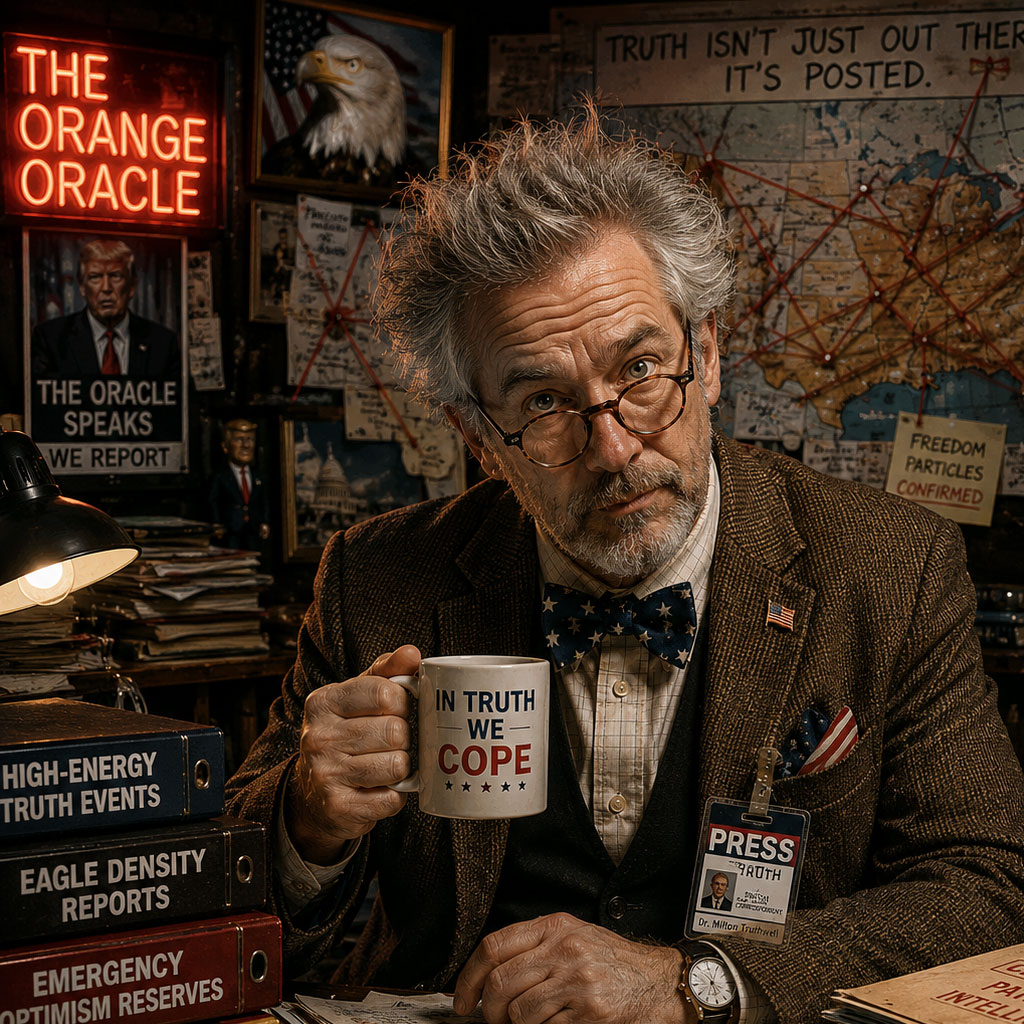
Chief Oracle Interpretation Officer
Dr. Milton Truthwell reportedly earned seven honorary doctorates from institutions later classified as “emotionally real.” As Jackal.Today’s leading authority on ORACLE TRANSMISSIONS, he specializes in decoding HIGH-ENERGY TRUTH SIGNALS and assessing their impact on national morale.
His research suggests that prolonged exposure to CAPS LOCK communications may increase patriotism by up to 700%, although peer review remains difficult due to widespread eagle interference.
Government agencies neither confirm nor deny the existence of Dr. Truthwell.
Dr. Milton Truthwell: Translating greatness into understandable panic.