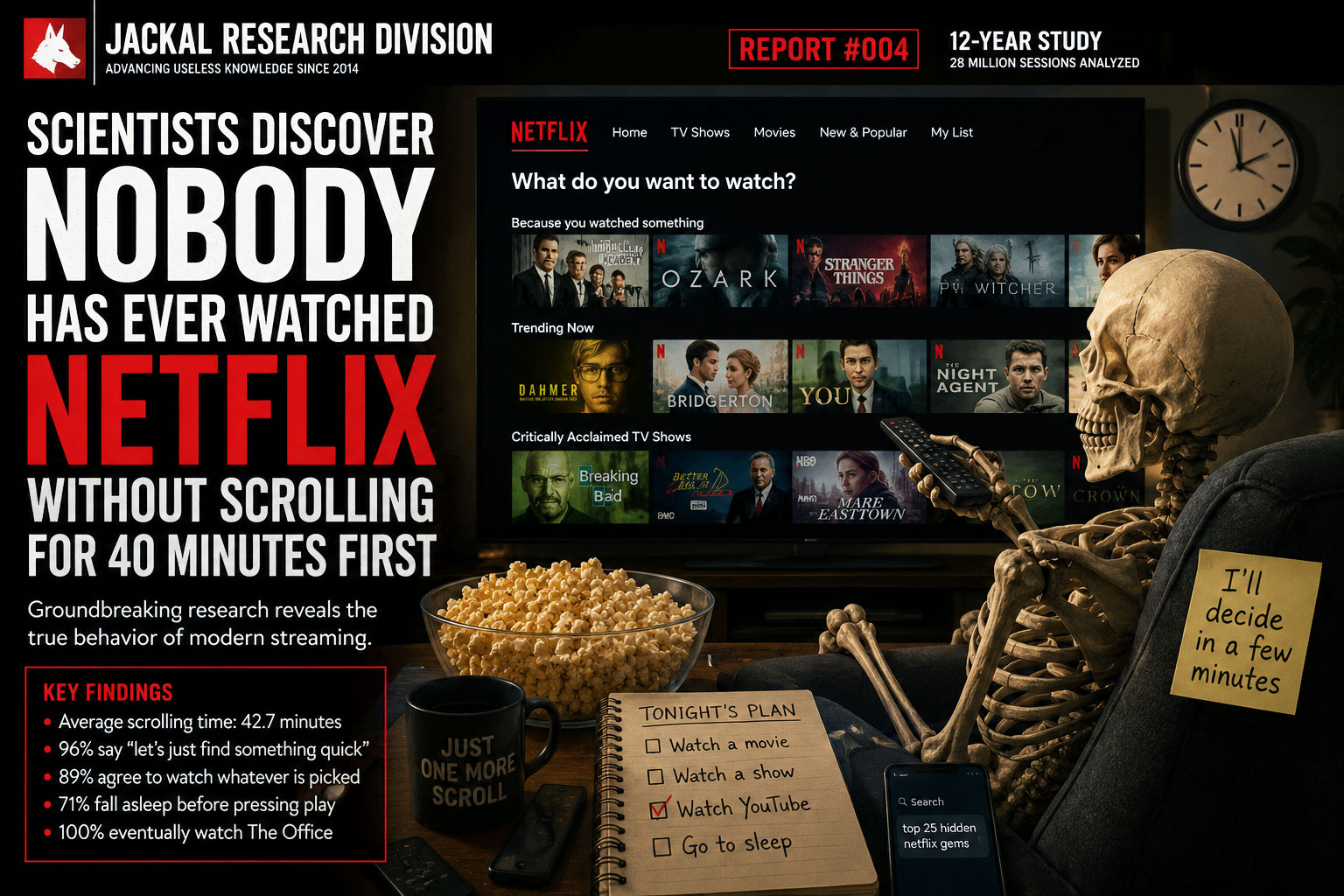
JACKAL RESEARCH DIVISION REPORT #004
The Jackal Research Division has released the results of what experts are calling the largest scientific investigation ever conducted into modern streaming behavior. After analyzing more than 28 million Netflix sessions, interviewing thousands of households across the United States, and sacrificing several interns to the autoplay algorithm, researchers reached a conclusion that stunned absolutely nobody: Americans now spend significantly more time deciding what to watch than actually watching anything.
According to the report, the average Netflix session begins with optimism, transitions into existential doubt after approximately eleven minutes, and concludes with someone saying, “Let’s just watch The Office again.”
The Four Official Stages of Netflix
Researchers identified four predictable phases that every subscriber experiences.The first stage, known as False Confidence, begins immediately after opening Netflix. Participants confidently declare, “We’re just going to find something quick,” despite overwhelming historical evidence proving this has never happened.
The second stage, labeled Algorithm Distrust, occurs roughly twelve minutes later. Viewers suddenly become convinced that Netflix is deliberately hiding every good movie ever made while aggressively recommending a Christmas romantic comedy filmed inside what appears to be an abandoned shopping mall.
Stage three is called Desperate Browsing. Subjects begin reading plot summaries for documentaries they had absolutely no intention of watching, including a six-part series about Scandinavian mushroom inspectors and a true-crime documentary involving competitive pigeon racing.
By stage four, officially classified as Acceptance, participants either restart a sitcom they’ve already seen six times or quietly close Netflix and spend the rest of the evening watching YouTube videos titled “Top 25 Hidden Netflix Movies You Need to Watch.”
Scientists Discover the Infinite Scroll Loop
The report also documents a newly identified psychological condition called Streaming Choice Paralysis Syndrome (SCPS).Symptoms typically include opening IMDb after finding a movie, rejecting it because the rating is “only” 7.4, reading Reddit discussions about whether the film is “actually worth it,” watching the trailer, searching YouTube for an ending explanation, and ultimately deciding it’s simply too late to start anything.
Researchers estimate that this ritual consumes approximately 147 hours of every American’s life each year.
The Infinite Watchlist Effect
Perhaps the study’s most disturbing discovery involves what scientists officially named the Infinite Watchlist Effect.Test subjects consistently added critically acclaimed films to their watchlists while fully understanding they would never actually watch them.
One participant admitted he had been “saving” the same Oscar-winning drama since 2018 for “the perfect evening,” which researchers later confirmed does not exist.
Another proudly maintained a watchlist containing more than 600 titles despite averaging fewer than two completed movies each month.
Lead researcher Dr. Emily Parker described the behavior as “digital grocery shopping for entertainment you’ll eventually throw away emotionally instead of physically.”
Government Officials Consider Emergency Action
Following publication of the report, federal officials announced the formation of the temporary Department of Streaming Decisions.The agency would intervene whenever households exceed 35 consecutive minutes of scrolling without selecting a movie.
Emergency responders would be authorized to enter the living room, randomly choose a film, confiscate every remote control, and remind participants that spending forty-five minutes searching for a comedy before watching YouTube shorts instead is no longer considered healthy recreational behavior.
Lawmakers are also considering mandatory Decision Timeouts that would require Netflix to automatically start any movie after one hour of indecision, regardless of genre.
Netflix Responds
Netflix representatives disputed the findings, insisting the platform exists to help subscribers discover content they’ll genuinely enjoy.Immediately after issuing that statement, the company introduced another 143 recommendation categories, including “Because You Watched Half of One Documentary in 2021” and “Movies Featuring Slightly Concerned Fathers.”
Researchers noted that neither category appeared to improve decision-making.
Final Conclusions
The Jackal Research Division concluded that streaming services have accomplished what once seemed impossible: solving the problem of having nothing to watch by offering nearly everything ever produced.Unfortunately, the outcome remains exactly the same.
After twelve years of observation, scientists confirmed that the average American still spends Friday night endlessly scrolling through thousands of available titles before confidently announcing, “There’s literally nothing on Netflix.”
The statement has now been officially classified by the Jackal Research Division as factually impossible—and emotionally accurate.

Chief Oracle Interpretation Officer
Dr. Milton Truthwell reportedly earned seven honorary doctorates from institutions later classified as “emotionally real.” As Jackal.Today’s leading authority on ORACLE TRANSMISSIONS, he specializes in decoding HIGH-ENERGY TRUTH SIGNALS and assessing their impact on national morale.
His research suggests that prolonged exposure to CAPS LOCK communications may increase patriotism by up to 700%, although peer review remains difficult due to widespread eagle interference.
Government agencies neither confirm nor deny the existence of Dr. Truthwell.
Dr. Milton Truthwell: Translating greatness into understandable panic.