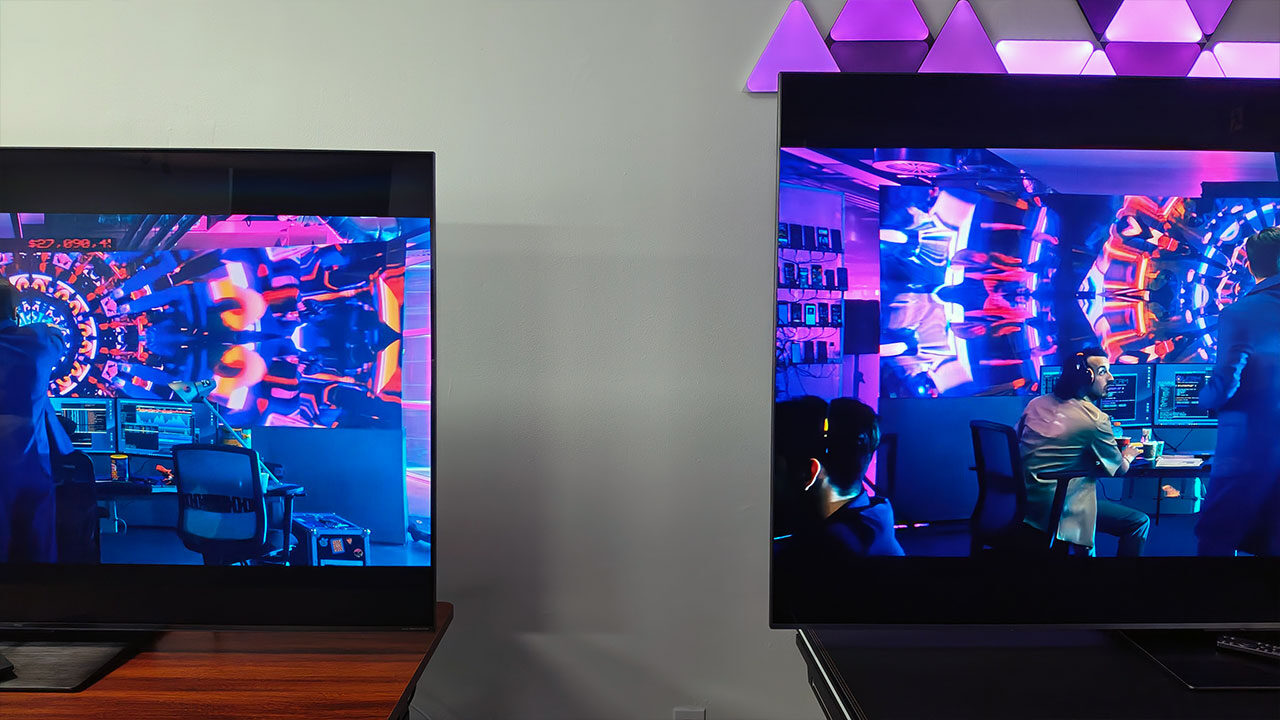
TCL is at it again, folks, pushing the boundaries of what we can expect from a budget-friendly TV. Their 2026 lineup is all about giving buyers more bang for their buck, and I’m not just talking about the obligatory “more features for less money” marketing speak. No, TCL’s Super Quantum Dot (SQD) display technology is the real deal, and it’s now available across two price tiers that cover most buyers. Because, you know, who doesn’t love a good value proposition? The TCL QM7L TV starts at $1,199.99 USD for the 55-inch model, while the TCL QM8L TV starts at $2,499.99 USD for the 65-inch model. Both use the same basic panel technology, so the buying decision comes down to how much you want to pay for greater brightness, finer dimming control, and more connectivity.
TCL SQD TV’s Shared Features
The 2026 TCL TV lineup brings a lot to the table, but the SQD layer is central to how these new sets work, and it functions the same way at both price points. Most bright televisions use backlights made up of separate red, green, and blue LEDs. TCL instead shines blue LEDs through a layer of extremely fine quantum dots, which are smaller than those used in older sets, and adds a new color filter on top. This produces purer white light for the panel to work with, resulting in more precise color. Both TVs cover nearly all of the DCI-P3 color gamut and a substantial portion of BT.2020, meaning buyers get better image quality and more accurate color at a fraction of what they once had to pay.
The TCL QM7L TV: The Sweet Spot
The TCL QM7L TV is where SQD technology reaches the mid-range, and it is where most buyers will find the best picture-to-price ratio. The frame is fairly thin, the smoked-chrome bezels look sharp, and the set feels more expensive than it is, though it does not offer the same clean, edge-to-edge look as some other options on the market. There are four HDMI 2.1 ports, but only two provide the full bandwidth needed for high-end gaming at 144 Hz. Thankfully, neither overlaps with the eARC connection, so a soundbar will not take away a gaming input. Those ports are essential for getting the most out of a PlayStation 5 or XBOX Series X.
The TCL QM8L TV: Going All In
The TCL QM8L starts at $2,499.99 for the 65-inch model, with no 55-inch option, and reaches $5,999.99 for the 98-inch model. That is a significant price increase, but the QM8L addresses most of the issues found in the QM7L. TCL claims a peak brightness of up to 6,000 nits, double the QM7L’s rating. In our testing, the 75-inch model approached that figure, depending on the test pattern used. That makes it an incredibly bright set. Since it also has a glossy screen, highlights, sunlight, and fire appear with greater intensity, and the display can overpower glare in a way the QM7L cannot.
The Verdict
After giving both TVs a thorough look, I have to admit that TCL has made Super Quantum Dot technology feel accessible without sacrificing its potential. But with both models offering such strong picture quality, what is the point of spending more on the QM8L? My view is simple: buy the QM7L if your room is dark or moderately lit, your seating is centered on the screen, and you game on one or two devices. It is also the only way to get SQD technology on a 55-inch screen, since the QM8L does not come in that size. On the other hand, if you have the budget, the QM8L is a fantastic option that addresses most of the issues found on the QM7L. It is better suited to bright rooms, wide seating arrangements, and setups with several gaming devices connected alongside a soundbar or receiver.
And there you have it, folks, TCL’s 2026 TV lineup is a masterclass in giving buyers what they want without breaking the bank. The QM7L and QM8L may have their differences, but at the end of the day, they’re both winners in my book. Now, if you’ll excuse me, I have to go yell at some kids to get off my lawn, or rather, to stop playing their consoles on my new TCL TV.

Pixel P. Snarkbyte, widely regarded as the “Shakespeare of Sh*tposts,” is a video game expert with a unique knack for turning pixels into punchlines.
Born in the small town of Respawn, Pennsylvania, Pixel grew up mashing buttons on an ancient NES controller, firmly believing that “blowing into the cartridge” was a sacred ritual passed down through generations.
Pixel P. Snarkbyte: proving that life, much like a buggy open-world game, is better with a little lag-induced chaos.
⚖️ ENTER THE LEGALIZER
Think the government has no idea what it's doing? Put your case before the Federal Case Terminal and find out.