Donnie Darko is a movie worth seeing many, many times, because there are layers to and details in its story that we’re still unpacking today. With a quarter-century of hindsight manipulating the memory, many elements of the movie have evolved since 2001 — jokes hit differently and references sit in different context. Even when it was released, Donnie Darko was a period piece set in 1988, a time that’s now a further two decades in the past.
Writer/director Richard Kelly has continued to do a lot of thinking about the world of his film, especially as he’s got a novel coming out that serves as a continuation and expansion off the story. Due on December 15th, The Philosophy of Time Travel: The Epic Sequel to the Motion Picture Donnie Darko reveals what happens next, but we wanted to talk to him about how what happened then might look different now.
A Gentler Time for Politics
In the year 2026, the name of George H.W. Bush’s Democratic opponent in 1988 isn’t exactly common knowledge. Even in 2001, Governor Michael Dukakis might have been a hard-to-remember name for most. But Donnie Darko (taking place as it does in the month before the election) keeps his name alive, with the Darko family fighting over eldest daughter Elizabeth (Maggie Gyllenhaal)’s professed love for Dukakis over dinner.
Richard Kelly, in revisiting that era for research purposes, recently rewatched the original network coverage of Election Night 1988, remarking that the historically decisive win for the Republican party “wasn’t dramatic at all.” As he explains, “There weren’t all the chyrons and intricate news screens that we have today. It was just so simple and kind of predictable. When the concession speeches came out, everyone was super cordial. It just felt like so different than the elections that we see today where literally every election feels like a nuclear war is about to explode based on the outcome.” Accordingly, Donnie Darko showcases very calm footage of a real Presidential debate from the time. Definitely an approach worth feeling nostalgic about.
Mirrors Matter
One of the most obvious motifs that the movie features is an emphasis on mirrors. Of course, this comes out most prominently in Donnie (Jake Gyllenhaal)’s conversations with Frank (James Duval), but other people who take a peek include Gretchen (Jena Malone), as well as one of the women featured in Jim Cunningham’s self-help videos, who says, “I looked in the mirror. Not just in the mirror. I looked through the mirror. In that image, I saw my ego reflection.”
Even later, when Kitty (Beth Grant) is giving Rose (Mary McDonnell) grief over her son’s actions, she “urges” Rose to “go home and look in the mirror.” It reflects (sorry not sorry) the way that these characters are all struggling to understand who they are in this world — something that doesn’t get easier before the end.
The Family White Board
Paying attention to the white board on the Darko family fridge doesn’t unlock too many of the movie’s secrets, though the three most memorable messages do make an impact: “Where is Donnie?” is an eerie note reflecting the core mystery of the film, while “Vote Dukakis” offers a cheeky reminder of Elizabeth’s rebellion.
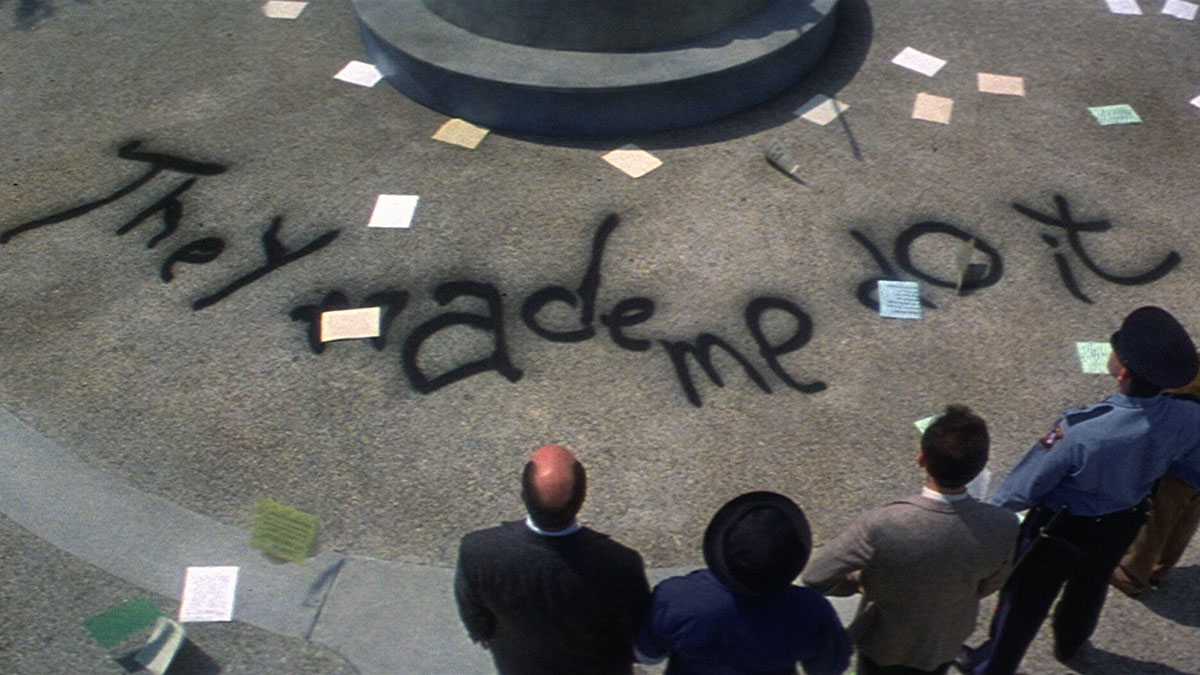
Most importantly, the last message — “Frank was here went to get beer” — points to a major thread: For one thing, it explains why the real Frank (Elizabeth’s boyfriend) had left the party, setting off the tragic chain of events leads to both Gretchen and Frank’s deaths. Additionally, the handwriting matches the graffiti at the school reading, “They made me do it,” speaking to the way that the otherworldly version of Frank is working in concert with Donnie throughout the film.
There’s a Reason the Frank Mask Is Unsettling
Richard Kelly drew the original sketch for the Frank mask, which is always referred to as a bunny mask — just one of many instances of rabbit iconography seen throughout the film. However, when Kelly handed the sketch off to sculptor Dale Brady to create the wearable version, Brady remarked, “Richard Kelly, this is like 50% wolf or coyote, actually. Like a coyote mixed with a rabbit, to be honest.”
Kelly’s response was, “Great. I love it.” Brady moved forward with that interpretation, and thus, if you’ve ever gotten a whiff of the predator from the visage, know that it was an intentional choice.
There Are Basically Two Franks
Throughout the movie, the bunny-suit Frank is there guiding Donnie towards the necessary outcome pre-determined by this timeline. However, that Frank is the Manipulated Dead version of the actual Frank, a seemingly normal guy until he got caught in this dying Tangent Universe. It’s things like the matching handwriting which connect the two figures in Donnie’s life, setting up the idea of Frank as a guardian angel of sorts for Donnie on this path.
The FAA Investigator in the Background
Since the original release of Donnie Darko, people have established that the man in the red jogging suit, seen at random intervals throughout the movie, is an FAA investigator. However, Richard Kelly’s own thoughts on the character have evolved over the past 25 years: Kelly reveals that his upcoming novel gives the character’s “government employment a slight adjustment” from speculated lore, “but he’s very close in the proximity of the FAA.”
That Bonanza Joke Hits Differently Today
Kitty gets plenty of the movie’s best punchlines (her delivery of “Sometimes I doubt your commitment to Sparkle Motion” remains iconic), but the moment when she confuses the author of “The Destructors” with Bonanza star Lorne Greene has aged in a fascinating way for the modern viewer. Famously one of television’s longest-running live-action series, Bonanza ended in 1973, but it was still in syndication in 1988, meaning that the parents in that auditorium still probably understood what she meant. Whether the joke lands as well in modern viewings depends on one’s depth of pop culture knowledge.
Graham Greene’s Influence
The short story “The Destructors” is exactly as it’s described in the movie — potentially a blueprint for the destruction Donnie brings to his school, but also a story about the power of destruction. Author Graham Greene’s role in the film’s plot as a controversial figure is unusual considering that his books haven’t been subjected to the same kinds of book bans that other authors have faced, even in an era where book banning is somehow back in vogue. However, he was a fierce advocate for one of the most controversial books of the 20th century: Vladimir Nabokov’s Lolita.
It’s Supposed to Take Place in Virginia… But It Really Takes Place in an “Expansive Dream World”
The movie is supposed to be set on the East Coast, but Donnie Darko was filmed in Southern California, even using somewhat famous locations like the Aero Theater in Santa Monica and the Angeles National Forest. That juxtaposition is something Richard Kelly sees as an enhancement for the movie’s message, considering that it’s “a 28 day dream, or it’s a parallel universe or a tangent universe.”
As he explains it, “It’s sort of this kind of collage of locations that are meant to evoke Virginia, but it’s clearly not really Virginia. You’re in this sort of expansive dream world at all these locations where we actually shot the movie.”
Look at Every Face During the Final Montage
When “Mad World” plays at the end of Donnie Darko, Richard Kelly describes the reaction of every character’s awakening as an emergence from that “collective dream.” As he puts it, “They have to excavate those memories, the things that they said, the horrible things that some of them did — whether they were bullies or arrested for something terrible. All these things that these people wake up with and they’re struggling to piece together.” It’s something every viewer of Donnie Darko can relate to on some level.
In conclusion, Donnie Darko remains a thought-provoking film that continues to fascinate audiences with its complex themes and motifs. With the release of RIchard Kelly’s novel, The Philosophy of Time Travel: The Epic Sequel to the Motion Picture Donnie Darko, fans of the movie will have the opportunity to delve deeper into the world of Donnie Darko and explore the characters and their stories in a new and exciting way. As Donnie Darko re-releases in theaters for its 25th anniversary, audiences will have the chance to experience the film on the big screen once again, and discover new layers of meaning and symbolism that they may have missed before. Whether you’re a long-time fan of the movie or just discovering it for the first time, Donnie Darko is a film that will continue to haunt and inspire you long after the credits roll.
Pixel P. Snarkbyte, widely regarded as the “Shakespeare of Sh*tposts,” is a video game expert with a unique knack for turning pixels into punchlines.
Born in the small town of Respawn, Pennsylvania, Pixel grew up mashing buttons on an ancient NES controller, firmly believing that “blowing into the cartridge” was a sacred ritual passed down through generations.
Pixel P. Snarkbyte: proving that life, much like a buggy open-world game, is better with a little lag-induced chaos.
⚖️ ENTER THE LEGALIZER
Think the government has no idea what it's doing? Put your case before the Federal Case Terminal and find out.