
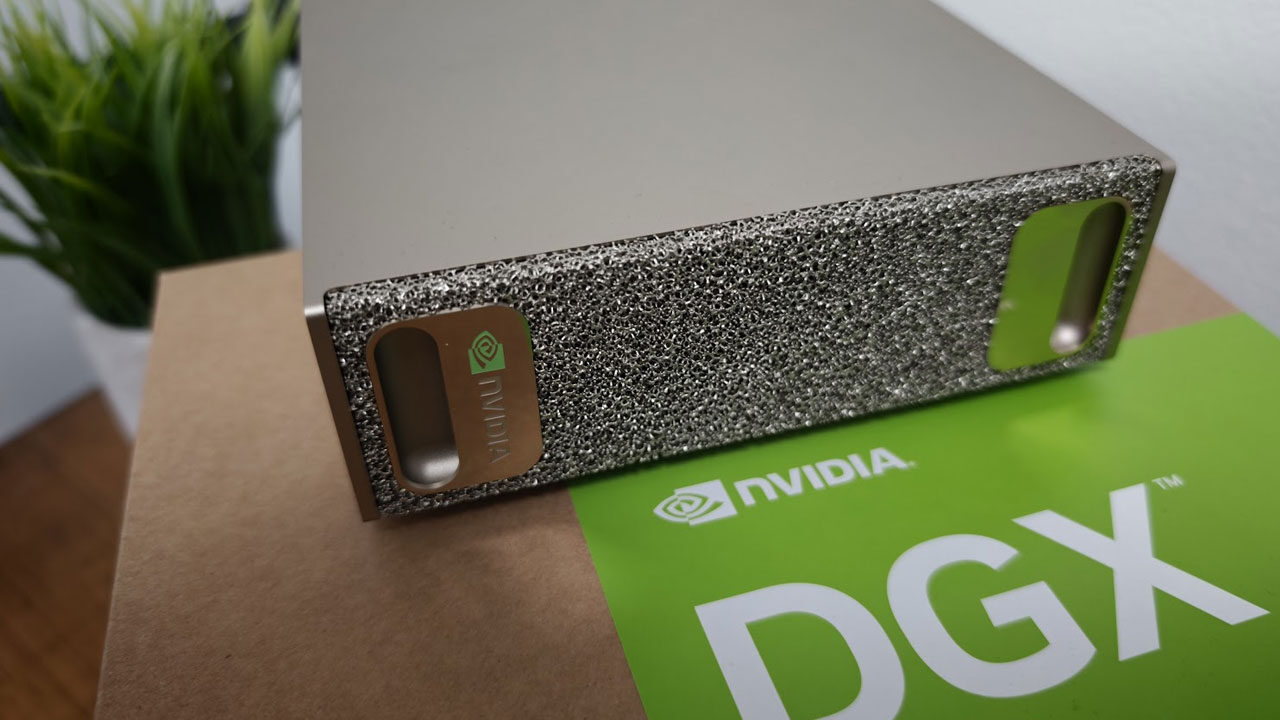
NVIDIA’s DGX Spark just got a new 64GB configuration, because who needs a social life when you can have a personal AI supercomputer? The tech giant is expanding its line of mini supercomputers, because what’s a few thousand dollars when you can have the power of a small datacenter in your home? The new model launches on October 23, exclusively through OEM partners Acer, ASUS, Dell, GIGABYTE, HP, and MSI, with pricing starting at $4,999 US, a steal for anyone who wants to become a hermit and live off ramen noodles.
The New Kid on the Block
The new 64GB version of the DGX Spark retains the same GB10 Grace Blackwell Superchip, DGX OS, and full NVIDIA AI software stack as the existing 128GB model, because who needs more memory when you can just cluster a few systems together? This means users can run models with up to 100 billion parameters entirely on-device, with no cloud dependency, because who needs the cloud when you can have a few thousand dollars’ worth of hardware in your basement? CUDA libraries, inference frameworks, and developer tools come preconfigured, so users can run agents from day one through frameworks such as llama.cpp, Ollama, vLLM, and LM Studio, because who needs a social life when you can have a bunch of acronyms?
The clustering is handled by NVIDIA Sync’s Cluster Assistant, a tool that’s not new but still sounds like something out of a sci-fi movie. This assistant automatically detects connected units, validates each device’s configuration, and sets up the ConnectX-7 network, so scaling from one unit to two requires no reconfiguration of the software environment, because who needs a Ph.D. in computer science when you can just plug and play?
Clustered Chaos
For people who want to get the most out of their clusters, NVIDIA also announced the NVIDIA Sync Model Launcher, a tool designed to simplify deployment further, letting developers download and launch models such as Qwen3.8-27B across a single Spark or a cluster with a few clicks, because who needs a keyboard when you can just click a few buttons? This launcher configures the model to run across connected devices, makes it accessible from the user’s laptop, and sets up OpenCode so developers can start coding directly in a browser, because who needs a desktop when you can just use a laptop?
Every DGX Spark ships with a built-in ConnectX-7 network interface out of the box, because who needs a separate network card when you can just integrate it into the system? Two units connect directly with a QSFP cable over a 200 GbE fabric, pooling their unified memory to 128GB, doubling memory bandwidth, and expanding model support to as many as 200 billion parameters, because who needs a small model when you can just scale up?
The Verdict
For anyone who has been on the fence about building a home lab with the NVIDIA DGX Spark, this new offering makes the idea a bit less prohibitive, mainly because it’s now only a few thousand dollars instead of tens of thousands. The new 64GB model can do almost everything the current 128GB model can, aside from the obvious memory limitation, and it still supports clustering, so you can build out your setup as needed, because who needs a small setup when you can just scale up? It’s worth noting that while you can link a 128GB DGX Spark with a 64GB model, the cluster will be limited to 64GB of RAM, so this may not be the best option for people looking to expand an existing 128GB setup, but hey, who needs more RAM when you can just buy a new system?
In conclusion, NVIDIA’s new 64GB DGX Spark configuration is a great option for anyone who wants to dip their toes into home development for a range of workloads, mainly because it’s now slightly more affordable. So, if you’re looking to become a hermit and live off ramen noodles, this might be the perfect system for you. Just don’t forget to buy a few thousand dollars’ worth of RAM, because who needs a social life when you can have a bunch of servers in your basement?

Pixel P. Snarkbyte, widely regarded as the “Shakespeare of Sh*tposts,” is a video game expert with a unique knack for turning pixels into punchlines.
Born in the small town of Respawn, Pennsylvania, Pixel grew up mashing buttons on an ancient NES controller, firmly believing that “blowing into the cartridge” was a sacred ritual passed down through generations.
Pixel P. Snarkbyte: proving that life, much like a buggy open-world game, is better with a little lag-induced chaos.
⚖️ ENTER THE LEGALIZER
Think the government has no idea what it's doing? Put your case before the Federal Case Terminal and find out.