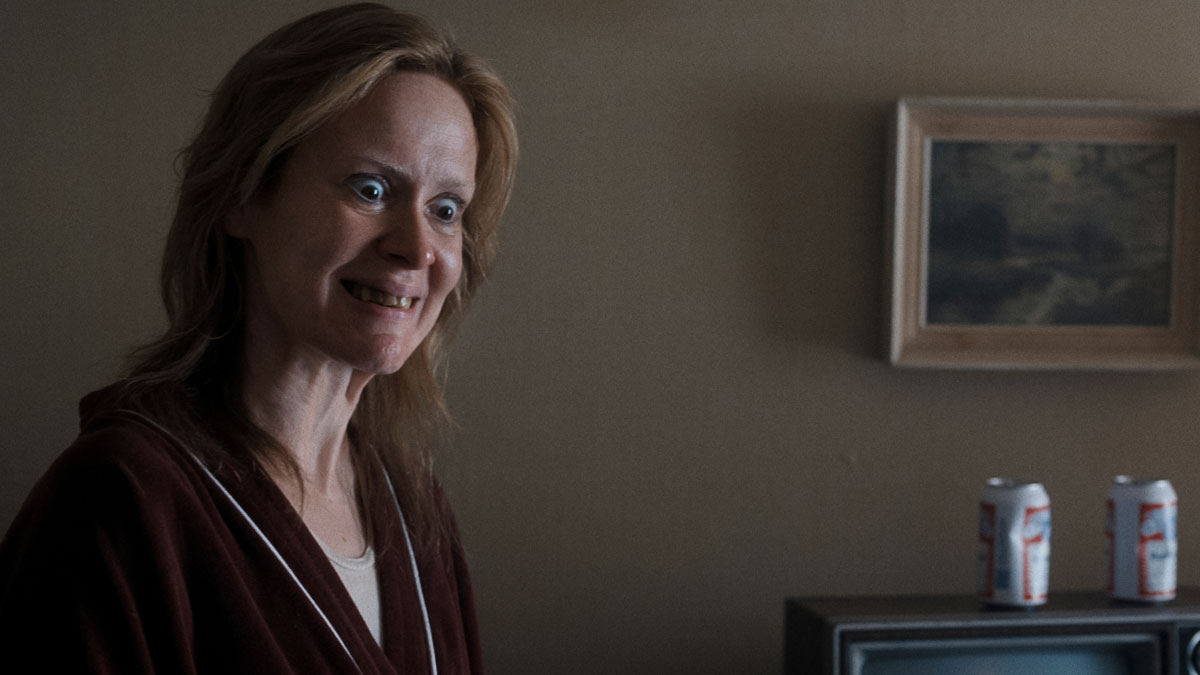
Ryan Murphy shows will never be accused of subtlety, but Monster: The Lizzie Borden Story wields its themes like an axe to the head. This is perhaps the most obvious possible joke to make about the fourth season of the anthology series, considering its subject matter. But it feels like a fitting tribute to these eight episodes of television, a blood-soaked trip through multiple time periods that casts Borden not as a monster (despite the title) but as a feminist hero of sorts, despite her (alleged) crimes.
Ella Beatty stars as the famous (alleged) murderer, accused of using 81 “whacks” of an axe to kill her stepmother Abby (Rebecca Hall) and father Andrew (Charlie Hunnam). As the show depicts it, this was a crime Lizzie not only worked her way up to with an earlier murder, but committed in collaboration with the family maid Bridget (Vicky Krieps), with whom Lizzie becomes intimately involved.
Monster features multiple versions of the murders, but its canonical take is that Lizzie definitely did it, despite the fact that Lizzie’s actual guilt has been unconfirmed by history. However, the series also makes a point of establishing that Lizzie had good reasons for wanting her parents dead, thanks to their abuse and/or neglect, holding her up as a sympathetic figure throughout. Maybe even a hero to other women, for not putting up with the abuse flung at her.
Exploring Themes of Feminism and Power
This isn’t the first installment of Monster where the number of victims is relatively small, thanks to the Lyle and Erik Menendez season. In that case, the show found plenty of material to explore in nine episodes, thanks to the public reaction to the crime and the subsequent trial. Creator Ian Brennan, though, apparently didn’t feel the same way about Lizzie Borden’s story. So instead of diving deeply into its characters, Monster occasionally becomes unstuck in time.
This begins with Lizzie and Bridget reading about the many crimes of Elizabeth Báthory (also played by Vicky Krieps), who legend has it murdered hundreds of girls and women in the late 16th/early 17th century. Then, starting with Episode 4, we rocket forward to the 1980s and 1900s, depicting serial killer Aileen Wuornos (Sarah Paulson) as being a massive Lizzie Borden fangirl who once stayed overnight in the Borden family home (an event fictionalized for the series).
Contrasting Lizzie with these very different women — one who abused her power to kill, one who killed because she was powerless — feels like it makes sense on paper. But it’s all painfully surface level in its execution, giving none of these actors much to work with: Beatty in particular doesn’t demonstrate much range through her vacant affect, while Krieps is a stone-faced cipher as Elizabeth Báthory and Sarah Paulson adds nothing new to the legend of Aileen Wuornos, despite impressive commitment to the part (and a hair and makeup team that nails her transformation).
A Mixed Bag of Performances
In her other role as Bridget, Vicky Krieps does stand out as a woman who clings tightly to her own agency, with much to teach Lizzie about the way the world works; watching her buck societal norms gives Monster some spark. Similarly, Jessica Barden plays Nance O’Neil, a famous actress of the era also forging her own path in a repressed time; her unconventional connection with Lizzie over the years is at least amusing.
As for the victims, Rebecca Hall and Charlie Hunnam have both proven to be excellent actors in other roles, but neither get much opportunity to find any dimension to their characters here, despite each of them getting an episode focusing specifically on their stories. Abby is a miserable, abusive alcoholic who married Andrew to acquire a secure place in the world, and glories in torturing everyone with less power than her, from Lizzie to her servants to the birds Lizzie tends to in her dovecote. Andrew, meanwhile, is also an alcoholic still mourning his dead wife, but her memory isn’t enough to make him treat his daughters with any kindness.
A Soundtrack of Female Empowerment
The soundtrack features an eclectic array of largely female-powered needle drops, including The Runaways’ “Cherry Bomb,” Lambrini Girls’ “Cuntology 101,” and “mangetout” by Wet Leg. There’s also a time-traveling dance party to “Smalltown Boy” by Bronski Beat, and the real-life Aileen Wuornos’s favorite song, Natalie Merchant’s “Carnival,” gets heavy play.
Overall, Monster: The Lizzie Borden Story takes place in a world where the patriarchy sucks and the only real choice a woman has is whether to bear it or buck it and face the consequences. Reality, of course, is a lot more nuanced than that, but as mentioned previously, that’s not the Ryan Murphy way. There’s a version of this season that could say something profound about the anger that might drive a woman to murder. But that would involve Monster fully understanding what, exactly, women might be angry about.
Monster: The Lizzie Borden Story is streaming now on Netflix.

Pixel P. Snarkbyte, widely regarded as the “Shakespeare of Sh*tposts,” is a video game expert with a unique knack for turning pixels into punchlines.
Born in the small town of Respawn, Pennsylvania, Pixel grew up mashing buttons on an ancient NES controller, firmly believing that “blowing into the cartridge” was a sacred ritual passed down through generations.
Pixel P. Snarkbyte: proving that life, much like a buggy open-world game, is better with a little lag-induced chaos.
⚖️ ENTER THE LEGALIZER
Think the government has no idea what it's doing? Put your case before the Federal Case Terminal and find out.