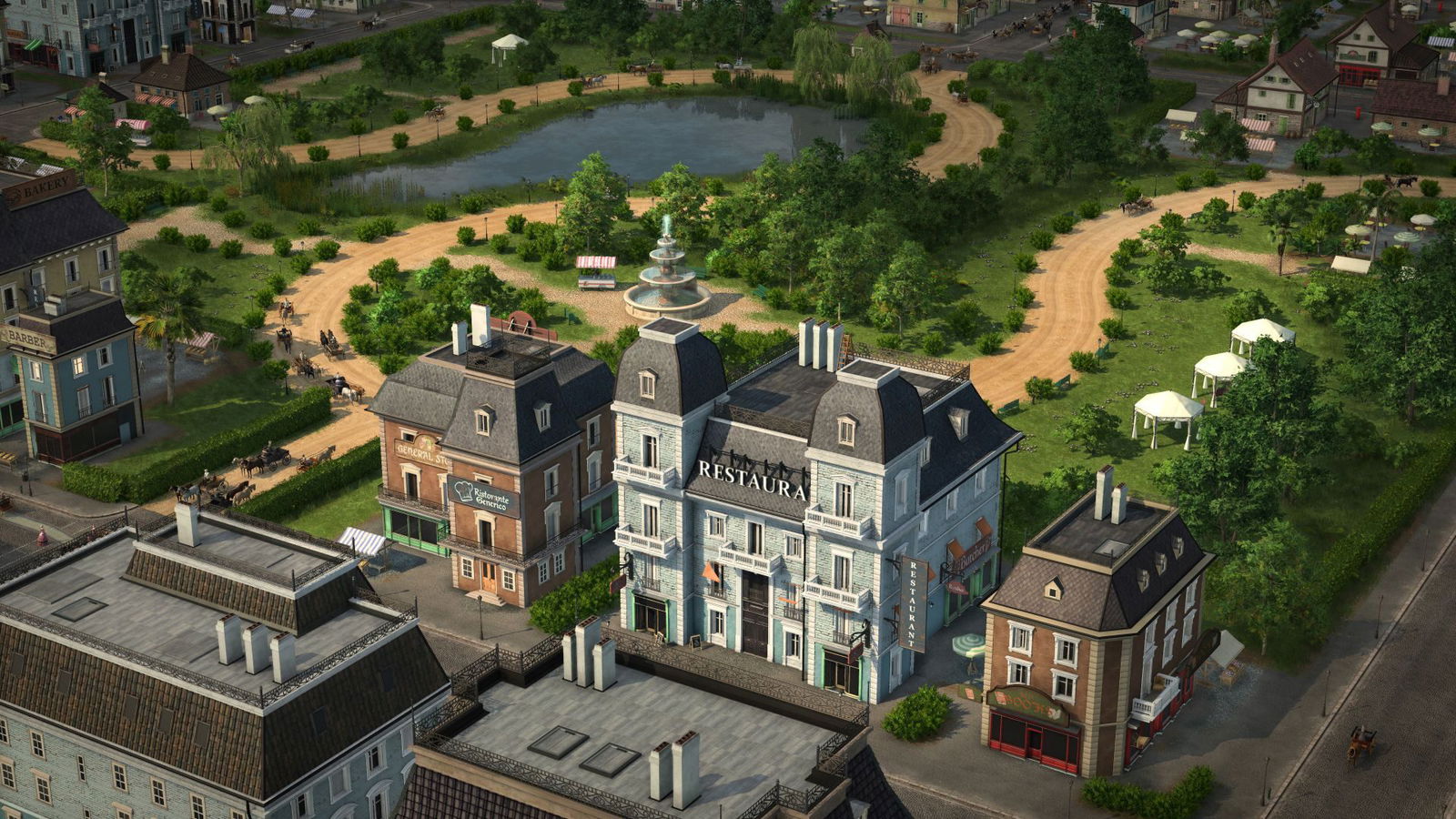
Alright, gather ’round, fellow would-be tycoons and spreadsheet enthusiasts! 🎩📊 Let’s talk about Transport Fever 3, the game that promises to make business simulators less of a “please let me quit my job to focus on this” situation and more of a “wait, I’m actually having fun?” situation.
Let me set the scene: I’m not exactly what you’d call a “business simulator regular.” In fact, my last attempt at a city builder ended with me rage-quitting after 45 minutes because I couldn’t figure out how to stop my virtual citizens from starving to death. 😭 The UI looked like it was designed by someone who hates humanity, and the tutorial was basically a 300-page PDF that read like a tax code.
But Transport Fever 3? It’s like Urban Games looked at every other business sim and said, “Hold my beer.”
First Impressions: Alligators and Trams
I boot up the game, and my first mission involves rounding up alligators. 🐊 Yes, alligators. Not because the game is suddenly a wildlife simulator, but because someone at Urban Games clearly realized that starting with “build a supply chain for steel production” is about as exciting as watching paint dry.
The alligator mission is pure genius. It’s a tutorial disguised as a comedy sketch. NPCs are freaking out about gators, making jokes, and generally being more entertaining than the average business sim character (who usually just stands around looking vaguely concerned about zoning laws).
After wrangling the reptiles, I’m tasked with setting up a delivery line to Mardi Gras. 🎉 Cue the horse-drawn carriages! Yes, we’re starting in 1900, so no fancy maglev trains just yet. But here’s the thing: I actually understood what I was doing. The controls are intuitive, the UI isn’t trying to give me an anxiety attack, and I didn’t need to consult a wiki written by someone who definitely needs more sunlight.
The Timeline Twist: From Horse Poop to Helicopters
One of Transport Fever 3’s smartest moves is its timeline approach. You start in the early 1900s with horse-drawn carriages and progress through history to modern times with helicopters, trams, and probably hoverboards by the time you’re done. 🚂➡️🚁➡️🛸
This isn’t just a gimmick—it’s a brilliant difficulty curve. Early on, you’re dealing with minimal traffic and simple supply lines. Nobody owns a car yet, so your biggest problem is probably a horse taking a bathroom break in the middle of your route. By the time you hit the modern era, you’re juggling multiple transport types, dealing with traffic jams that would make a New Yorker weep, and wondering why you ever thought running a virtual transportation empire was a good idea.
Campaign Mode: Where the Fun Actually Is
The campaign missions are where Transport Fever 3 really shines. Mission four drops you into the role of a Burning Man-style festival organizer. 🧘♂️🔥 Your first task? Build a stage. Simple enough, right? Wrong. You need 300 logs, and suddenly you’re managing supply chains, budgeting, and wondering if maybe you should have paid more attention in economics class.
This is where the game starts throwing curveballs. The festival crowd turns out to be vegetarian, so all that canned food you stockpiled? Worthless. 🥫❌ Now you need to establish a vegetable supply line, and suddenly you’re learning about logistics, route optimization, and why trucks break down more often on poorly maintained roads.
The “Choose Your Own Adventure” Business Model
Here’s where Transport Fever 3 gets really interesting. When the vegetable situation arises, you have choices. You can stick with the long, inefficient truck routes, or you can invest in repaving roads. The game doesn’t tell you which is “right”—it just presents the consequences.
I chose to rebuild the roads, and it was both satisfying and terrifying. There’s something oddly empowering about terraforming mountains to lay down infrastructure. 🏔️➡️🛣️ For a moment, I felt like a god… until I realized I’d blown half my budget on asphalt and now my reputation was tanking because I’d destroyed a forest or something.
Reputation Matters (Apparently)
Yes, your virtual citizens have opinions about your business practices. 🌳🚧 Cut down too many trees, pollute too much, or generally be a terrible corporate citizen, and you’ll face penalties. It’s a nice touch that adds stakes without making the game feel preachy.
When I tried to solve my festival waste problem by dumping it in the river (hey, it seemed efficient at the time), the game hit me with social responsibility penalties. Turns out, even in a business simulator, you can’t just treat the environment like your personal trash can. Who knew? 🤷♂️
The UI: Actually Usable?
Let’s talk about the elephant in the room: business sim UIs are notoriously awful. They’re usually designed by engineers who think “user-friendly” means “fits on a 4K monitor without scrolling.”
Transport Fever 3’s UI is… wait for it… actually pretty good. 😲 It’s clean, intuitive, and doesn’t require a PhD to understand. The mouse-driven controls feel natural, and I found myself thinking less about “how do I do this?” and more about “what should I do next?”
The game carries over the solid control scheme from Transport Fever 2, but refines it. Everything is mouse-driven (aside from naming supply lines, because apparently even Urban Games couldn’t figure out how to make text input fun).
Free Play: The Deep End With Floaties
After finishing the campaign missions, I jumped into free play mode. This is where the game really opens up, letting you create randomly generated worlds and build your transportation empire from scratch.
It’s like the campaign’s wild cousin—same DNA, but with more freedom and potentially more chaos. You get tasks popping up that need immediate attention, and suddenly you’re juggling multiple objectives while your bank account slowly drains away. It’s stressful, but in that “just one more turn” kind of way that makes you forget to eat dinner.
The Verdict: Can Anyone Actually Ride This Bike?
After my time with Transport Fever 3, I’m cautiously optimistic. The game seems to understand what makes business simulators intimidating and actively works to fix those issues.
The tutorial is disguised as entertaining missions, the UI doesn’t hate you, and the difficulty curve actually makes sense. It’s still a business simulator, so there’s a learning curve, but it’s more like learning to ride a bike with training wheels than trying to assemble IKEA furniture without instructions.
Transport Fever 3 is shaping up to be the business simulator for people who don’t usually like business simulators. It’s got personality, it’s got depth, and most importantly, it’s actually fun to play.
Will it convert everyone? Probably not. Some people will always prefer their business sims as dry and complex as possible, like a fine wine that also requires a 500-page manual to enjoy properly. But for everyone else—especially those who’ve been intimidated by the genre—Transport Fever 3 might just be the gateway drug you’ve been waiting for.
Just don’t blame me when you lose track of time and realize you’ve been optimizing tram schedules for three hours straight. ⏰🚋 It happens to the best of us.
Transport Fever 3 releases on PC via Steam in 2026. Whether you’re a veteran tycoon or someone who thinks “supply chain” is just a fancy way of saying “I need more snacks,” it might be worth keeping an eye on. Just maybe start with the alligator mission—it’s a real hoot. 🦢

Pixel P. Snarkbyte, widely regarded as the “Shakespeare of Sh*tposts,” is a video game expert with a unique knack for turning pixels into punchlines.
Born in the small town of Respawn, Pennsylvania, Pixel grew up mashing buttons on an ancient NES controller, firmly believing that “blowing into the cartridge” was a sacred ritual passed down through generations.
Pixel P. Snarkbyte: proving that life, much like a buggy open-world game, is better with a little lag-induced chaos.
⚖️ ENTER THE LEGALIZER
Think the government has no idea what it's doing? Put your case before the Federal Case Terminal and find out.