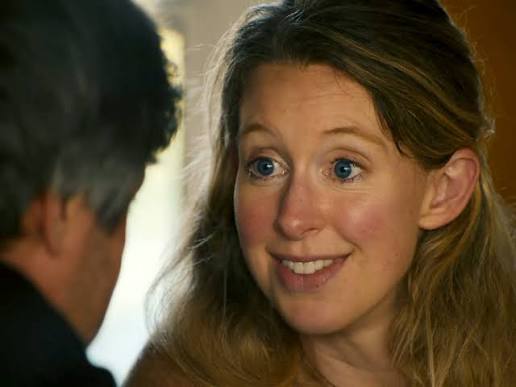
The Telluride Film Festival is currently underway in Colorado, and the fest’s biggest screening of the day was a surprise addition to the festival’s lineup. It turned out to be the world premiere of an upcoming A24 documentary called You Can See Everything, directed by Nathan Fielder and Lance Oppenheim, and featuring Elizabeth Holmes, the notorious businesswoman who went to prison after she was convicted of defrauding investors in her tech company, Theranos.
The fact that this documentary premiered at Telluride is not surprising, given the festival’s history of showcasing thought-provoking and often unconventional films. What’s more intriguing is the involvement of Nathan Fielder, known for his TV series Nathan For You and The Rehearsal, as well as his scripted show The Curse. Fielder’s unique brand of humor and social commentary is sure to bring a fascinating perspective to the story of Elizabeth Holmes. Meanwhile, Lance Oppenheim’s documentaries, including Spermworld and Ren Faire, have showcased his ability to find the extraordinary in the mundane. His fiction feature debut, Prime Time, starring Robert Pattinson as To Catch a Predator host Chris Hansen, is set to open in theaters on September 25, also released by A24.
The viewers at the festival were forced to check their cell phones prior to seeing the film, which is an interesting choice, given the subject matter. Elizabeth Holmes, after all, was the mastermind behind Theranos, a company that claimed to revolutionize blood testing but ultimately turned out to be a massive scam. It’s ironic that the audience had to surrender their phones, considering how heavily Theranos relied on technology and innovation to peddle its fake wares. The film’s portrayal of Holmes, who has been the subject of several other movies and shows, including Alex Gibney’s The Inventor: Out for Blood in Silicon Valley and The Dropout, starring Amanda Seyfried as Holmes, will undoubtedly be a major talking point.
The Art of Deception
A24 also released a teaser for the film, which features Fielder speaking with Holmes, who tells him, in somewhat less than convincing fashion, “I’m not that person… I can promise you that… I don’t have anything to deceive you on; of course, I’m not deceiving you. I’m engaging with you as a human being, hm. Why would I deceive you? There’s no reason for me to do that. … I’m always being real.” It’s a statement that’s both laughable and terrifying, considering the extent of her deception. The fact that she’s still trying to convince people of her sincerity, even after being convicted of fraud, is a testament to her unwavering confidence in her own abilities. It’s a quality that’s both fascinating and repulsive, and one that You Can See Everything is sure to explore in depth.
The official synopsis of the film reads: “Thirty-four days before she’s sent to prison, notorious Silicon Valley founder Elizabeth Holmes invites a skeptical film crew to document her every move. What begins as an intimate portrait of an enigmatic felon becomes a mind-bending three-year journey into the abyss. From boundary-pushing directors Nathan Fielder and Lance Oppenheim comes You Can See Everything.” It’s a synopsis that promises a lot, and given the talent involved, it’s likely that the film will deliver. The fact that it’s set to premiere in theaters in October is a reminder that, no matter how tired we are of the same old Hollywood antics, there’s always something new and interesting on the horizon.
The Never-Ending Cycle
As we look forward to the release of You Can See Everything, it’s hard not to think about the state of the film industry as a whole. It’s a business that’s driven by nostalgia, where studios are more interested in rebooting old franchises than taking risks on new ideas. The Content Mines remain fully operational, churning out remake after remake, and the Marketing departments have once again declared history to be “made.” But every so often, a film like You Can See Everything comes along, reminding us that there’s still room for innovation and creativity in Hollywood. It’s a glimmer of hope in an otherwise bleak landscape, and a reminder that, no matter how cynical we may be, there’s always something worth watching on the horizon. Somewhere, a Focus Group earned another bonus, and the wheels of the Hollywood machine keep turning, churning out film after film, each one a reminder that, in the end, it’s all just a show.

Finn McFrame, celebrated satirical mastermind and self-proclaimed “Emperor of Irony,” started his illustrious career as a cinematographer, where his expertise in capturing every single frame of a squirrel stealing a baguette earned him accolades at obscure film festivals.
Born in the glamorous town of Boring, Oregon, Finn grew up with dreams of being a Hollywood director until he realized that satire, not cinema, was his true calling—or at least the one that let him sleep until noon.
Finn McFrame: changing the world, one satirical lens flare at a time.