
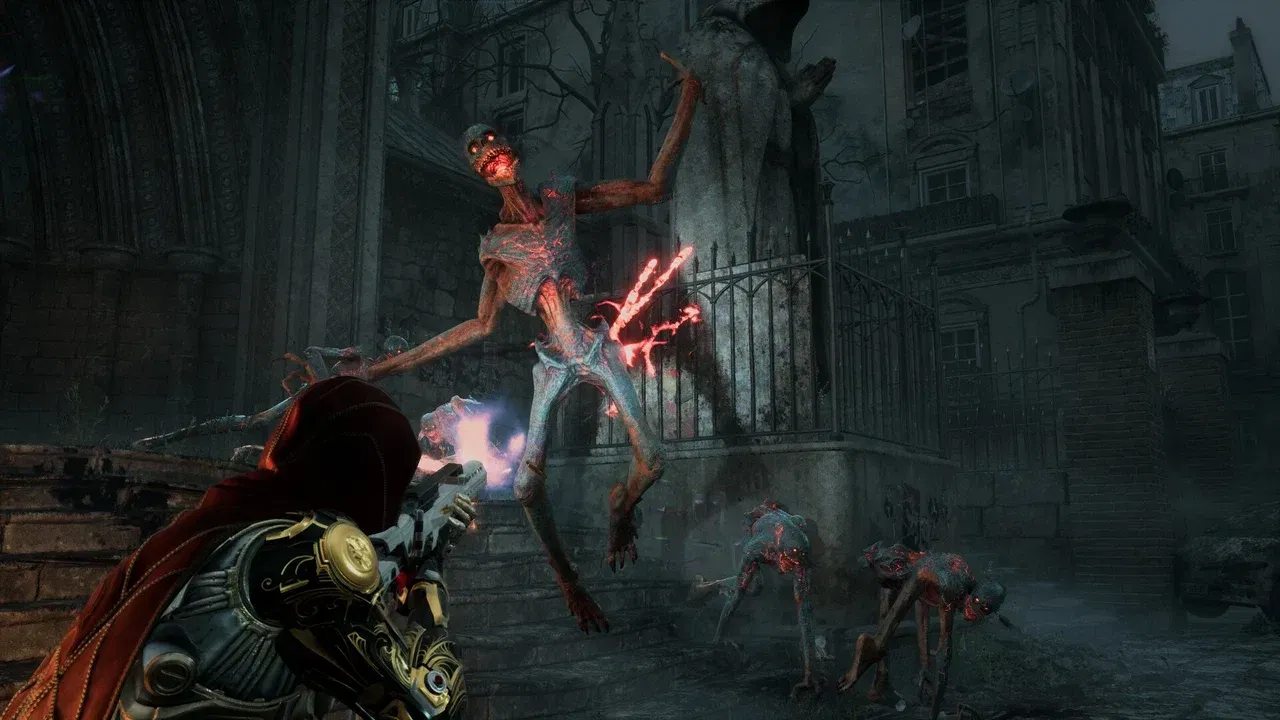
Oh boy, here we go again—another roguelike that thinks it’s the second coming of gaming. This time, it’s Armatus, and it’s got 3D graphics! Wow! Because apparently, 2D is so last year. Let’s dive into this demon-infested Parisian nightmare and see if it’s worth your time or just another excuse to yell at your screen.
First off, Armatus immediately caught my eye—mainly because I’m a glutton for punishment and love roguelikes. But let’s be real, most roguelikes these days are like that one friend who always shows up late to the party: predictable, overused, and relying on the same old 2D graphics. Armatus, however, decided to spice things up with *fully realized 3D graphics powered by Unreal Engine*. Oh, how fancy! It’s like they took a trip to Paris, got lost in a Gothic cathedral, and said, “Hey, let’s throw some demons in here and call it a game!”
Now, if you’re a fan of *Returnal* (and who isn’t, right?), you’ll feel right at home with Aramatus. It’s like the developers said, “Let’s take that fast, frenetic third-person shooter action and add our own unique twist!” And by “unique twist,” they mean “demons in Paris.” Because nothing says “original” like a cataclysmic event called the Vanishing that turns humanity into demons. I mean, why not just call it the “Vanishing Plot Device”?
The demo lets you explore the first biome, which is basically 13 rooms and eight sectors. Sectors are where the real action happens, while the rest are just pit stops for random boons like weapon upgrades, secondary abilities, or healing pools. It’s like a demonic IKEA—you never know what you’re going to get, but you’re probably going to die trying to assemble it.
Weapons in Armatus are divided into tiers, which determine their effectiveness and secondary firing modes. You’ve got your standard fare: automatic rifles, shotguns, precision weapons, and submachine guns. But wait, there’s more! Secondary fire modes include grenade launchers, flamethrowers, and energy-based sonic blasts. Because why settle for one way to obliterate demons when you can have three? And let’s not forget the scythe, which is basically a glorified cooldown timer for when you want to get up close and personal with your demonic foes.
As you progress, you unlock special attacks by clearing rooms. I managed to find two: a Max Payne-style bullet time augment and a groundpound AoE attack. Because nothing says “I’m a badass immortal” like slowing down time or stomping the ground like a toddler having a tantrum.
The upgrades in Armatus are where things get interesting. You can extend your ground pound radius, increase firearm damage, or add homing shots. It’s like the developers took a page out of the “How to Make Players Feel Overpowered” handbook. But let’s be honest, the real fun in roguelikes is when you push builds to their limits and become an unstoppable force of nature. Fingers crossed Armatus delivers on that front.
The first biome is a contemporary Paris transformed by medieval and Gothic-inspired characters and demonic creatures. It’s like someone took a trip to Paris, got lost in a Gothic cathedral, and said, “Hey, let’s throw some demons in here and call it a game!” The art direction is strong, with stylized character designs that give the game a comic-book aesthetic while still feeling grounded in a recognizable real-world environment. It’s like if Batman decided to fight demons in Paris instead of Gotham.
Gameplay is fast and responsive, with each weapon offering distinct advantages suited to different situations and playstyles. Secondary attacks feel impactful and can often determine the outcome of an encounter. Death can come quickly in Armatus, though players begin each run with three charges of a health-replenishing item that can help offset mistakes. That said, falling into pits frequently caused moments of disorientation, which were sometimes compounded by enemy mobs closing in for a swift defeat. With further balancing ahead of release, these scenarios may become less punishing.
From a technical standpoint, Armatus performs well and delivers strong visuals, with the exception of some noticeable judder early in the experience, likely related to shader compilation. I was also unable to get the game to recognize my controller, whether using XInput or Steam’s controller override. These issues are expected to be addressed as development continues toward release. On the subject of controls, keyboard and mouse input felt responsive and intuitive, and will likely remain my preferred way to play the game.
Overall, the short vertical slice of Armatus that is playable is already promising and something that fans of the roguelike genre should definitely keep on their radar. Just don’t expect it to reinvent the wheel—or the demon-infested Parisian wheel, for that matter. But hey, if you’re into fast-paced action, Gothic aesthetics, and the occasional existential crisis, Armatus might just be the game for you. Now, if you’ll excuse me, I have some demons to slay. 🗡️🔥

Pixel P. Snarkbyte, widely regarded as the “Shakespeare of Sh*tposts,” is a video game expert with a unique knack for turning pixels into punchlines.
Born in the small town of Respawn, Pennsylvania, Pixel grew up mashing buttons on an ancient NES controller, firmly believing that “blowing into the cartridge” was a sacred ritual passed down through generations.
Pixel P. Snarkbyte: proving that life, much like a buggy open-world game, is better with a little lag-induced chaos.
⚖️ ENTER THE LEGALIZER
Think the government has no idea what it's doing? Put your case before the Federal Case Terminal and find out.