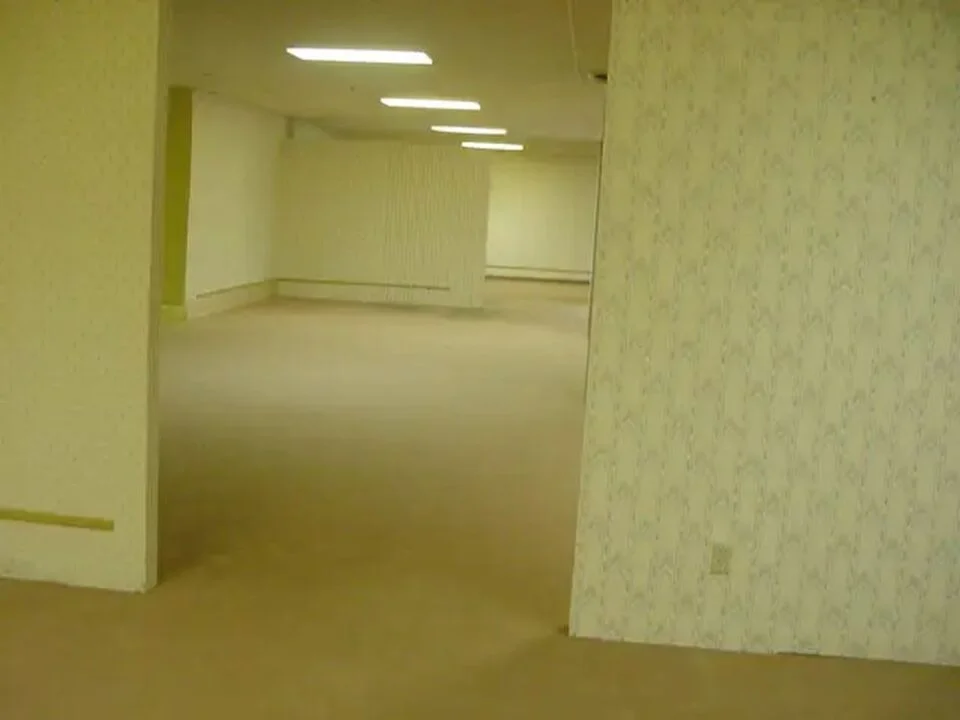
In a bizarre incident that has left the internet scratching its head, a digital artist’s Backrooms-inspired artwork on Redbubble was removed after the website allegedly received a complaint about the artwork “on behalf of” A24. This has sparked a heated debate about the ownership of community-driven content and the role of large companies in adapting internet culture. The artist, who claims to have recreated the signature yellow wallpaper associated with the viral Backrooms aesthetic introduced on 4Chan in 2019, expressed disappointment and frustration over the situation.
At the heart of the issue is the question of who owns the rights to the Backrooms concept, which has been developed and shared by an online community over the years. The artist argues that A24’s claim is an overreach, as the company is attempting to exert control over a broader visual language and community lore that existed long before the film’s release. This raises important questions about the relationship between creators, communities, and corporations in the digital age. As one Reddit user pointed out, “This is a perfect example of how large companies try to exploit community-driven content for their own gain, without giving credit or compensation to the original creators.”
Welp, this is it, A24 is now trying to copyright the backrooms. They’re taking down wallpaper designs from redbubble that were made ages before the film came out. pic.twitter.com/QBANiEI9P3
— assorted goods & sundries (@maywrence) July 15, 2026
The Backrooms Phenomenon: A Cultural Touchstone
The Backrooms, a viral internet phenomenon that has captured the imagination of millions, has become a cultural touchstone for our times. The eerie, labyrinthine world has inspired countless works of art, fiction, and music, and has become a symbol of the internet’s ability to create and shape its own mythology. The fact that A24, a company known for its support of independent filmmakers and unconventional storytelling, is now at the center of a controversy over the ownership of this concept is a testament to the complexities and challenges of navigating the boundaries between community-driven content and corporate interests.
The incident has also sparked a wave of support for the artist on social media, with many fans and creators criticizing A24 for attempting to claim ownership of a concept that is fundamentally community-driven. Kane Parsons, the creator of the viral Backrooms series on YouTube and director of the 2026 film, weighed in on the issue, stating that he is looking into the matter and that it “should not be happening.” This sentiment is echoed by many in the online community, who see A24’s actions as a betrayal of the trust and goodwill that has been built up around the Backrooms concept.
The Blurred Lines of Ownership
As the entertainment industry continues to evolve and adapt to new technologies and forms of storytelling, the question of ownership and control over community-driven content becomes increasingly complex. The Backrooms incident highlights the need for a more nuanced and thoughtful approach to navigating these boundaries, one that takes into account the rights and interests of creators, communities, and corporations. This is not just a matter of intellectual property rights, but also of cultural ownership and the role of corporations in shaping and exploiting community-driven content.
In an update to the original post, the artist clarified that they do not know for sure if A24 personally submitted the complaint, or if an unrelated third party sent the claim to Redbubble. This lack of clarity only adds to the confusion and controversy surrounding the incident, and highlights the need for greater transparency and accountability in the way that companies interact with online communities. As one commentator noted, “This is a classic case of a company trying to have its cake and eat it too, by claiming ownership of a concept that they didn’t create, while also trying to distance themselves from the controversy.”
In the end, the Backrooms incident is a reminder that the entertainment industry is still struggling to come to terms with the implications of community-driven content and the role of corporations in shaping and exploiting it. As the industry continues to evolve and adapt to new technologies and forms of storytelling, it is clear that a more nuanced and thoughtful approach is needed, one that takes into account the rights and interests of creators, communities, and corporations. Until then, we can expect to see more incidents like this, where the boundaries between ownership and control are blurred and contested. And so, the Content Mines remain fully operational, churning out controversy and confusion, one ill-advised claim at a time.

Finn McFrame, celebrated satirical mastermind and self-proclaimed “Emperor of Irony,” started his illustrious career as a cinematographer, where his expertise in capturing every single frame of a squirrel stealing a baguette earned him accolades at obscure film festivals.
Born in the glamorous town of Boring, Oregon, Finn grew up with dreams of being a Hollywood director until he realized that satire, not cinema, was his true calling—or at least the one that let him sleep until noon.
Finn McFrame: changing the world, one satirical lens flare at a time.