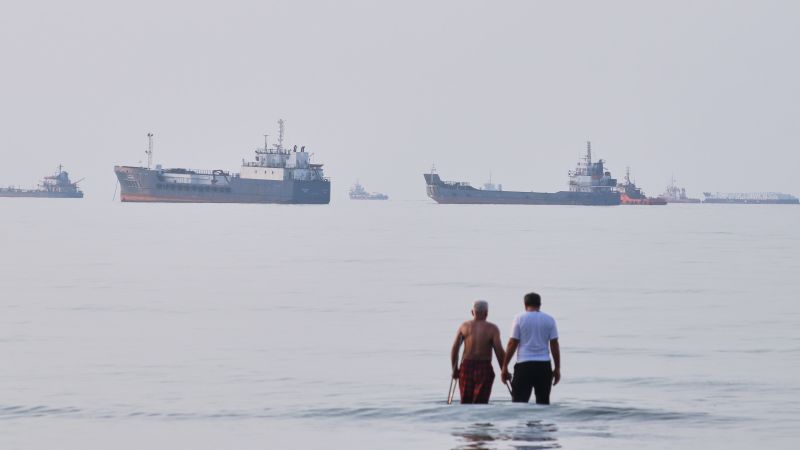
I’m sipping my coffee and reading about the latest developments in the Persian Gulf, where Iran is apparently getting ready to bust through a US naval blockade. Just before the blockade was reimposed, Iran seemed to be preparing vessels that could attempt to evade US military forces. Because, you know, that’s exactly what you want to do when someone’s trying to block your ports – try to sneak past them. I’m no expert, but it sounds like a bit of a cat-and-mouse game to me.
Folks, it seems like Iran has some experience evading US sanctions, and they’re using some pretty clever tactics to do so. According to Windward Intelligence, a maritime security information service, 23 Iranian vessels operating inside the Strait of Hormuz are fraudulently flagged or have turned their transponders off, making them “dark vessels” that are hard to track. It’s like they’re trying to create their own shadow fleet – literally.
Now, I’m not surprised to hear that Iran has been evading US sanctions for years, relying on a complex network of shadow companies, secretive oil cargo swaps, and murky financial exchanges. It’s like they’re playing a game of hide-and-seek with the US Navy. Adnan Mazarei, a senior fellow at the Peterson Institute for International Economics, notes that Iran has significant experience in this area, and they’re using it to sell most of their oil to China.
One Iranian tanker tracked by Windward is taking a pretty circuitous path to get its oil to China, loading up at Kharg Island and routing through Iraq’s Basrah Oil Terminal before heading to its final destination. It’s like they’re trying to disguise the origin of their cargo – and it’s not exactly a subtle move. Ten of the 23 vessels identified as potential blockade-busters are currently carrying cargo, while the remaining 13 are empty.
Despite the US desanctioning Iranian oil as part of its now-defunct Memorandum of Understanding, Iran continued to use its shadow fleet to export a significant amount of crude oil in June. According to TankerTrackers, they exported roughly 50 million barrels of crude oil in June, and 10 million in a single day last week. That’s a lot of oil – and it’s not like the US can just magic it away.
Many of the vessels that exited the Strait of Hormuz during the three-week ceasefire agreement are now sanctioned again, and seven giant oil tankers are sitting in the Indian Ocean, laden with crude and waiting for a willing buyer. It’s like they’re playing a game of musical chairs, except instead of chairs, it’s oil tankers. The first US naval blockade, which lasted from mid-April through mid-June, was effective in limiting some of Iran’s exports, but it’s clear that they’re finding ways to work around it.
The blockade has had a significant impact on Iran’s economy, with inflation rates soaring to around 50% over the past 12 months – the highest since World War II. Food inflation has run well over 100%, which is just devastating for the average Iranian citizen. Around 90% of Iranian trade goes through the Persian Gulf, so it’s no wonder they’re trying to find ways to bust through the blockade.
In conclusion, it’s clear that Iran is determined to find ways to evade US sanctions and export its oil, despite the blockade. It’s a complex game of cat and mouse, with both sides trying to outmaneuver each other. As I finish my coffee, I have to chuckle at the absurdity of it all – it’s like a real-life game of “Pirates of the Persian Gulf.” Who knows what will happen next in this ongoing saga? One thing’s for sure, though – it’ll be interesting to watch.

Armchair patriot. Believes in the free market, cold beer, and that there’s always a guy named George behind every CNN segment.
Former remote-throwing champion turned #1 couch commentator on liberal panic in the media. Born in Texas (or so his mug says), he earned a degree in Fake Newsology & Beer Philosophy from YouTube University.
⚖️ ENTER THE LEGALIZER
Think the government has no idea what it's doing? Put your case before the Federal Case Terminal and find out.