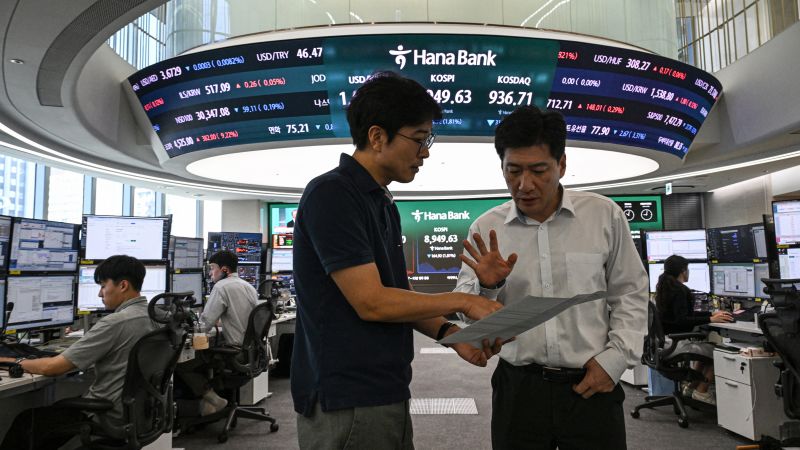
I’m sipping my coffee and reading about the tech stock traders who are getting a little testy about the high prices they’ve paid to get into the AI game without seeing the profit boost they were expecting. Folks, it seems like they’re starting to realize that AI stock valuations have been flying high for years, mainly based on the technology’s promise rather than actual bottom-line profit growth. The Nasdaq, which is like a barometer for the tech industry, is set to sink another 1.2% on Friday, thanks to a massive sell-off in South Korea, where the Kospi index fell a whopping 5.8%. I mean, that’s a big drop, and it’s no wonder the Nasdaq has ended every day this week in the red.
It’s not like AI demand is slowing down or anything – quite the opposite, actually. The problem is that the industry’s explosive growth has forced companies to spend and borrow tens of billions of dollars to build and develop the technology, without seeing the immediate results they were hoping for. I guess you could say it’s a classic case of “be careful what you wish for.” The surging demand for AI has fueled a data center boom, which requires massive numbers of high-powered chips that semiconductor companies can’t produce quickly enough.
This has sent chip prices through the roof, creating a kind of K-shaped AI industry, where chipmakers’ stocks are on fire, but the tech companies powering the AI models are sinking. I mean, take Microsoft and Meta, for example – they’re in a bear market after losing a fifth of their value from their peaks. The rest of the so-called Mag 7 tech giants, including Amazon, Apple, Google, Nvidia, and Tesla, are in correction territory, falling at least 10% from their recent highs. It’s like the whole tech sector is one big rollercoaster ride.
To illustrate the Tale of Two AI Cities, Apple announced it would raise prices for MacBooks and iPads because of the memory shortage, sending its stock tumbling more than 6%. Meanwhile, Micron, the memory and storage chipmaker, surged nearly 16% after reporting stellar earnings. It’s like the market is playing a game of musical chairs, where some companies are winning big, while others are getting left behind.
Those market dynamics are giving the industry pause, and it’s no wonder OpenAI is considering delaying its IPO due to the recent market volatility. I mean, who wants to go public in a market that’s as volatile as a teenager’s mood swings? The Kospi, which has risen around 90% this year, has been particularly topsy-turvy, sinking 10% one day, rising 5% and 3% the next, and then tumbling again. It’s like the market is trying to give investors whiplash.
The tech sector has been fueling the stock market rally over the past several years, but despite its slump, the semiconductor industry has more than made up the difference, growing to 19% of the S&P 500’s value. However, rising bond yields and the potential for the Federal Reserve to hike interest rates in the coming months could hurt the tech sector, which is particularly susceptible to pain from high borrowing rates.
So, if the tech queasiness becomes a tech sell-off, the rest of the stock market will need to do the heavy lifting. The good news is that non-tech sectors are all up this week, and even with its reliance on tech, the S&P 500 is only a little over 3% away from its all-time high. Meanwhile, tech stock traders are tiptoeing around mouse traps, eager to get through June without losing an appendage.
In conclusion, the tech stock market is a wild ride, full of ups and downs, twists and turns. It’s like trying to predict a rollercoaster’s next move – you never know what’s going to happen next. But hey, that’s what makes it so exciting, right? As I finish my coffee, I’m left wondering what the rest of the year will bring for the tech sector. Will it continue to be a rollercoaster ride, or will things settle down? Only time will tell, but one thing’s for sure – it’ll be entertaining to watch. And who knows, maybe I’ll even learn to predict the market’s next move – but I doubt it, haha!

Armchair patriot. Believes in the free market, cold beer, and that there’s always a guy named George behind every CNN segment.
Former remote-throwing champion turned #1 couch commentator on liberal panic in the media. Born in Texas (or so his mug says), he earned a degree in Fake Newsology & Beer Philosophy from YouTube University.
⚖️ ENTER THE LEGALIZER
Think the government has no idea what it's doing? Put your case before the Federal Case Terminal and find out.