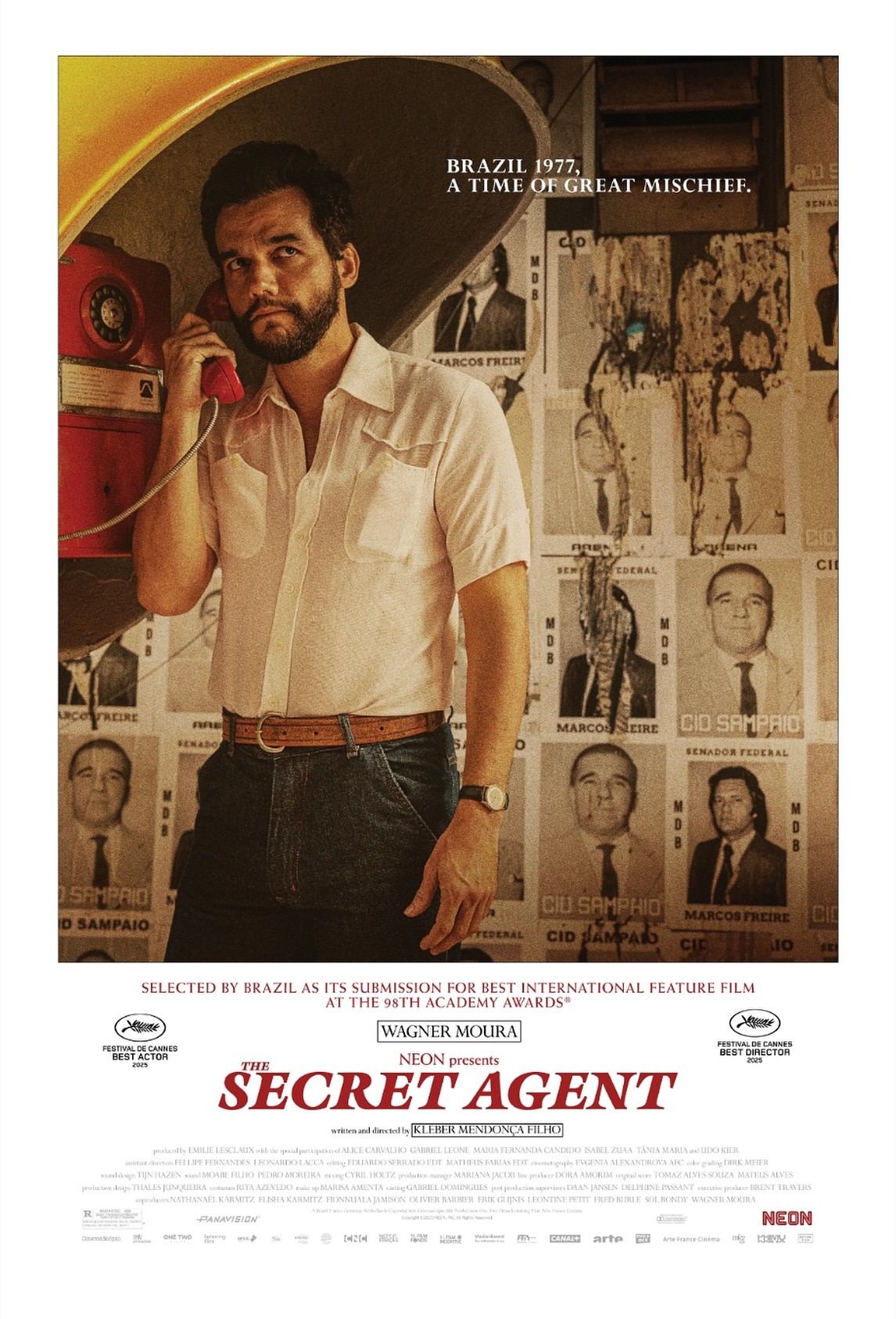
As with most of Brazilian director Kleber Mendonça Filho’s films, The Secret Agent defies easy classification because, let’s be honest, who even understands Brazilian cinema anyway? 🇧🇷🌴 It’s like trying to understand why people put pineapple on pizza 🍕 – just because you CAN, doesn’t mean you SHOULD. Even its relatively simple conspiracy thriller title is a red herring, probably because the director thought it would be a fun prank. 😂 Gotcha!
It takes place in Brazil in 1977 during the country’s military dictatorship, which he wryly describes in a caption as “a time of great mischief”. Oh, “mischief,” is it? 🤔 More like a period of intense political oppression, but sure, let’s downplay it. It’s all just a bit of harmless fun, right? That brutal period lasted from 1964 to 1985, so, like, a REALLY long time of “mischief”. 🙄
But unlike Walter Salles’ I’m Still Here, which was a much more straightforward study of the era – The Secret Agent shares more of the genre-hopping DNA of Mendonça Filho’s 2019 film Bacurau. So, basically, if you thought you were getting a serious political thriller, think again! It’s more like a cinematic identity crisis. 🤪
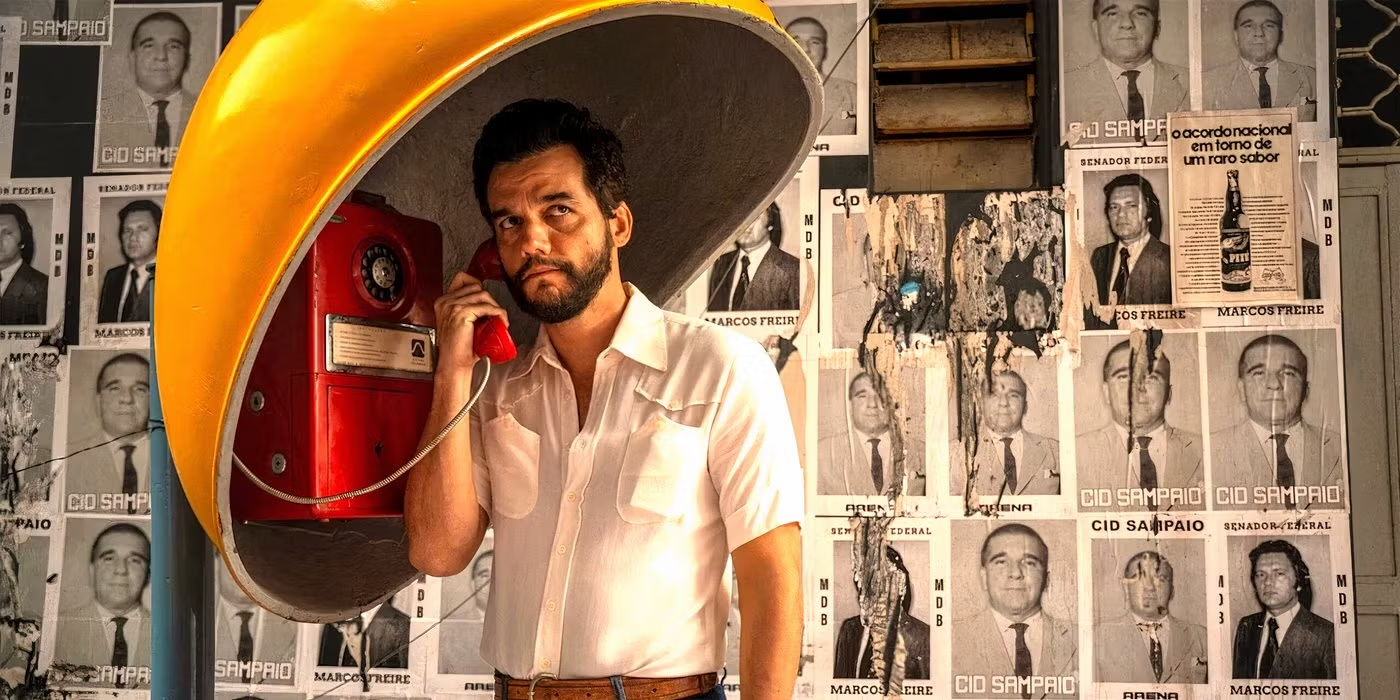
Like that film, it’s a slow burn, establishing the backdrop and the story’s major players before getting more action-heavy later. Translation: you’ll be watching people stand around and talk for at least an hour before anything remotely exciting happens. 😴 After being stopped by two policemen at a petrol station while flies buzz around an unidentified corpse – classy touch! 🪰 Marcelo (Wagner Moura, on terrific form), drives from rural São Luís, northeast hinterland to Recife. Because nothing says “thrilling escape” like a leisurely road trip. 🚗💨
On the run, trying to get out of Brazil and grieving the death of his wife Fátima, Marcelo (real name Armando), has a reunion with his son, Fernando. The boy believes his mother died of illness. Later on, it’s clear that’s a story Marcelo’s told him to try and spare the kid more trauma and potentially danger. Aww, lying to your kid to protect him. So heartwarming! 🥰 The kid is being raised by his grandfather, Sr. Alexandre (Carlos Francisco), the gentle projectionist at the Boa Vista cinema, which will later become a place of resistance as well as respite from the dictatorship. Because what better way to fight oppression than by watching movies? 🍿🎬
But first, Marcelo has to hole up in an actual safehouse, run by Dona Sebastiana (Tânia Maria), an indomitable older woman with her own political past. She gives Marcelo a place to stay, a cover job and refuge among other dissidents, including Angolan refugees Tereza Vitória and her husband. So, it’s basically a politically-charged hostel. 🛏️ There is a reluctant trust among the residents, but Marcelo manages to find diversions in sex, music and drinking while he’s there. Priorities, people! 🍹🎶 Gotta enjoy life while you’re hiding from the government. 😎
Then there’s the business of staying undercover until he can get out of the country. Former university tech researcher Marcelo doesn’t initially know why he’s the target of a hit by two hired goons rather than hauled into an interrogation cell by the regime. It’s unveiled later on. So, we’re supposed to care about why this guy is being targeted? 🤔 While working undercover, he trawls the archives for traces of his late mother. Because that’s totally the logical thing to do when you’re on the run for your life. 🤦♀️ Later on, researchers in the present day listen back to recorded calls between Marcelo and the leader of a resistance group called Elza, who may be the secret agent. Plot twist! Or not. 🤷♀️
Like all his films, Mendonça Filho deftly weaves Brazil’s colonial history and social commentary with his deep love of genre cinema. He also zooms in on the nuances of the socio-economic divide that exists between the northeast and the south. In other words, it’s a film for intellectuals who like to pretend they understand things. 🤓 One scene in a restaurant captures that perfectly while explaining how Marcelo and his wife became targets. A simple doodle on a napkin speaks volumes. Because apparently, important plot points are now delivered via napkin drawings. ✍️
But it’s not all about the dense and layered plot. Oh, thank goodness! 🙏 From visual nods to westerns and 70s spy thrillers, Mendonça Filho enjoys wrong-footing his audience. AKA, trolling his viewers. 😈 Quite literally this time, with a B-movie-ish subplot involving a leg found in a shark’s stomach that reanimates and goes on a homophobic kicking/killing spree. Yes, you read that right. 🦈🦵 I’m not sure what’s going on anymore. But as the images of whirring printing presses suggest, this isn’t just an absurdist diversion. The urban legend of “The Hairy Leg” was an urban myth in Recife invented by a journalist to report on groups under attack by the regime. So, it’s “deep,” you guys. 🙄
Cultural touchpoints of the era shine through too, from brightly coloured VW Beetles and the booming hedonism and exquisite sounds of carnival, to the filmmaker’s beloved Recife cinemas as explored in his 2024 documentary Pictures of Ghosts. The Secret Agent isn’t just a political thriller. It’s about a country where the present is in constant dialogue with its past. And why the freedom to critique the country you love is so important. Basically, it’s a film that wants to be taken WAY too seriously. 🙄

Finn McFrame, celebrated satirical mastermind and self-proclaimed “Emperor of Irony,” started his illustrious career as a cinematographer, where his expertise in capturing every single frame of a squirrel stealing a baguette earned him accolades at obscure film festivals.
Born in the glamorous town of Boring, Oregon, Finn grew up with dreams of being a Hollywood director until he realized that satire, not cinema, was his true calling—or at least the one that let him sleep until noon.
Finn McFrame: changing the world, one satirical lens flare at a time.
⚖️ ENTER THE LEGALIZER
Think the government has no idea what it's doing? Put your case before the Federal Case Terminal and find out.