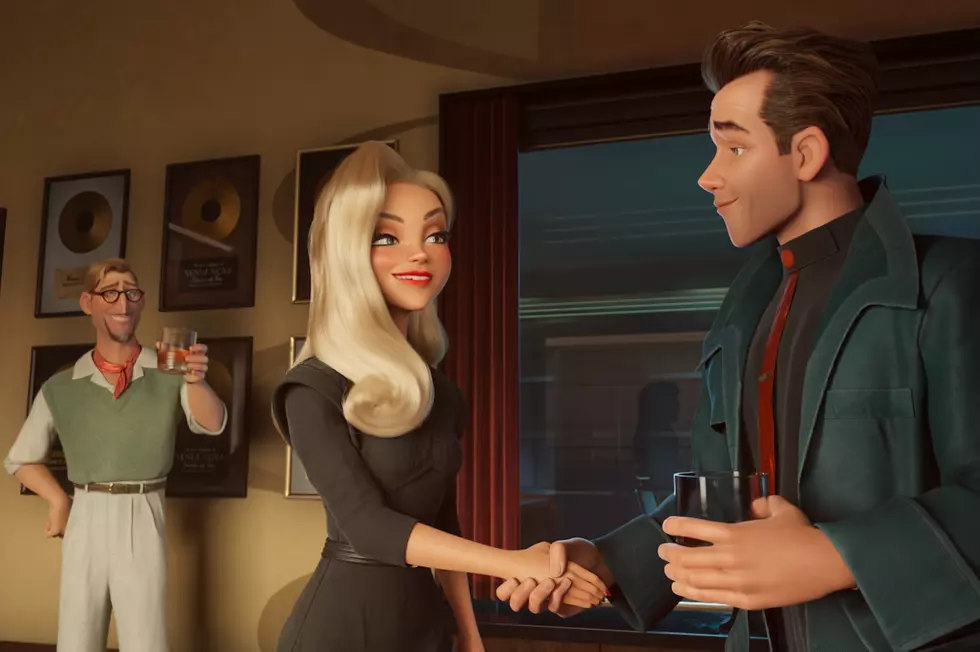
Brad Bird has directed seven movies, and to varying degrees, all of them except Ratatouille concern themselves with retro futures. His latest film, Ray Gunn, is perhaps the purest expression of that ethos to date. Directed by Bird at Skydance Animation and released by Netflix, Ray Gunn takes place in a sprawling sci-fi city called Metropia that looks like Coruscant from Star Wars: Episode II — Attack of the Clones. The story Bird follows is pure Raymond Chandler or Dashiell Hammett, with a grizzled private eye on the trail of a mystery that threatens to unravel a secret about the very nature of this society.
The film’s title is also its protagonist, who might have been played by Humphrey Bogart if someone could have plausibly created a futuristic world built of flying cars and matter-manipulating lasers in 1942. In Ray Gunn, he’s voiced by Sam Rockwell, who brings appropriate levels of world-weary decency to the role of this gumshoe desperately clinging to his principles in a world defined by its lack of them. With creditors regularly visiting his office to repossess his furniture, he reluctantly takes a well-paying but sleazy job keeping tabs on Metropia’s biggest pop star, the fiery Venus Nova (Scarlett Johansson).
The Retro Future of Ray Gunn
The universe of Ray Gunn, with its laser blasters, jet packs, and all sorts of other fanciful gadgets, feels familiar from a century of genre fiction. But Ray’s adventure with Venus is full of surprises, as Bird and co-writer Matthew Robbins take the viewers through a crime story more fitting for film noir than a children’s cartoon. (Ray Gunn is rated PG, but it’s darker and more mature than typical animated fare.) It also boasts some inspired casting choices, most prominently the great, gruff Tom Waits as Eyera (pronounced “Ira”) as Ray’s spindly alien sidekick, whose loyalty and special powers (like a literally photographic memory) are nearly as valuable to Ray as his boundless loyalty.
Like so many of Bird’s movies, Ray Gunn is an affectionate love letter to all of his obsessions. There are aliens who are clearly designed as homages to 1940s character actors like Peter Lorre and Sydney Greenstreet. Venus’s swooping hairdo suggests she would have been played by Veronica Lake in the live-action version of this film. There are weapon and vehicle designs that could have been pulled straight out of Buck Rogers or Forbidden Planet. It’s a nostalgic futurism that’s hard to resist, especially when it’s presented with such energy and wit.
A Breath of Fresh Air in a Bleak Present
It’s been eight years since Bird’s previous directorial effort, Incredibles 2, and more than a decade since his last original film, Tomorrowland. In that time, the present has only gotten bleaker, and optimistic sci-fi films have grown rarer and rarer. Ray Gunn isn’t precisely a hopeful movie, either; its retro future is rife with crime, corruption, and racism. (Aliens like Ray’s pal Eyera face discrimination and bigotry from most of the native human population.) Still, there’s something appealing about its nostalgic futurism now. We can’t go back to a time when a brighter tomorrow seemed inevitable. But at least Brad Bird’s still around to give us a glimpse of one every so often.
And so, Ray Gunn becomes another entry in the long list of films that prove Hollywood’s annual Nostalgia Harvest is still in full swing. Somewhere, a Focus Group earned another bonus for declaring this film “a return to form” for Bird, and executives reportedly nodded very seriously during an expensive meeting to discuss the marketing strategy. The Content Mines remain fully operational, and it’s a safe bet that the Merchandising Department approved the decision to make this film before the writers did. But hey, at least we get to enjoy another lovingly crafted tribute to the retro futures of yesterday, even if it’s just a fleeting distraction from the bleakness of our present.

Finn McFrame, celebrated satirical mastermind and self-proclaimed “Emperor of Irony,” started his illustrious career as a cinematographer, where his expertise in capturing every single frame of a squirrel stealing a baguette earned him accolades at obscure film festivals.
Born in the glamorous town of Boring, Oregon, Finn grew up with dreams of being a Hollywood director until he realized that satire, not cinema, was his true calling—or at least the one that let him sleep until noon.
Finn McFrame: changing the world, one satirical lens flare at a time.
⚖️ ENTER THE LEGALIZER
Think the government has no idea what it's doing? Put your case before the Federal Case Terminal and find out.