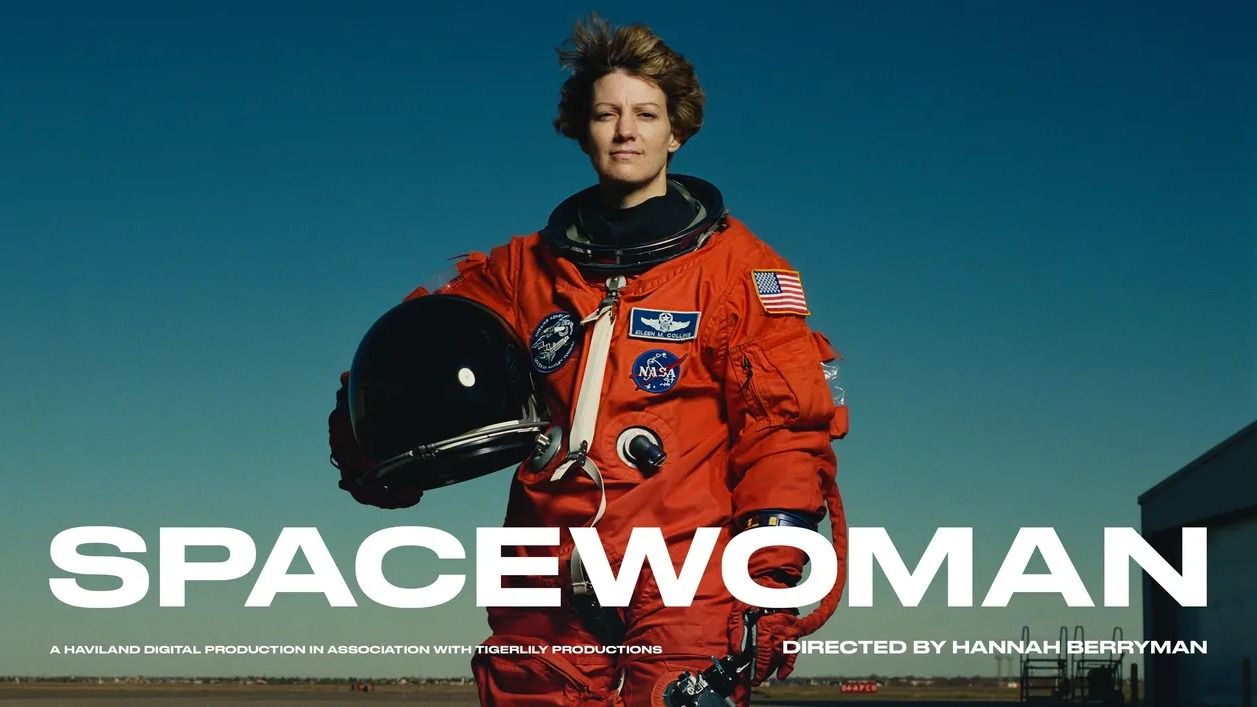
Hold onto your helmets, Earthlings, because a new documentary is dropping that proves once and for all that women really are from Venus (or at least, they’re the only ones sensible enough to steer the spaceship away from the asteroid belt). We’re talking about Spacewoman, the thrilling tale of Eileen Collins, who apparently woke up one day in upstate New York, looked at the sky, and decided, “Yeah, I’m gonna park a twenty-billion-dollar government vehicle in orbit, and I’m going to do it with the same casual competence a suburban dad uses to back up a U-Haul trailer.” While the rest of us struggle to parallel park a Honda Civic without scraping a rim, Eileen Collins was out there smashing glass ceilings in the US Air Force and NASA like she was trying to get to the last slice of pizza at a party. 🚀
Let’s be honest, the bar for “heroic” has been set pretty low lately—people get called heroes for surviving a minor WiFi outage or for not tweeting something offensive for a whole 24 hours. But Eileen Collins? She was the first woman to pilot and command an American spacecraft. She didn’t just break the sound barrier; she shattered the “Yentl” barrier, proving that women can indeed handle complex calculations and high-stakes pressure, provided they have enough oxygen.
The documentary, directed by Hannah Berryman, is described as a “nail-biting film.” This is a polite way of saying it’s two hours of watching dashboard lights blink and listening to the Houston Control drone on loop, punctuated by moments of sheer terror where you realize that space is very, very empty and the nearest bathroom is 200 miles away on the ground. 🌍
But wait, there’s more! The film apparently features “intimate interviews.” These usually consist of the subject staring into the middle distance while a cello plays a sad song in the background, designed to make you feel deep and emotional about the human condition. We get to explore the “emotional journey” of Eileen’s family. That’s the polite way of saying we get to watch her husband try to assemble IKEA furniture while wondering if his wife is currently being chased by space debris at 17,500 miles per hour.
And let’s talk about the score by Marcelo Zarvos. 🎻 Because nothing says “scientific exploration” quite like a dramatic crescendo as a woman fills out a flight checklist. We can only assume the music swells every time she successfully reboots the guidance computer, because if my laptop crashes, I usually just sob quietly into a bag of chips, not get a movie soundtrack.
The film also explores “what level of risk is acceptable in human endeavour.” Spoiler alert: If you’re a woman in the 1990s space program, the acceptable risk level is apparently “literally everything.” Meanwhile, if a man gets a paperclip in his stapler, it’s a workplace safety hazard. The documentary highlights how Eileen was born “on the other side of the tracks,” which is a cinematic way of saying she didn’t grow up with a golden spoon in her mouth, just a regular spoon and a burning desire to defy gravity. She smashed so many glass ceilings that NASA had to install a dedicated crew just to sweep up the shards. 🧹
For those of you with short attention spans (looking at you, TikTok generation), *Spacewoman* promises to be “nail-biting.” This is great. It’s like *Speed*, but instead of a bus that can’t slow down, it’s a fragile tin can surrounded by a vacuum, and instead of Sandra Bullock, you have a highly trained astrophysicist who is probably annoyed that the air recycling system smells faintly of burnt popcorn.
The trailer features dramatic shots of the shuttle lifting off, which is basically just a controlled explosion that people voluntarily sit on top of. It’s the ultimate “I’m going to work” commute, whereas the rest of us are stressed because the subway is delayed by three minutes. 🚇💥
Here is a visual representation of Eileen’s journey:
Step 1: Join the Air Force.
Step 2: Realize the cockpit is smaller than a sedan.
Step 3: Fly a space shuttle.
Step 4:Do it three more times because apparently, once wasn’t enough adrenaline.
Step 5: Retire and watch a documentary about yourself where people clap politely.
The film promises a look into the “risk” involved. Yes, the risk. The specific risk of a shuttle disintegrating upon re-entry, which is a scenario most of us only experience in video games when we hit the “reset” button. But Eileen didn’t have a reset button. She just had skill, grit, and the terrifying knowledge that if she made a mistake, history books would be very unkind, whereas if a male astronaut made the same mistake, he’d get a biopic starring Chris Pratt. 🎬
You can witness this spectacle of tension and awe when *Spacewoman* hits US cinemas on March 20th, 2026. Mark your calendars, set your alarms, and prepare to feel simultaneously inspired and deeply inadequate about your own life achievements. While Eileen was orbiting the Earth, the most impressive thing most of us did that day was remember to take the chicken out of the freezer for dinner. 🍗
So go see it. Buy the popcorn. Clap for the lady who stared into the void and said, “Not today.” And then go home and marvel at the miracle of gravity, which is the only thing keeping your sofa from floating into the ceiling. 🍿✨

Finn McFrame, celebrated satirical mastermind and self-proclaimed “Emperor of Irony,” started his illustrious career as a cinematographer, where his expertise in capturing every single frame of a squirrel stealing a baguette earned him accolades at obscure film festivals.
Born in the glamorous town of Boring, Oregon, Finn grew up with dreams of being a Hollywood director until he realized that satire, not cinema, was his true calling—or at least the one that let him sleep until noon.
Finn McFrame: changing the world, one satirical lens flare at a time.
⚖️ ENTER THE LEGALIZER
Think the government has no idea what it's doing? Put your case before the Federal Case Terminal and find out.