
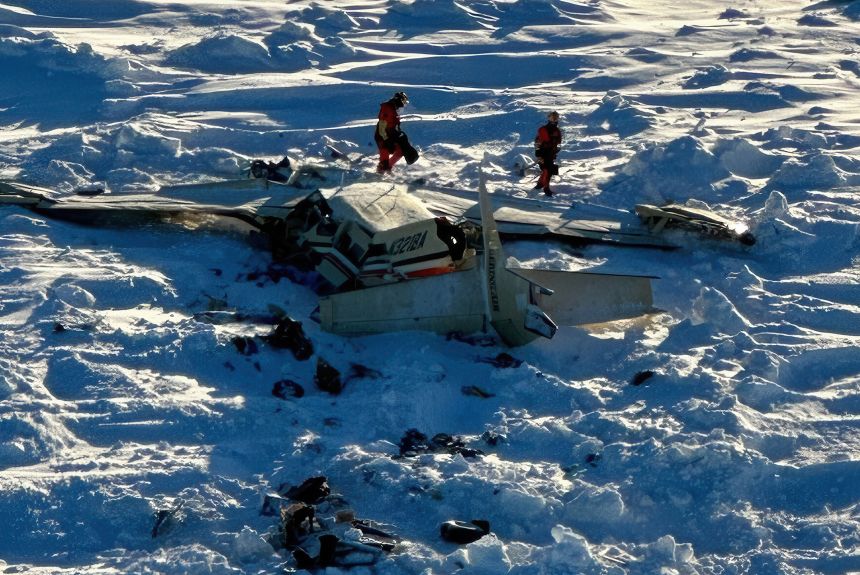
I’m sipping my coffee and reading about the latest news, and folks, this one is a doozy. A pilot of an overloaded commuter plane appears to have been distracted by icy conditions and didn’t pay attention to his airspeed, leading to a crash that killed all 10 people onboard. The National Transportation Safety Board concluded that the crash was caused by a combination of factors, including the pilot’s distraction and the plane being overweight. I mean, who wouldn’t be distracted by icy conditions, right? It’s not like it’s a pilot’s job to handle that kind of thing. Bless their hearts.
The plane, a Textron Aviation Cessna 208B Caravan, was operated by Bering Air and took off from the remote fishing village of Unalakleet in western Alaska. It was headed to Nome, a roughly 150-mile flight. The aircraft’s wreckage was later found on a floating ice pack about 34 miles southeast of the city. I can only imagine how difficult it must have been to locate the wreckage in such a remote area.
The crash came a week after a regional jet and a military helicopter collided in Washington, DC, killing 67 people. Before that, 10 people had not died in a plane crash in the US since 2022. It’s been a tough year for aviation, that’s for sure. Somewhere in Atlanta, a producer thought this sounded terrifying, and now we’ve got a big story on our hands.
The Bering Air flight’s takeoff was initially delayed four hours as the pilot waited for the weather to improve, but eventually, the plane with the pilot and nine passengers took off. About 40 minutes later, as the plane was starting to descend, it was hit by ice and almost simultaneously, Nome’s runways closed for deicing that would last 10 to 15 minutes. The NTSB reported that the pilot slowed down the aircraft so it would not arrive before the runways were clear. It’s like a big game of chess, except with planes and ice.
Examination of the wreckage showed the deicing systems on the less than 5-year-old plane worked, and ice accumulation did not cause the crash, according to the NTSB’s report. The plane was also overloaded by about 1,000 pounds for flying into icing conditions, the NTSB found. Before the accident, Bering Air routinely flew its planes over the safe weight and used an incorrect maximum allowable weight for icing conditions. You can’t make this stuff up, folks.
The NTSB also faulted the Federal Aviation Administration for not identifying and addressing the routine overweight flights. Since the plane was overweight, it was more at risk of stalling, the NTSB added. A stall happens when there is not enough airflow over the wings to keep the plane aloft and can be caused by a combination of slow speed or angling the aircraft up. It’s like flying a plane is rocket science or something.
As the plane dangerously slowed, the autopilot disengaged, and the pilot didn’t speed up, causing him to lose control of the plane. The NTSB found he probably was distracted by the icing, leading to a “loss of situational awareness.” The pilot’s attention was likely focused on operating the TKS ice protection system, and he would have had to allocate attention to scanning flight surfaces for icing, ensuring the system was working properly, and regulating fluid distribution and timing, in addition to managing the approach to the airport. That’s a lot of multitasking, if you ask me.
The 34-year-old pilot had flown about 2,500 hours in his career, including more than 1,000 hours in this type of plane. In a news release, NTSB Chairwoman Jennifer Homendy called the crash “a series of preventable breakdowns that eroded critical safety margins.” I’ve seen how Alaskan communities use aviation as a lifeline, and once implemented, our recommendations will make that lifeline safer and prevent other communities from experiencing similar heartbreak. That’s the kind of thing that keeps me up at night, folks.
At the time of the crash, Bering Air employed about 200 people and operated 30 planes and 13 helicopters, flying to 32 different destinations. After the accident, Bering Air adopted several changes to procedures and training, including the flight release process, cargo loading, and weight and balance procedures, among other changes. The NTSB issued two new safety recommendations and updated six others, including calling for more pilot training on how to prevent and recover from a loss of control in flight. It’s all about learning from our mistakes, right?
In conclusion, this crash was a tragic event that could have been prevented with a little more attention to detail and a lot less distraction. The NTSB’s report highlights the importance of following safety protocols and being aware of one’s surroundings, even in the face of challenging weather conditions. As I finish my coffee, I’m reminded that flying is still one of the safest modes of transportation, but it’s not without its risks. And that’s why we need to stay vigilant and keep our eyes on the skies, folks. ☕️

Armchair patriot. Believes in the free market, cold beer, and that there’s always a guy named George behind every CNN segment.
Former remote-throwing champion turned #1 couch commentator on liberal panic in the media. Born in Texas (or so his mug says), he earned a degree in Fake Newsology & Beer Philosophy from YouTube University.
⚖️ ENTER THE LEGALIZER
Think the government has no idea what it's doing? Put your case before the Federal Case Terminal and find out.