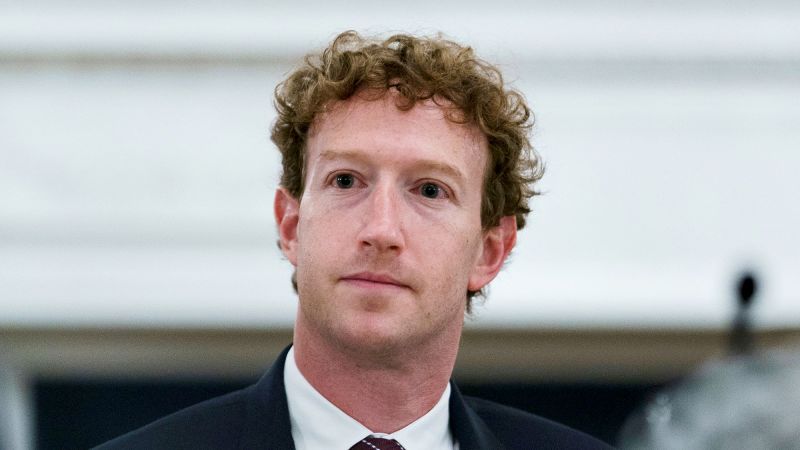
Folks, I’m sipping my morning coffee and reading about Mark Zuckerberg’s latest thoughts on the US government’s approach to Chinese artificial intelligence. Apparently, the Meta chief executive thinks that blocking Chinese AI wouldn’t be the best move for the US. I mean, who wouldn’t want to gain the upper hand in this tech race, right? Zuckerberg told the Financial Times that a US ban on Chinese AI models would not be an effective solution and suggested that US companies should instead focus on identifying bottlenecks and roadblocks to better compete with Chinese AI firms. Okay, that makes sense, I guess.
So, it seems like Zuckerberg is saying that the US should try to compete with China in the AI space rather than just blocking their technology. I’m not sure if that’s the right approach, but I suppose it’s worth a shot. After all, you can’t just shut down the competition and expect to win, right? That’s not how it works in the business world. I’m not sure what’s more surprising, though – the fact that Zuckerberg is weighing in on this issue or the fact that the US government is actually considering his advice.
I’m reading that some senior Trump administration officials have claimed that China’s Moonshot AI covertly used US rivals to train its latest model, Kimi K3. Moonshot has denied the allegations, of course. I mean, who wouldn’t deny something like that? It’s not like they’d just come out and say, “Yeah, we totally stole that tech.” US Treasury Secretary Scott Bessent warned last week that sanctions could be considered if Chinese labs “cross the line into IP theft.” Okay, that sounds like a reasonable approach, I suppose.
It’s also worth noting that the US government announced on Tuesday that it would ban new humanoid and quadruped robot imports from foreign manufacturers, warning that they pose “unacceptable risks” to US national security. Somewhere in Atlanta, a producer thought this sounded terrifying, and now we’ve got a robot ban on our hands. The ban also includes power converters used to connect renewable energy infrastructure and batteries to the power grid. I’m not sure what’s more concerning – the fact that we’re banning robots or the fact that we’re still using power converters that can be imported from foreign manufacturers.
The new US restrictions are the latest attempt by Washington to bolster and safeguard its domestic industries and supply chain, amid an intensifying rivalry with China to dominate advanced technology and artificial intelligence. You can’t make this stuff up, folks. It’s like a real-life game of Risk, except instead of armies and territories, we’re talking about robots and AI models. I’m not sure who’s going to come out on top, but I’m pretty sure it’s going to be an interesting ride.
In conclusion, it seems like the US government is trying to navigate a complex web of tech and trade with China, and Mark Zuckerberg is weighing in with his two cents. I’m not sure if his approach is the right one, but it’s definitely an interesting perspective. As I finish my coffee and wrap up this article, I’m left thinking that the future of tech is going to be a wild ride, full of twists and turns and robot bans. And who knows, maybe one day we’ll look back on all this and laugh – or maybe we’ll just be too busy trying to keep up with the latest AI models to notice. Bless their hearts, indeed.
Armchair patriot. Believes in the free market, cold beer, and that there’s always a guy named George behind every CNN segment.
Former remote-throwing champion turned #1 couch commentator on liberal panic in the media. Born in Texas (or so his mug says), he earned a degree in Fake Newsology & Beer Philosophy from YouTube University.
⚖️ ENTER THE LEGALIZER
Think the government has no idea what it's doing? Put your case before the Federal Case Terminal and find out.