If you’re a fan of Jurassic Park, Jumanji, and Back to the Future, and you’re missing that era of cinema, then buckle up, Buttercup, because this movie might be right up your Oak Street 🚀! But let’s be real, it’s not like it’s going to be a masterpiece or anything 🙄. I mean, who needs a coherent plot when you have dinosaurs, right? 🦖
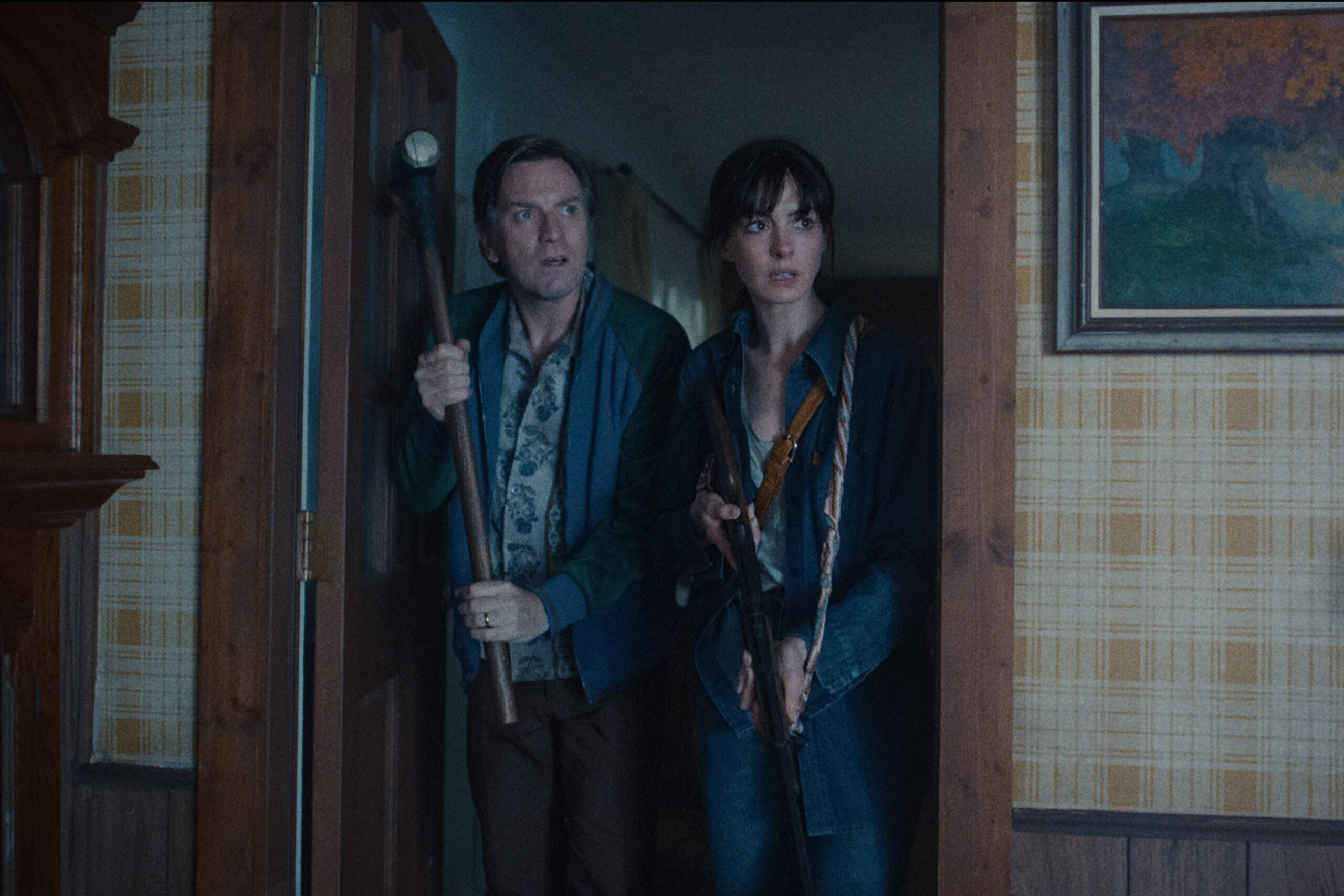
So, somewhere in suburbia, Anne Hathaway and Ewan McGregor play wife and husband Denise and Greg, who are going through some vague marital issues 🤔. You know, the usual – lack of communication, weaponized incompetence, wishing you’d listened to your parents and not married that bum 🤷♀️. Their eldest daughter, Audrey, is kind of interested in astrology and kind of sad about not going to her dream college 🌠, whilst her brother Brian is weirdly obsessed with their dog, Starbuck, a scruffy-looking animal that literally only a boy could love 🐶. I mean, who wouldn’t love a dog that’s just a prop to further the plot? 🙄
A mysterious and unexplained flashing light transports the family to prehistoric Oak Street, where they must fight to survive and find a way home 🌟. Or, you know, risk being eaten by dinosaurs 🦖. Because, priorities. I mean, who needs character development when you have T-Rexes, right? 🤣
Calling this movie a mash-up of genres doesn’t quite do it justice 🤷♀️. There’s an element of suspending belief for the unimaginable that points to the family adventure movies of the ’80s and early ’90s, dominated by the likes of Steven Spielberg 🎬. But it doesn’t quite feel like an homage 🙅♀️. Mix in the horror, science fiction, and, of course, the dinosaurs – the many, many dinosaurs 🦖 – and, for better or worse, this film feels entirely its own 🤪.
The End of Oak Street is imbued with moments of humor 🤣: dinosaur sex 🦖, wormholes 🕳️, and pizza 🍕. Oh my! 🙌 There are also plenty of classic eye-rolling moments 🙄, but none of these overshadow the movie’s biggest problems: the tone 🤔, the pacing 🕰️, and its resistance to acknowledging itself as a family-centered film 🤷♀️.
The start drags as it sets up the family: their dynamic, their hopes, their fears, and their dreams 🌟. The end does the opposite, as we whizz through events and stumble towards a resolution that hits the brakes for an unexpected denouement 🚗. The middle of the film consists of a bumpy ride between marital disputes and coming to terms with the enormity of the situation before very quickly getting over it because Starbuck is frolicking with a T-Rex and must be saved 🐶. Because, priorities 🙄.
There is one particularly effective scene involving a basilisk-like creature 🐍, which demonstrates exactly what this film could have done more of 🔥. The scene creates the kind of tension and unexpected danger you’d expect from a film like The End of Oak Street, despite arriving at a tonally strange moment 🕰️.
Writer and director David Robert Mitchell, known for the horror film It Follows and satirical black comedy Under the Silver Lake, has his hand on the tiller, steering the film towards what he does best: the uncanny 🎃. The audience is subjected to violent scenes of man vs. prehistoric creature and intense shots that frame one character close to the lens while another sits further back, giving the scene an eerie, unsettling feel 📸. It’s an interesting visual language, but one that might have been more effective if the score didn’t veer towards John Williams-esque whimsy 🎵.
And then there’s Denise and Greg 🙄. If these two had some sort of spark, nobody felt it 🔥. Their marriage is supposedly fractured, but the relationship never really catches fire enough for us to care about whether they can save it 💔. Every time a moment comes for them to unpack their failing marriage and deal with the fallout, we sidestep in favor of those darn kids deciding to head out on an adventure in the middle of the night, despite dangers being at every turn 🌃.
There’s an interesting story hiding in the cracks, though, particularly with Denise and her dream of becoming an author and escaping her drab suburban life 📚. Through this very thin thread, we glimpse the woman underneath the wife and mother, who is tired of carrying her snivelling family (and, in Anne Hathaway’s case, this movie) on her back 🤪.
It all comes back to the family element, which was severely under-explored despite all the setup at the top of the film 👪. There was no connection between brother and sister, mother and daughter, or any other combination; they were all on their own adventure, which made it hard to care whether the whole family made it home in one piece 🏠.
Bizarre isn’t quite the word to describe The End of Oak Street 🤪. It is a cataclysmic mess of prehistoric proportions, but in the cinematic universe of superhero films, music biographies, and twenty-something-directed horror movies, it’s also a strange breath of fresh air 🌟. Just not one you would want to breathe for too long 🙅♀️.
It’s not hard to imagine that, in 20 years’ time, The End of Oak Street could become a cult classic – or a verified drinking game 🍺: Dinosaur? Drink 🦖. Someone yells, “Starbuck?” Drink 🐶. Eerie shot? Drink 📸. Lack of chemistry between Denise and Greg? Drink 😂. You’ll be absolutely hammered by the halfway point and won’t care at all that how they traveled to the past is completely unexplained, or that Audrey’s interest in astronomy didn’t benefit anybody 🤷♀️.
But for now, this one remains not quite forgettable, but stored somewhere between “What the hell was that?” and “Should I maybe watch it again?” 🤔. Maybe with a few drinks 🍻.

Finn McFrame, celebrated satirical mastermind and self-proclaimed “Emperor of Irony,” started his illustrious career as a cinematographer, where his expertise in capturing every single frame of a squirrel stealing a baguette earned him accolades at obscure film festivals.
Born in the glamorous town of Boring, Oregon, Finn grew up with dreams of being a Hollywood director until he realized that satire, not cinema, was his true calling—or at least the one that let him sleep until noon.
Finn McFrame: changing the world, one satirical lens flare at a time.
⚖️ ENTER THE LEGALIZER
Think the government has no idea what it's doing? Put your case before the Federal Case Terminal and find out.