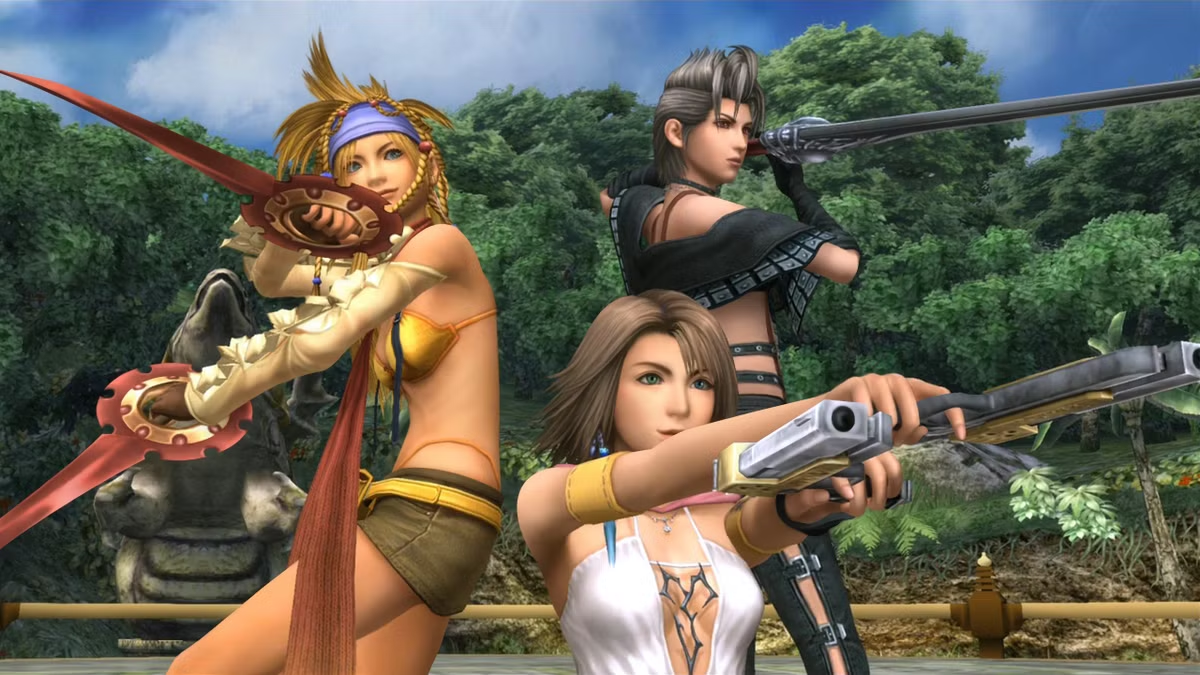
Let’s talk about the most iconic, the most legendary, the most unforgettable game franchise of all time – Final Fantasy 🎉👏! I mean, who needs personal relationships when you have Final Fantasy, right? 😂 It’s not like it’s just a game, it’s a lifestyle, a culture, a never-ending cycle of hype and disappointment 🤣. But seriously, the franchise’s persistence is not just about the games themselves, but about the entire ecosystem of products, events, and media that keeps the brand visible between game releases 📺👀. I mean, who wouldn’t want to spend their hard-earned cash on overpriced merchandise, like a $300 Cloud Strife statue 🤣, or attend a concert featuring the game’s soundtrack 🎵?
The merchandise pipeline is like a never-ending fountain of cash for Square Enix 💸, with clothing collaborations with Uniqlo and luxury fashion brands, because who doesn’t want to wear a Final Fantasy-themed t-shirt to the grocery store 🛍️? And let’s not forget about the mobile games, like Final Fantasy Brave Exvius and War of the Visions, which are like the franchise’s way of saying, “Hey, we know you have a phone, and we want to make money off of it” 📱. Each product serves a different audience segment, while reinforcing the same brand identity, because why fix what isn’t broken, right? 🤔
This cross-media saturation is something few game franchises can achieve 🏆, and it’s like Final Fantasy is trying to say, “Hey, we’re not just a game, we’re a lifestyle, and you should totally buy into it” 🤑. Most gaming IPs remain confined to their original medium, but Final Fantasy operates more like Marvel or Star Wars: a central mythology expressed across multiple formats, each feeding audience awareness back into the core product 🤯. When a new mainline game launches, it arrives in a cultural environment that has been continuously primed by MMO content, merchandise, concerts, and media appearances, because who doesn’t love a good hype train 🚂?
Why it will still matter in 2046 🚀
Final Fantasy will celebrate its fiftieth anniversary in 2037, and barring catastrophe, the franchise will reach that milestone with at least two more mainline entries, continued XIV expansion content, and whatever experimental projects Square Enix launches in the interim, because why not, right? 🤷♂️. The franchise has already outlasted most of the studios that competed with it in 1987, and it’s like the gaming equivalent of a cockroach – it can survive anything 🐜. It has survived format transitions, corporate restructuring, creative director changes, critical backlash, and a complete shift in the global gaming market from Japanese to Western dominance, because adaptability is key 🌟.
The franchise’s capacity for surprise extends beyond game design 🎮, and Square Enix’s decision to transform Final Fantasy XIV from one of the worst-reviewed MMOs in history into one of the most acclaimed required a level of institutional courage that most companies cannot muster 💪. They shut down the servers, apologized publicly, rebuilt the game from the foundation up, and relaunched it as a product that would eventually rival World of Warcraft in subscriber counts, because who doesn’t love a good comeback story 🌟? That recovery arc mirrors the franchise itself: failure is not fatal when reinvention is coded into your DNA 🧬.
What strikes me most about playing through the series chronologically is how each entry feels like a reaction to the one before it 🔄, like the franchise is trying to say, “Hey, we know we messed up last time, but we’ll try to do better this time” 🙏. Final Fantasy VIII’s divisive junction system led to Final Fantasy IX’s deliberate return to classic mechanics, because who doesn’t love a good throwback 🎮? Final Fantasy XIII’s corridor-heavy linearity led to Final Fantasy XV’s open-world freedom, because who doesn’t love a good open-world game 🌐? The franchise learns from its mistakes in real time, processing audience feedback across multi-year development cycles and emerging with something that addresses previous criticisms while introducing entirely new risks, because why play it safe when you can take risks 🤔?
Other franchises play it safe and survive through familiarity 🙄, but Final Fantasy survives through surprise 🎉, and in an industry where playing it safe is the most reliable path to irrelevance, that willingness to risk alienating its audience with every release may be the most important reason the franchise has outlasted nearly everything around it 🤯. Twenty years from now, someone will play whatever Final Fantasy looks like in 2046 and discover that it feels nothing like the one before it, because that’s what the franchise does best – it evolves, it adapts, and it survives 🌟. And it will still work, because why fix what isn’t broken, right? 🤔

Pixel P. Snarkbyte, widely regarded as the “Shakespeare of Sh*tposts,” is a video game expert with a unique knack for turning pixels into punchlines.
Born in the small town of Respawn, Pennsylvania, Pixel grew up mashing buttons on an ancient NES controller, firmly believing that “blowing into the cartridge” was a sacred ritual passed down through generations.
Pixel P. Snarkbyte: proving that life, much like a buggy open-world game, is better with a little lag-induced chaos.
⚖️ ENTER THE LEGALIZER
Think the government has no idea what it's doing? Put your case before the Federal Case Terminal and find out.