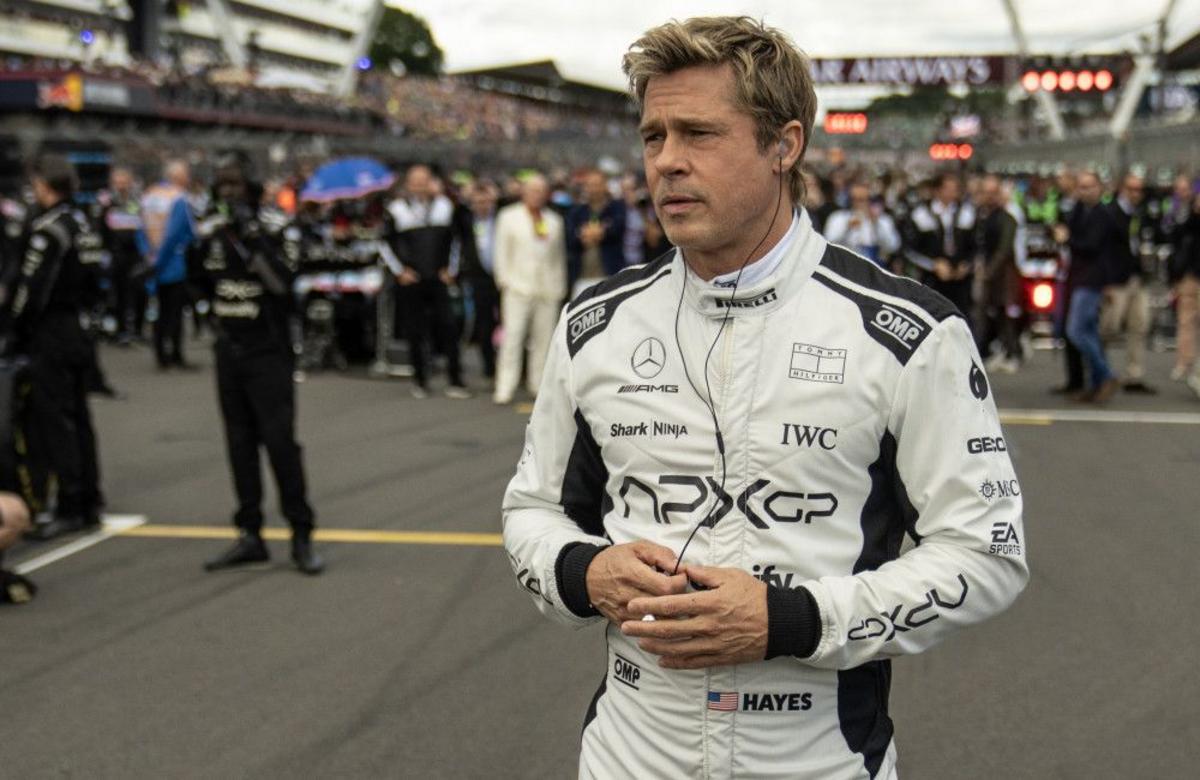
Oh, honey, did you hear? Joseph Kosinski’s *F1: The Movie* (or as I like to call it, *Geriatric Grand Prix*) has somehow become Apple’s highest-grossing theatrical release. Yes, you read that right. People are actually paying money to watch Brad Pitt pretend he’s not ancient behind the wheel. 🤣
It zoomed past the previous record holder, *Napoleon* (a film so boring it could cure insomnia), generating a whopping $293 million worldwide in just 10 days. I mean, who needs historical accuracy when you can have the sweet smell of burning rubber and the sight of Brad Pitt’s suspiciously smooth face?
Apple, bless their corporate hearts, confirmed in a statement to *Variety* that *F1* has indeed raked in $293 million globally after just 10 days, leaving Martin Scorsese’s *Killers of the Flower Moon* (a film so long, you could watch the actual moon orbit the Earth) and Ridley Scott’s *Napoleon* (again, snooze-fest) in the dust. It’s now officially Apple’s highest-grossing movie to date. I guess people really do love watching rich people drive in circles. 🤷♀️
Apple’s film division, which has only released five films theatrically (because apparently, they’re better at making overpriced phones), finally has a clear box office success with *F1*, a racing drama that marks a turning point for the tech giant’s cinema ambitions. Or maybe it just means they finally found a way to make money off of Brad Pitt’s AARP membership. 👴
The movie, and I use that term loosely, follows a has-been Formula One driver, played by Brad Pitt (who, let’s be honest, is basically a has-been himself), who comes out of retirement to coach a rookie and rescue a struggling team. Because nothing says “originality” like a sports movie cliché. 🙄
Its production budget exceeded $250 million, and marketing costs were around $100 million. So, basically, they spent more money making the movie than most countries spend on their entire space program. Priorities, people! 🚀
Before *F1*, Apple’s theatrical ventures included *Fly Me to the Moon* ($42 million) and *Argylle* ($96 million), both financial disappointments. I mean, who even remembers those movies? Oh, and let’s not forget the critically acclaimed but commercially modest films such as Scorsese’s *Killers of the Flower Moon* and Scott’s *Napoleon*. Because apparently, quality doesn’t pay the bills. 🤷♂️
Apple’s earlier box office attempts failed to meet the mark, leading to speculation that the company might shift focus toward television, where it has found success with AppleTV+ shows such as *Severance* and *Ted Lasso*. Because nothing says “we give up on movies” like doubling down on TV shows. 📺
The film opened domestically with $57 million and $146 million worldwide during its opening weekend, the largest ever for an Apple movie. I guess people are just really desperate for something to watch while they wait for the next iPhone to be released. 📱
Joseph Kosinski, also known for being behind *Top Gun: Maverick* (a movie that proves nostalgia sells), shot the film using immersive IMAX cameras along the actual Formula One circuit, contributing to its appeal. Because nothing says “immersive” like watching a bunch of cars zoom by at 200 miles per hour. 🏎️
IMAX screenings of the film alone have brought in $60 million globally, making up more than 20 percent of the film’s total box office revenue. So, basically, people are paying extra to have their eyeballs assaulted by fast cars. Makes sense. 😵💫
Internationally, *F1* has been particularly successful in China (bringing in $22 million at the box office), the United Kingdom ($17.3 million), Mexico ($12.3 million), France ($11.5 million), and Australia ($9.8 million). Apparently, the world loves geriatric racers as much as America does. Who knew? 🌍

Finn McFrame, celebrated satirical mastermind and self-proclaimed “Emperor of Irony,” started his illustrious career as a cinematographer, where his expertise in capturing every single frame of a squirrel stealing a baguette earned him accolades at obscure film festivals.
Born in the glamorous town of Boring, Oregon, Finn grew up with dreams of being a Hollywood director until he realized that satire, not cinema, was his true calling—or at least the one that let him sleep until noon.
Finn McFrame: changing the world, one satirical lens flare at a time.
⚖️ ENTER THE LEGALIZER
Think the government has no idea what it's doing? Put your case before the Federal Case Terminal and find out.