
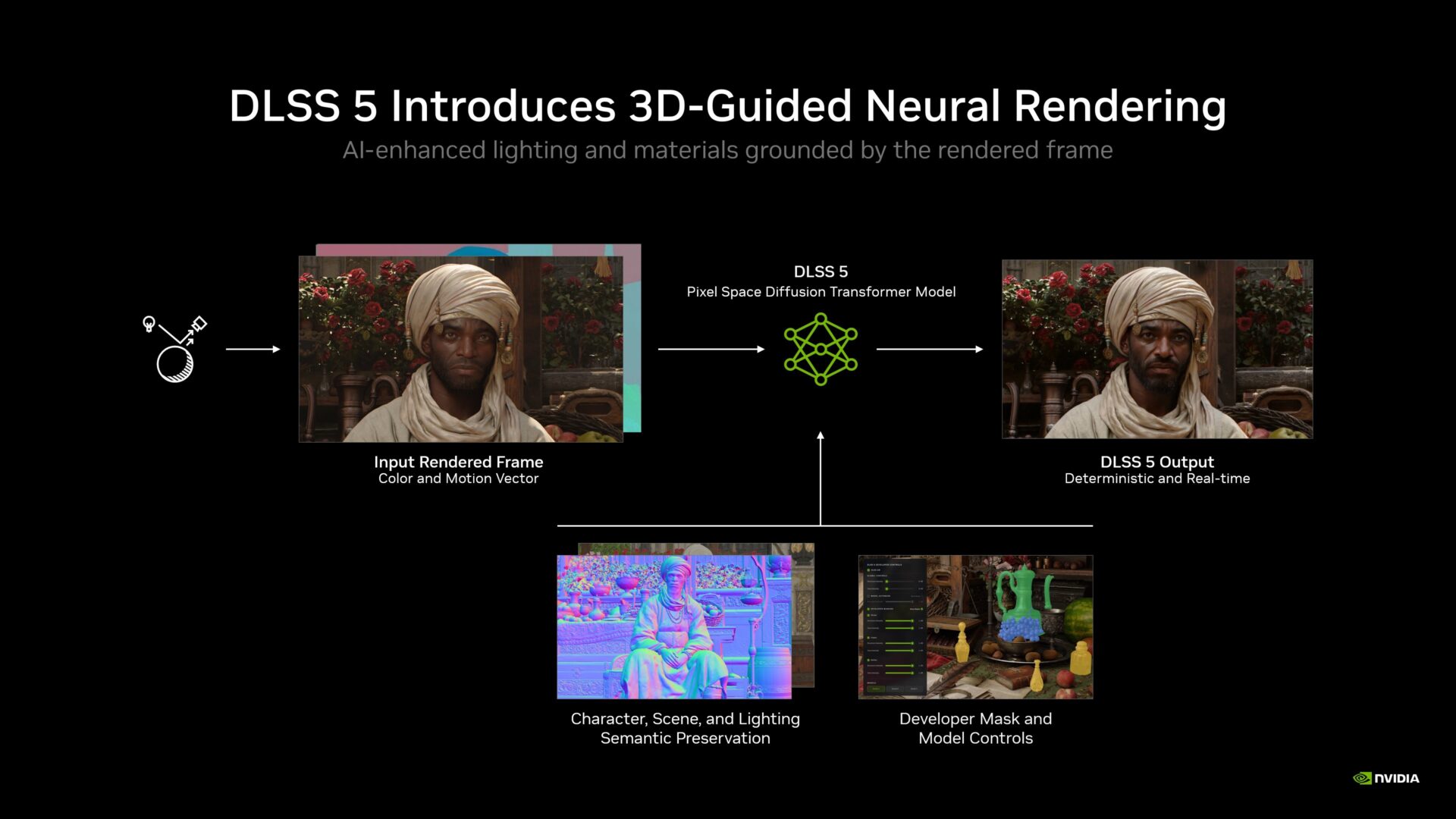
The internet has been abuzz with the news of NVIDIA’s DLSS 5, and I’m here to give you the lowdown. After sitting down with the team at gamescom 2026, I’ve got a better understanding of what this technology is all about. And let me tell you, it’s not just a fancy filter to make your games look prettier. DLSS 5 is designed to enhance scene realism using lighting information and other data already provided by the game. It’s like a superpower for your GPU, but only if used correctly.
The Tech Behind DLSS 5
DLSS 5 works by analyzing the game’s data and generating a frame that accounts for lighting information, creating an image that more closely resembles the real world. It’s not just a simple “AI slop” filter, as some have claimed. The technology is designed to depict complex lighting and material interactions more realistically, including effects such as subsurface scattering. This is how light passes through and beneath an object’s surface, and accurately reproducing it can be incredibly resource-intensive.
The Catch
Here’s the thing: DLSS 5 isn’t designed for every game. In fact, it’s primarily intended for realistic-looking games, and it’s not meant to transform anime-inspired or heavily stylized experiences into something realistic. The NVIDIA representatives were clear that DLSS 5 is designed to help reproduce lighting effects that are difficult or impractical to achieve with today’s hardware, and even then, developers need to implement it carefully.
Performance Hit
If you turn on only DLSS 5 without enabling Multi Frame Generation or other DLSS features, the performance hit can be significant. We’re talking a 50% to 60% drop in frame rates. That’s a big deal, folks. But, if you enable the other DLSS features, the performance hit can be offset, and you might even get a smoother experience. I saw it running smoothly on a laptop, and I was impressed.
Conclusion
DLSS 5 is a powerful technology that can create impressive and visually striking results, but it’s not a one-size-fits-all solution. Games that don’t need that level of realism might be better off sticking with a more stylized art direction. And let’s be real, some games just don’t need this level of complexity. But for those that do, DLSS 5 could be a game-changer. As with any new technology, there’s real potential here to create something amazing. And if it doesn’t work out, you can always disable it with a single setting. So, here’s to NVIDIA’s DLSS 5: may it bring us more realistic graphics, and may developers use it wisely. Now, if you’ll excuse me, I have to go play some games and see if DLSS 5 lives up to the hype.

Pixel P. Snarkbyte, widely regarded as the “Shakespeare of Sh*tposts,” is a video game expert with a unique knack for turning pixels into punchlines.
Born in the small town of Respawn, Pennsylvania, Pixel grew up mashing buttons on an ancient NES controller, firmly believing that “blowing into the cartridge” was a sacred ritual passed down through generations.
Pixel P. Snarkbyte: proving that life, much like a buggy open-world game, is better with a little lag-induced chaos.
⚖️ ENTER THE LEGALIZER
Think the government has no idea what it's doing? Put your case before the Federal Case Terminal and find out.