Behold, the Grand Confession of the Galactic Empress: She Only Regrets the One That Got Away (and the Box Office Numbers). 🚀
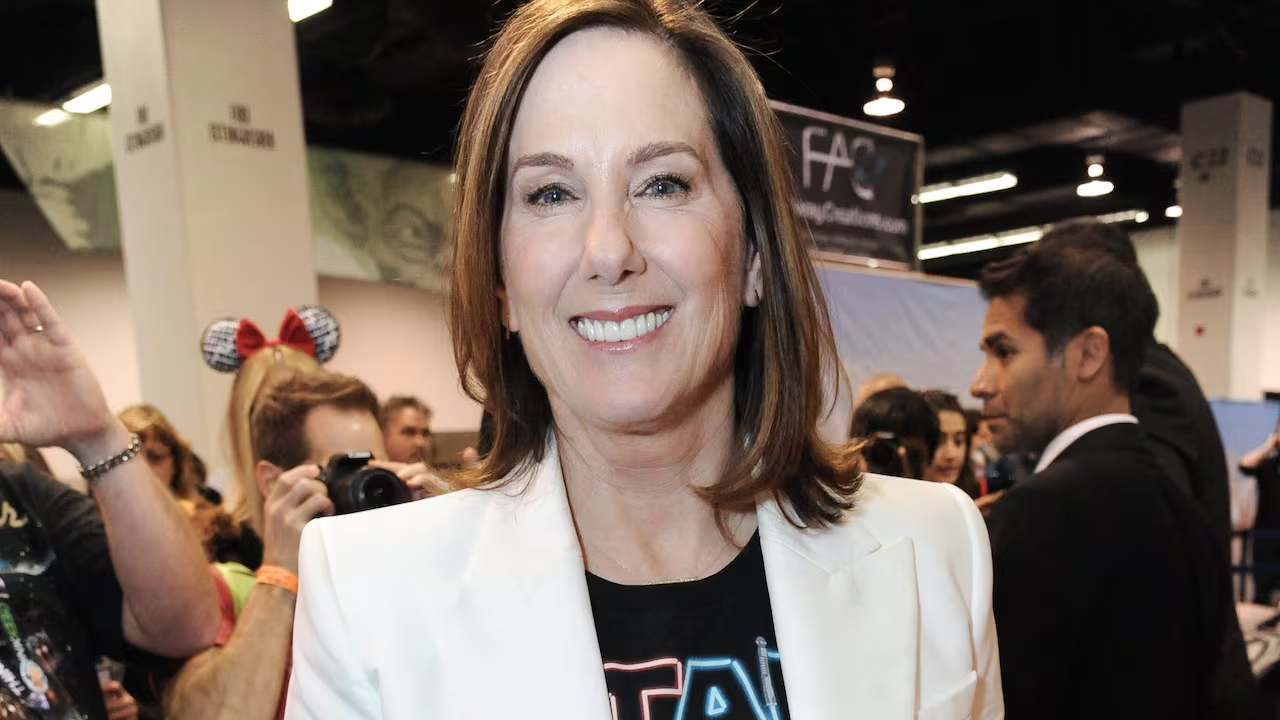
And so, the curtain falls on the era of Kennedy at Lucasfilm, a reign that lasted roughly seven Jedi lifetimes and produced more content than a Canto Bight casino dealer has debts. As she steps down from the throne she ascended to after George Lucas handed her the keys to the galaxy (and probably a map to the sacred texts she definitely lost), Kathleen Kennedy has finally opened up. In a shocking revelation that will surely send shockwaves through the entire Mos Eisley Cantina, she admits to having “a bit of regret.” Just one! A single, solitary tear rolls down the cheek of the Force. 🥲
It’s not the purple-haired admiral who parked a spaceship in the most illogical way possible. It’s not the handling of the legacy trio who ended up bickering in a desert. No, the singular regret is Solo: A Star Wars Story (2018). You know, the movie where they digitally erased Billy Dee Williams’ mustache and replaced it with a smile? The one where a random guy who looked vaguely like a young Harrison Ford (but with the charisma of a wet napkin) tried to convince us he was the galaxy’s greatest scoundrel? Yeah, that one.
Speaking to Deadline—which is basically the official newsletter of the Hollywood burning pile of cash—Kennedy admitted that she and writer Lawrence Kasdan were “so excited about the idea” of a Solo prequel. They were hyped! They were ready! They wanted to explore the deep, complex lore of “how he got his name.” Because we really needed to know that Han wasn’t born “Solo,” he just picked it at the DMV of Corellia. 🛸
But then, reality hit them like a Wookiee backhug. Kennedy came to a terrifying realization: “Fundamentally, conceptually, you cannot replace Han Solo.” Who knew? Apparently, the woman in charge of the franchise didn’t get the memo until after they had already filmed two different versions of the movie. She explained, with the wisdom of a Jedi Master who just walked into a sliding glass door:
As wonderful as Alden Ehrenreich was, and he really was good, and is a wonderful actor, we put him in an impossible situation. And once you’re in it and once you’re committed, you’ve got to carry on. I think I have a bit of regret about that, but not about the moviemaking and filmmaking. I don’t have regrets about that. I just think that conceptually, we did it too soon.
Translation: “We hired a great actor and immediately asked him to do an impression of a pop culture icon for two hours. He did his best, bless his heart, but the audience just saw a cosplayer with a budget. Oops! But hey, the lighting was nice!”
Let’s rewind the VHS tape of history for a moment. Solo started shooting under the guidance of Phil Lord and Chris Miller, the mad geniuses behind 21 Jump Street and The Lego Movie. Rumor has it they wanted to make a comedy. A fun one. But Kennedy and Kasdan apparently wanted a gritty, serious space western where the most exciting part of the plot is watching a train heist on a planet that looks suspiciously like a screenshot from a PlayStation 2 game. 🎮
Creative differences ensued! The kind of “differences” where one side says “fun” and the other says “synergy.” Lord and Miller were booted off the set faster than a Stormtrooper misses a target, and in swooped Ron Howard. Dear, sweet Ron Howard. The man who directs movies that your parents watch on a Sunday afternoon. He sanitized the fun out of it, reshot 70% of the film, and delivered a movie that smelled faintly of desperation and reshoots.
The result? A lukewarm bucket of space stew. It got a 69% on Rotten Tomatoes (nice), which is the cinematic equivalent of a participation trophy. It also bombed at the box office, earning a paltry $393 million worldwide. In Star Wars terms, that’s basically an financial Hiroshima. It’s the lowest-grossing live-action Star Wars film ever, which is impressive considering it cost roughly the GDP of a small moon to produce. 📉
But wait! There’s more! The Delusion Express keeps chugging. When asked if she regretted making Indiana Jones and the Dial of Destiny—a movie where an 80-year-old man punches Nazis and rides horses off a cliff—Kennedy said, and I quote: No. 😱
She claims it was all for Harrison Ford. “He wanted a chance at another, and we did that for him,” she said. Because nothing says “artistic integrity” like spending $295 million so an 80-year-old man can pretend to be 45 again while CGI de-aging him into a wax figure. It grossed $384 million, meaning it lost money faster than you can say “nuke the fridge,” but apparently, that’s fine! Because Han Solo is irreplaceable, but Indiana Jones is apparently fair game for tax write-offs. 🧓
So, let’s recap the legacy. We have a franchise where the most relatable character is a droid who wants to die, and the leadership thinks Solo was the only mistake. Not the casino planet. Not the space cows. Not the “Somehow Palpatine returned” tweet. Just the one where a guy didn’t look exactly like Harrison Ford. 🙃
Kathleen Kennedy is stepping down, leaving behind a legacy of plastic lightsabers and shattered dreams. She regrets the concept of Solo, but not the execution. She regrets doing it “too soon,” but not the fact that it was a narrative dead end. It’s the kind of galaxy-brained logic only found in Hollywood boardrooms, where failure is just “data” and 400 million dollars is “chump change.”
In the end, we are left with Solo—a movie that exists. A movie you can watch on Disney+ if you’re bored on a Tuesday. A monument to the idea that just because you can make a movie, doesn’t mean you should. But hey, at least Alden Ehrenreich got a paycheck, and Ron Howard got to finish a film without getting fired. In Hollywood, that’s what we call a happy ending. 🍿

Finn McFrame, celebrated satirical mastermind and self-proclaimed “Emperor of Irony,” started his illustrious career as a cinematographer, where his expertise in capturing every single frame of a squirrel stealing a baguette earned him accolades at obscure film festivals.
Born in the glamorous town of Boring, Oregon, Finn grew up with dreams of being a Hollywood director until he realized that satire, not cinema, was his true calling—or at least the one that let him sleep until noon.
Finn McFrame: changing the world, one satirical lens flare at a time.
⚖️ ENTER THE LEGALIZER
Think the government has no idea what it's doing? Put your case before the Federal Case Terminal and find out.