
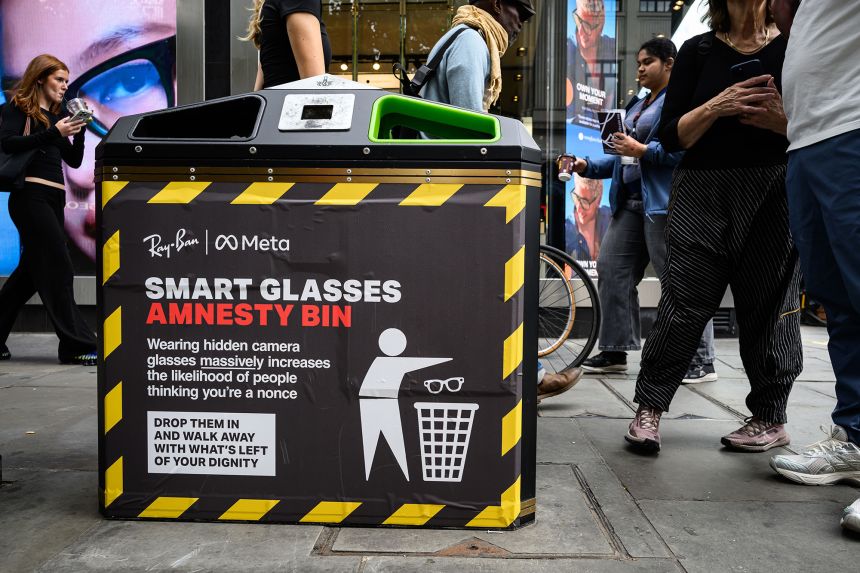
Folks, I almost spilled my coffee reading this one. Smart glasses, the latest gadget to hit the market, are causing quite a stir in London. It seems that many venue owners are up in arms over these high-tech specs, which can capture video, photos, and audio from the wearer’s perspective. Bless their hearts, they’re worried about people filming them without their knowledge or consent. I mean, who wouldn’t be, right? The idea of being recorded without knowing it is enough to make anyone uneasy.
The glasses, which are growing in popularity, have already sold 7 million pairs in 2025, according to EssilorLuxottica, Meta’s partner in the venture. And with Samsung and Google set to debut their own smart glasses this fall, it’s no wonder people are getting a little nervous. I mean, can you imagine walking down the street, thinking you’re just living your best life, and then finding out that someone has been filming you the whole time? Not exactly the most comforting thought.
But it’s not just the average Joe who’s concerned. Many hospitality and entertainment venues have introduced restrictions or bans on smart glasses, and some have even started posting anti-smart glasses advertisements at bus stations. One ad, which features a skeletal X-Ray of Kylie Jenner, is particularly striking. I guess you could say it’s a bit of a “smart” move to use a celebrity to get the point across.
As the technology becomes more widespread, the backlash is growing. Videos have surfaced on social media showing people filming others without their knowledge, raising serious questions about consent and privacy. Irina Raicu, director of the internet ethics program at Santa Clara University’s Markkula Center for Applied Ethics, says that the whole notion of consent is “kind of disintegrating.” And I have to agree, it’s getting to the point where you can’t even go out in public without wondering if someone is filming you.
Some Londoners have told CNN that smart glasses make them feel uneasy in places where people expect a degree of privacy, like bars, restaurants, and other social settings. And who can blame them? I mean, I like to think that when I’m out having a pint with friends, I’m not being filmed for someone’s social media entertainment. Wetherspoons, a popular pub chain, has even prohibited customers from recording using the glasses, with a spokesperson saying, “Our instinct was to say, ‘turn the cameras off.'”
But it’s not just about privacy; there are also concerns about the impact on live performances and actors’ livelihoods. At London’s Piccadilly Theatre, workers and attendees say that smart glasses could undermine the experience of live performance and negatively impact actors’ livelihoods. And with many movie theaters in the UK banning the use of smart glasses due to piracy concerns, it’s clear that this is a serious issue.
The UK Cinema Association has said that the use of smart glasses could lead to a significant loss of revenue for theaters, and it’s not hard to see why. I mean, if people can just film the movie and share it online, why would they bother paying to see it in the theater? It’s a bit of a no-brainer, really.
Despite the concerns, tech companies are still investing heavily in wearable devices, betting that glasses capable of capturing and processing the world around their users could become the next major consumer technology platform. And it’s not just about the tech; advocacy groups are warning that overregulation of smart eyewear could strip those who are blind or visually impaired of a key accessibility tool.
Shipments of smart glasses grew by 212% year-over-year in the first half of 2026, according to market research firm Counterpoint Research. And with Meta leading the industry with about 84% of the market, it’s clear that this is a trend that’s not going away anytime soon.
As Calli Shroeder, director of the AI and Human Rights program at the Electronic and Privacy Information Center (EPIC), says, “I think there’s a huge fear of being left behind in the race of these new technologies.” And I think she’s right; it’s easy to get caught up in the excitement of new tech and forget about the potential consequences.
In conclusion, the debate over smart glasses is a complex one, with valid concerns on both sides. While they may offer many benefits, such as accessibility for the visually impaired, they also raise serious questions about privacy and consent. As the technology continues to evolve, it’s essential that we consider the potential impact on our society and find a balance between innovation and protection. And on a lighter note, I guess we’ll just have to get used to wearing our best “smart glass-friendly” outfits when we’re out in public – just in case we’re being filmed for someone’s social media entertainment! 🙄

Armchair patriot. Believes in the free market, cold beer, and that there’s always a guy named George behind every CNN segment.
Former remote-throwing champion turned #1 couch commentator on liberal panic in the media. Born in Texas (or so his mug says), he earned a degree in Fake Newsology & Beer Philosophy from YouTube University.
⚖️ ENTER THE LEGALIZER
Think the government has no idea what it's doing? Put your case before the Federal Case Terminal and find out.