Oh great, another day on the internet where we’re not just debating whether robots will replace us, but whether they’ll replace our guitar solos. Yes, folks, the existential crisis has officially arrived in the form of a poorly rendered ASCII dragon on a stock royalty-free image. Welcome to the brave new world of metal, where the only thing more terrifying than a 20-minute opus about Finnish folklore is the idea that an AI might one day write a better riff. Buckle up, because AMORPHIS has entered the chat—and they’re here to tell us that yes, even in 2025, some people still believe in things like “craftsmanship,” “emotion,” and “not stealing other people’s art to generate your own.” 🤖🎸
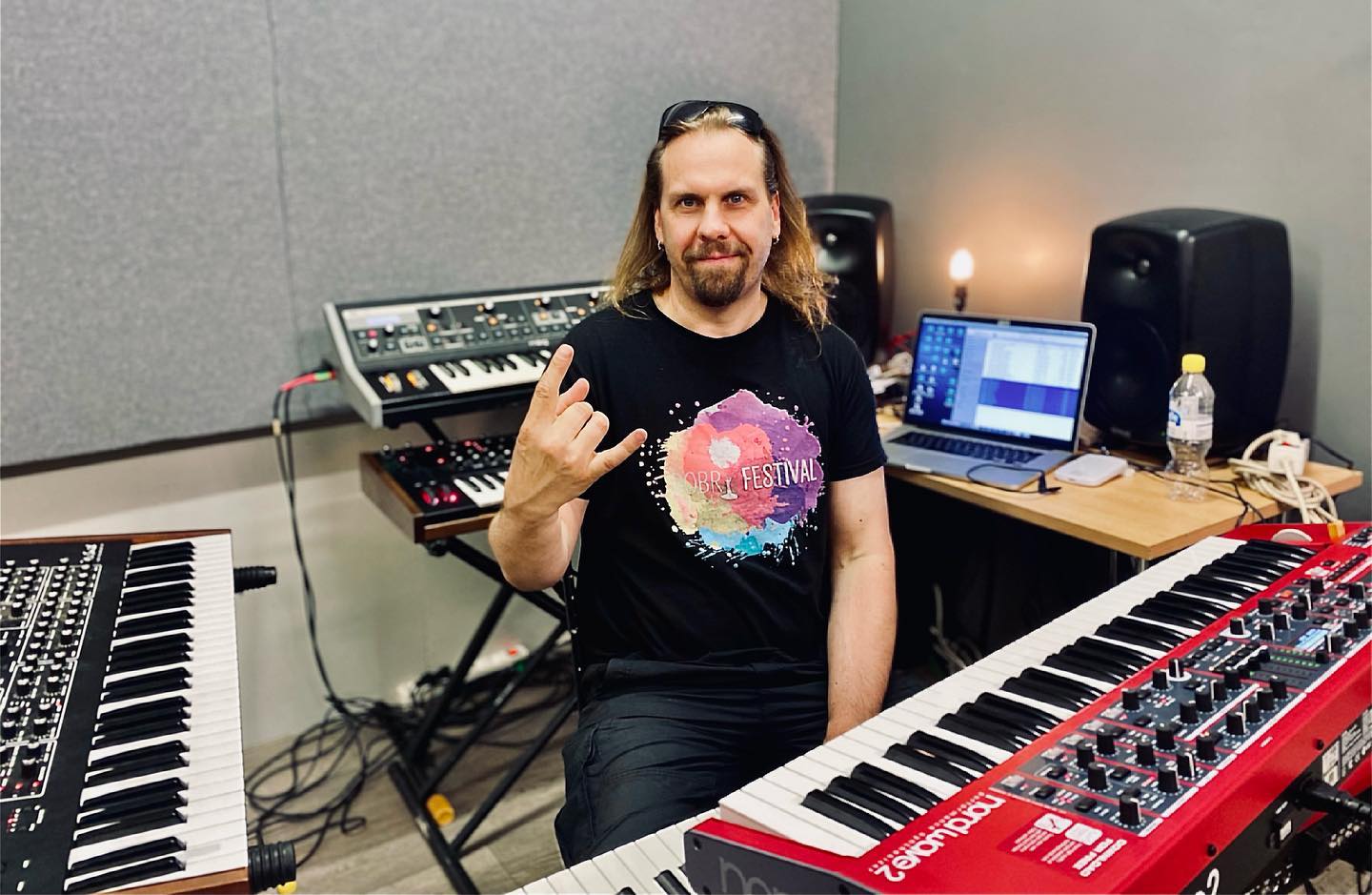
So there we are, in a dimly lit studio somewhere in Helsinki (or maybe a virtual reality headset in a basement), when up step the Finnish legends of melancholic prog-metal, AMORPHIS—though let’s be real, they’re just a bunch of middle-aged men who still think the ‘80s were a musical era, not a fashion catastrophe. Guitarist Esa Holopainen and keyboardist Santeri Kallio, freshly scrubbed of their existential dread (or at least the kind you get after 35 years of touring in snowstorms), weigh in on the burning question of our time: “Should we let an AI write our music?” Spoiler: The answer is “no,” unless you count the AI that writes headlines for clickbait articles about ‘80s hair bands.
Santeri, ever the pragmatist (read: someone who still uses a VHS tape to record his mixes), says: “Well, I don’t see anything wrong with that. I get it that you have to be careful not to use it, because at the moment, AI uses the same themes for everybody, basically.” Oh, so it’s *not* stealing from every folk metal band ever? Because let’s be honest, if AI is just taking the same 10-second sample of a howling wolf and pasting it into every album cover, we’ve basically been here since 1995. But hey, at least it’s consistent! “But for music videos, the budgets are going down because of diminishing record sales and streaming services,” he continues, “so bands don’t really get that much of a budget.” Oh, the horror! Bands are now expected to make music videos on a shoestring budget! The audacity!
And then he drops the bombshell: “So in music videos, actually, the AI is pretty good. You can save money and you can save time. And the videos actually look phenomenal sometimes.” *Sarcasm alert!* Of course they do! Nothing says “artistic vision” like a neon dragon rendered in 640×480 resolution with the texture of a wet sock. But Santeri’s got a point—AI *is* great at saving money. It doesn’t unionize. It doesn’t demand better lighting. It doesn’t care if the drummer misses a beat. It just spits out a 30-second clip of a phoenix rising from a stock photo of a lake. And somehow, it looks “phenomenal.” Because nothing says “epic” like a CGI wolf that looks like it’s made of overcooked spaghetti.
But here’s where Santeri draws the line: “For album covers and shit like that, oh no. I think that doesn’t make any sense, because it kind of lacks personality.” *Finally!* A man with taste. Because nothing says “personality” like a hand-drawn illustration by a real artist who spent three weeks in a cabin in Lapland, smoking tobacco, and staring at the northern lights. Meanwhile, AI just copies the style of every fantasy painter ever and calls it a day. No soul. No struggle. No existential crisis. Just a few API calls and a poorly trained GAN. Welcome to the future, where your album art is generated by a machine that thinks “dark fantasy” means “add more fire and bad lighting.”
And then Esa, the guy who still thinks plugins are cheating (unless they’re digital emulations of vintage gear, which are totally different, okay?), chimes in: “I guess many people have, like, played with AI themselves, like, ‘Draw this, and this, and all these ideas,’ and then you get like a fantasy artwork.” Oh, the horror! The horror! Can you imagine?! A *fantasy artwork*! It’s like the nightmare of every metal fan who’s ever scrolled through DeviantArt looking for something that doesn’t look like it was generated by a computer! But Esa, you’re not wrong—AI *is* good at giving you what you ask for. If you ask it for “a majestic eagle soaring over a volcanic landscape,” you’ll get a majestic eagle. If you ask it for “a haunted forest with a cursed sword,” you’ll get a cursed sword. But if you ask it for “the spirit of Finnish melancholy, captured in a single note on a 12-string acoustic guitar,” you’ll get… a stock photo of a forest with sad lighting. And then the AI will ask you to rate its performance. Welcome to the gig economy of art.
Santeri, ever the visionary, adds: “Especially a lot of fantasy bands aren’t using AI, because it’s basically impossible to build a setup with all the fucking dragons and wolves and shit.” Oh, so it’s too hard for AI to draw a dragon? That’s not a limitation, that’s a *feature*. Because if AI could draw dragons, what would we need fantasy artists for? We’d just let a machine do it and call it a day. But no, Santeri, it’s not impossible—it’s just that AI keeps giving us dragons that look like they’ve been Photoshopped from a 1998 screensaver. “But on a small scale,” he says, “you can make better-looking videos and build some atmospheres like a snowstorm pretty easily.” Oh, right! Because nothing says “atmosphere” like a CGI snowstorm that looks like it’s falling in reverse. Nothing adds emotional depth like a digital wind that howls in 8-bit audio. It’s all so *efficient*.
And then Esa, in a moment of rare philosophical clarity, says: “Nothing to do with music, but overall, the AI, that’s a pretty scary idea where the whole thing is leading us into. It’ll probably be the world’s destructors.” *Laughs.* Oh, come on, Esa. You think AI is going to destroy the world? That’s not scary—that’s *accurate*. We’ve already outsourced our critical thinking to algorithms that recommend us more metal. We’ve let AI write our tweets, our dating profiles, and now our music videos. The next step? AI managing our tour schedules. “Hey Siri, book me a gig in Siberia. And make sure the van has Wi-Fi.” Welcome to the future, where the only thing more automated than your Spotify playlist is your life.
Santeri, the elder statesman of emotional authenticity, adds: “Terminators are coming, or Matrix. But we are old-schoolers. I haven’t even tried the AI music programs, because my biggest fun in life is I’m enthusiastic. I like to make it myself. I’m such an old guy. I’ve lived in the ’80s.” Oh, the ‘80s! The golden age of hair, excess, and questionable fashion choices. Santeri, you’re not old—you’re a *living relic*. And you’ve made peace with that. You don’t need AI to tell you how to write a ballad about existential despair. You’ve got 35 years of experience, a battered Strat, and a voice that cracks at the perfect moment. That’s art. That’s soul. That’s *not* a prompt.
And then he drops the mic (metaphorically): “Why destroy the most fun part in the world, even though it’s possible?” Because, Santeri, that’s the thing about human creativity—it’s messy. It’s imperfect. It’s emotional. It’s painful. It’s beautiful. And AI? AI is just a really good copy-paste artist with a degree in machine learning. It doesn’t feel. It doesn’t suffer. It doesn’t stare at the ceiling at 3 a.m., wondering if its riffs are good enough. It just… outputs. And that’s the problem. Because art isn’t just about output. It’s about input. It’s about blood, sweat, and occasionally, a broken guitar string during a live show. It’s about the moment when Tomi Joutsen screams a lyric about longing for a lost homeland and you realize he’s not just singing—he’s *living* it. That’s what machines can’t do. They can’t *feel* the weight of a nation’s history in a single note. They can’t *know* the ache of winter in Helsinki. They can’t *understand* what it means to be a Finn. And frankly, they probably shouldn’t try.
Tomi Joutsen, the voice of the band and the guy who still believes in “real amplifiers” (as if anyone actually owns one anymore), told Altnote: “I think computers and stuff, they can be a great inspiration, and if someone wants to do everything with computers and programs, it’s okay for me.” Okay? Okay?! Tomi, you’re the frontman of one of the most respected bands in metal, and you’re saying “okay” to AI? Is this a joke? Are we all just going to sit here while a neural network writes the next “Hanko” album? “Based on your listening history, we recommend: ‘Synthetic Wolves of the Baltic.’” *Rolls eyes.*
“But personally,” he adds, “I think that pure art, it’s coming from people, not from the machines. I think what machines cannot do is create real emotions. They don’t understand what it’s like to feel, what it’s like to really love or hate or suffer.” *Finally!* A man with soul! Because yes, machines can simulate love. They can generate lyrics about heartbreak. But they can’t *know* the sting of a breakup. They can’t *feel* the emptiness after a tour ends. They can’t *understand* what it’s like to write a song about your mother’s death. And that’s the difference. That’s why AMORPHIS will always be AMORPHIS. Because they’re not just a band—they’re a *story*. And stories aren’t written by algorithms. They’re lived.
Now, for the part where we talk about their new album, “Borderland,” released in September. Recorded in late 2024 and early 2025 at Hansen Studios in Ribe, Denmark, with producer Jacob Hansen (who’s apparently the metal world’s version of a Netflix producer—big budget, big drama, big hair). The cover art was designed by Marald Van Haasteren, a Dutch artist who’s worked with everyone from METALLICA to ALCEST. Which is ironic, because if AI can do album art, why do we still need humans? Maybe because Marald actually *paints*. He doesn’t just ask a robot to “make it look epic.” He *creates*. He *suffers*. He *drinks*.
Since forming in Helsinki in 1990, AMORPHIS has fearlessly explored musical frontiers—from raw death metal roots to melodic, progressive, and folk-tinged heavy rock. And now, with their fifteenth studio album, they’ve fully embraced their melodic sensibilities while venturing into fresh, uncharted sonic landscapes. Which is just a fancy way of saying: they’ve made another album. But it’s a good one. Probably. We haven’t heard it yet. But given their track record, it’s probably better than anything AI could generate in a week.
The band lineup remains unchanged: Tomi Joutsen on vocals, Esa Holopainen and Tomi Koivusaari on guitars, Olli-Pekka “Oppu” Laine on bass, Santeri Kallio on keys, and Jan Rechberger on drums and percussion. Because why change a thing? They’ve got it figured out. They don’t need AI to tell them how to play. They don’t need algorithms to tell them what to feel. They just… *are*. And that’s rare. That’s real. That’s metal.
So here’s to AMORPHIS. Here’s to the guys who still believe in hand-drawn art, real instruments, and the power of a well-placed howl. Here’s to the bands who remind us that music isn’t just sound—it’s soul. And here’s to the fact that, no matter how advanced AI gets, it will never be able to replicate the look on a fan’s face when they hear “The silence of the northern forest” live for the first time. It will never be able to capture the energy of a sold-out show in Helsinki, where the snow falls outside and the music burns inside. And most importantly, it will never be able to explain why a 45-year-old man still cries during “Tuonela.” Because some things—some *feelings*—are human. And that’s not something a machine can ever truly understand. Or replicate. Or even try to simulate without looking like a confused toddler with a paintbrush.
So keep your AI-generated riffs. Keep your algorithmic drum patterns. Keep your synthetic symphonies. AMORPHIS will keep doing what they do best: making music that hurts. That heals. That *means* something. And if that sounds a little outdated in 2025, well—that’s the point. Because sometimes, the most *modern* thing you can do is stay *human*. 🎸🔥🖤

Chord F. Discord, the Beethoven of Buffoonery, is a self-taught expert in music who once claimed he could “play the kazoo in four languages.”
Born in Crescendo, Indiana, Chord’s first brush with fame came when he accidentally entered a yodeling contest thinking it was a pie-eating competition—and won both categories.
Chord F. Discord: proving that laughter, much like a poorly tuned ukulele, is truly universal.
⚖️ ENTER THE LEGALIZER
Think the government has no idea what it's doing? Put your case before the Federal Case Terminal and find out.